How Can Direct Importers Verify REACH SVHC Compliance for Kids’ Sunglasses?
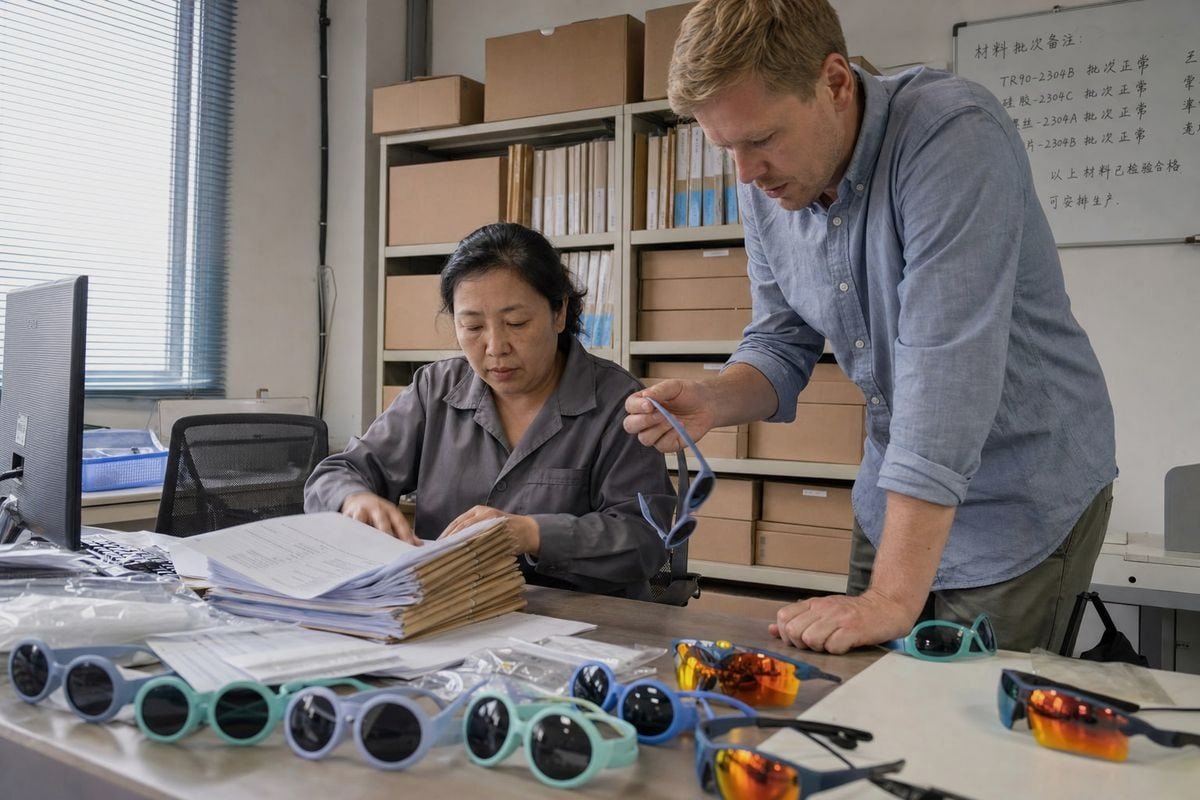
REACH SVHC compliance for kids’ sunglasses trips up many importers. I’ve watched buyers visit our Taizhou factory holding a single “REACH compliant” certificate, believing they were covered. They weren’t — and one bad customs inspection can freeze a whole shipment.
Direct importers verify REACH SVHC compliance for kids’ sunglasses by collecting component-level supplier declarations referencing the current ECHA Candidate List, cross-checking bills of materials, commissioning ISO 17025 accredited laboratory testing on high-risk parts, and documenting an Article 33 communication procedure with archived evidence.
That sounds like a lot. It is manageable when you break it into four questions. Let me walk you through each one, the same way we walk our own B2B buyers through it.
What documents should I request from my manufacturer to confirm REACH SVHC compliance?
A procurement manager from a European baby brand once asked me for "the REACH certificate" for a TR90 frame with TPEE temples. I had to explain gently: there is no single certificate. There is a document stack.
Request a component-level SVHC declaration citing the current ECHA Candidate List version, a bill of materials, third-party test reports matched to your exact SKU, a Declaration of Conformity, Technical File documentation, and Product Safety Data Sheets for coatings or adhesives where applicable.

The key legal trigger is REACH Article 33 1. If any component of the sunglasses contains a Candidate List substance above 0.1% w/w, your supplier must give you enough information for safe use — at minimum, the substance name. So your document requests should map to that duty, component by component.
La pila de documentos principal
Here is what we prepare for our own export customers, and what you should demand from any factory:
| Documento | What it must contain | Por qué importa |
|---|---|---|
| SVHC declaration | Exact style number, colorway, component list, current ECHA Candidate List 2 version and date | Generic "REACH compliant" wording proves almost nothing |
| Lista de materiales (BOM) | Every material by part: lens, frame polymer, temple tips, screws, hinges, coatings | Shows which components were actually assessed |
| Test reports | Lab name, accreditation, sample description matching your article, test date | Links the claim to physical evidence |
| Declaración de conformidad | Product identification, applicable regulations, signatory | Ties the compliance claim to a responsible party |
| Technical File documentation | Drawings, specs, risk assessment, test history | Your defense file if authorities ask questions |
| Product Safety Data Sheets | Chemical details for inks, coatings, adhesives used in production | Covers the "invisible" chemistry on the article |
Why component-level wording matters
Kids' sunglasses are multi-component articles. The 0.1% w/w threshold 3 applies to each article within the product — a hinge screw, a nose pad, a rubberized temple tip — not to the finished product's total weight. A product can look "overall compliant" while one small plasticized part quietly exceeds the threshold. In our experience shipping to 20+ countries over 15 years, the declarations that survive scrutiny always name the article, the components, and the Candidate List basis. Anything vaguer should be treated as a starting point, not proof.
How do I verify that my supplier's test reports are accurate and up to date?
Early in our export history, we learned a hard lesson: a buyer's freight forwarder flagged a competitor's shipment because the attached lab report was three years old and covered a different frame color. That story shaped how we handle test documentation on our own production line.
Verify test reports by confirming the laboratory holds ISO 17025 accreditation, matching the sample description to your exact SKU and material version, checking the test date against the latest biannual ECHA Candidate List update, and validating the report number directly with the issuing lab.

Test reports are stronger evidence than declarations. But only when they actually match the goods in your container. The ECHA Candidate List is updated roughly twice a year, so a report that was valid at signing can become outdated before your next purchase order. Verification is a repeatable process, not a one-time check.
A five-step verification routine
- Check the lab, not just the logo. Third-party laboratory testing only carries weight when the lab is ISO 17025 accredited 4 for the specific test methods used. Look up the accreditation scope, not just the certificate frame on the wall.
- Match the sample to your SKU. The report should describe the tested article — material, color, coating — in terms that match your BOM. A report for a glossy black TR90 frame does not automatically cover a periwinkle-blue soft-touch version, because pigments and surface treatments differ.
- Check the date against the Candidate List. If new SVHCs were added after the test date, ask whether the new substances are plausibly present in the materials. If yes, request retesting or a gap declaration.
- Validate authenticity. Reputable labs let you verify report numbers online or by email. Faked or edited reports exist in this industry. Two minutes of checking removes that risk.
- Trace versions over time. When we change a masterbatch or a coating supplier, we treat it as a new material version. Ask your factory whether the tested version is still the production version. If they cannot answer, that itself is your answer.
One more distinction worth making. Some corporate restricted substance lists go beyond the law — for example, requiring migration testing 5 on skin-contact parts like nose pads and temple tips. Baseline REACH testing does not automatically satisfy those internal standards, so align the test plan with both legal and buyer-specific requirements before you book the lab.
Which SVHC substances should I specifically check for in children's sunglasses materials?
There is a trade-off we weigh every time we quote a new kids' style: material cost versus chemical risk. Cheap PVC temple tips 6 save a few cents. We chose TPEE and TR90 for our children's lines partly because they sidestep the plasticizer problem entirely — a decision that pays off every time a buyer runs a chemical risk assessment.
Prioritize phthalates and heavy metals: check plasticizers such as DEHP, DBP, and DIBP in soft plastics, lead and cadmium in pigments and metal parts, nickel release from hinges and screws, and legacy flame retardants in recycled feedstocks — mapped against both the Candidate List and Annex XVII restrictions.

Remember that SVHC disclosure and REACH restrictions are two different obligations. The Candidate List drives Article 33 communication duties. Annex XVII restrictions 7 set hard concentration limits — and several apply with extra force to children's products. A defensible screening plan covers both.
Component-by-component risk map
| Componente | Typical materials | Substances to check | Risk level |
|---|---|---|---|
| Frame front | TR90, PC, ABS, sometimes PVC | Phthalates, heavy metal pigments | Medium (high if PVC) |
| Lenses | PC, acrylic, coated | Residual monomers, coating chemistry | Low–medium |
| Temple tips / nose pads | TPEE, silicone, soft PVC | Phthalates, PAHs in soft-touch parts | High if plasticized |
| Hinges and screws | Metal alloys | Nickel release, lead, cadmium | Medio |
| Decorative parts / prints | Inks, coatings, platings | Heavy metals, certain azo dyes | Medio |
| Straps / accessories | Textiles, elastomers | Phthalates, formaldehyde-based finishes | Medio |
| Recycled-content plastics | Mixed feedstocks | Legacy flame retardants, heavy metals | Alta |
Special caution: eco-claims and recycled plastics
If your kids' sunglasses are marketed as eco-friendly or made from recycled plastics, run dedicated legacy chemical screening. Recycled feedstocks can carry banned brominated flame retardants 8 or heavy metals that would never appear in virgin resin. We support recycled-material projects at our factory, but we always tell buyers: recycled content raises the testing bar, it does not lower it.
Also watch skin-contact geometry. Children wear sunglasses for hours against sweaty skin. Nose pads, temple tips, and any wraparound sport-style contact zones deserve migration-oriented scrutiny, not just total-content screening. That is one reason we build kids' frames with TPEE temples — flexible, comfortable, and free of the plasticizer chemistry that makes soft PVC a compliance headache.
How can I build a reliable compliance verification process when importing from overseas factories?
A lesson we learned working with a Japanese kids' brand: their sourcing team did not want more paperwork — they wanted a repeatable system. Once we mapped our 5S-managed workshop processes to their supplier audit checklist, approvals that used to take weeks took days.
Build a risk-based process: classify components by chemical risk, require updated declarations at every Candidate List revision, test high-risk parts through accredited labs, file SCIP database notifications where SVHCs exceed 0.1%, embed compliance duties in contracts, and archive everything in a living Technical File.

When goods enter the EU from outside, you as the importer effectively carry the manufacturer's responsibilities. That makes your process — not your supplier's promises — the real safety net. Here is how to structure it.
The importer's verification workflow
| Etapa | Acción | Owner | Frequency |
|---|---|---|---|
| Sourcing | Screen factories with a supplier audit checklist covering materials and traceability | Procurement | Per new supplier |
| Development | Collect BOMs and material specs; flag PVC, coatings, inks, recycled content | Product development | Per new style |
| Pre-production | Obtain SVHC declarations referencing the current Candidate List | Compliance | Per PO |
| Production | Commission third-party laboratory testing on high-risk components | QA | Per material version |
| Pre-shipment | Reconcile declarations, reports, and BOMs; issue Declaration of Conformity | Compliance | Per shipment |
| Post-placement | File SCIP database notification if any SVHC exceeds 0.1% w/w; maintain Article 33 response capability within the 45-day consumer request window | Compliance | Ongoing |
| Monitoring | Track ECHA's Registry of Intentions to anticipate new SVHC listings and substitute materials early | Compliance | Twice yearly |
Handling the document-first versus test-first debate
Some buyers tell us declarations alone are enough because suppliers control formulation knowledge. Others insist on testing everything because overseas supply chains lack traceability. Both positions have merit — and both fail as absolutes. Testing every SKU is unaffordable; trusting every declaration is indefensible. The workable answer is risk-based verification. Well-documented declarations can cover low-risk components like standard TR90 fronts from a traceable resin source. High-risk items — plasticized parts, metal hardware with nickel-release potential, recycled feedstocks, or any weakly documented material — get targeted lab testing and stronger contractual controls, including unannounced spot-audits down to Tier-2 raw material suppliers where stakes are high.
Two forward-looking points. First, put update obligations into your purchase contracts, so suppliers must refresh declarations at each Candidate List revision without being chased. Second, prepare for the Ecodesign for Sustainable Products Regulation: structuring your chemical data now, in a format ready for a Digital Product Passport accessible by QR code, will turn today's compliance files into tomorrow's market access asset.
Conclusión
One weak certificate can stall a shipment and damage a kids' brand. Verify REACH SVHC compliance component by component: demand specific declarations, validate accredited testing, screen high-
Más artículos que te podrían gustar

1 de agosto de 2026
¿Debería la fábrica encargarse del embalaje y etiquetado de las gafas de sol para niños, o utilizar un proveedor designado?

1 de agosto de 2026
Almacén propio vs. Cumplimiento directo del proveedor: ¿Qué reduce los costos de devolución para las marcas de gafas de sol para niños?

1 de agosto de 2026
Directo al almacén del puerto o staging en el extranjero: ¿Cuál ahorra más en el envío de gafas de sol para niños?
¿Buscas un socio confiable en gafas para niños?
Explore más de 800 estilos listos y soporte OEM/ODM completo adaptado a su marca.
Ponte en contacto English
  Español de México
  Deutsch
  Français
  日本語
日本語  العربية
  Português do Brasil