How to Custom-Order Non-Sale Kids Optical Frames for a Home Try-On Kit?
Custom-ordering non-sale kids optical frames for a home try-on kit sounds simple until quotes arrive with confusing MOQs 1. I have seen buyers stall for months over this exact problem — and our factory floor taught me the fix.
To custom-order non-sale kids optical frames for a home try-on kit, select regular-stock styles from a manufacturer’s existing catalog, request low-quantity sample sets instead of full production, confirm frame measurements and child-safety materials, then agree on lead time, packaging, and MOQ before paying.
That is the short version. The longer version involves choosing the right styles, deciding what customization is realistic at sample volume, and avoiding costly ordering mistakes acetate-look style 2. Let me walk you through each step, the way I do with new buyers every week.
How do I choose the right styles from OKAY EYEWEAR's existing collection for a home try-on kit?
A procurement manager from Australia once asked me to shortlist frames for her brand's first home try-on program hypoallergenic materials 3. She had no molds, no tooling budget, and a launch date. Our existing catalog solved all three problems for her.
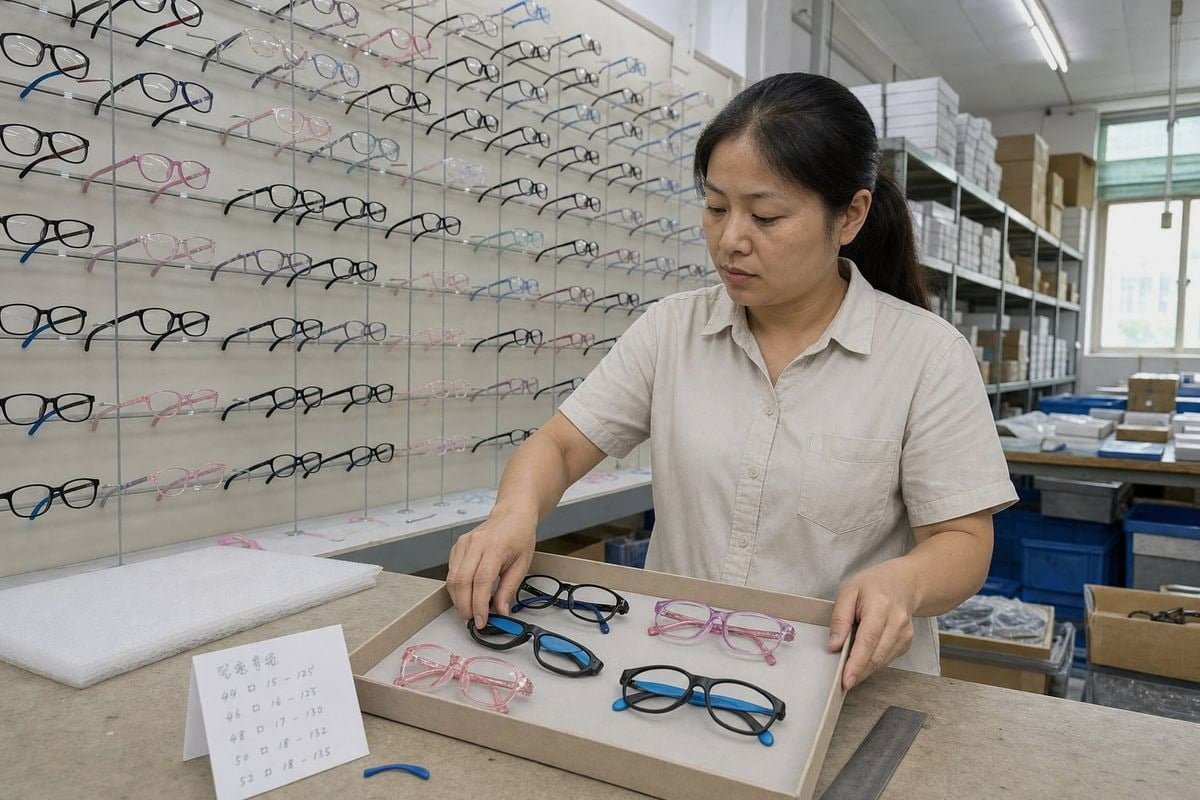
Choose try-on kit styles by filtering an existing catalog — such as OKAY EYEWEAR's roughly 800 ready styles — by age group, frame measurements, material flexibility, and shape variety. Pick 4 to 6 contrasting styles per kit so families can compare fit, not just color.
First, let me clarify what "non-sale" means here, because the term confuses many buyers. Non-sale frames are not clearance or discounted stock. They are regular-catalog or custom-spec frames ordered specifically for fitting trials, brand approval, or prescription confirmation. When you build a home try-on kit from non-sale frames, you are curating a fitting tool, not liquidating inventory.
In our experience exporting kids' eyewear to buyers in more than 20 countries, the strongest kits offer contrast. A child cannot tell you why a frame feels wrong. But a parent comparing a rounded rectangular montura TR90 4 against a translucent acetate-look style with soft silicone temple tips will see the difference immediately. So I always recommend selecting across three axes: shape, size, and temple construction.
Filter by age and frame measurements first
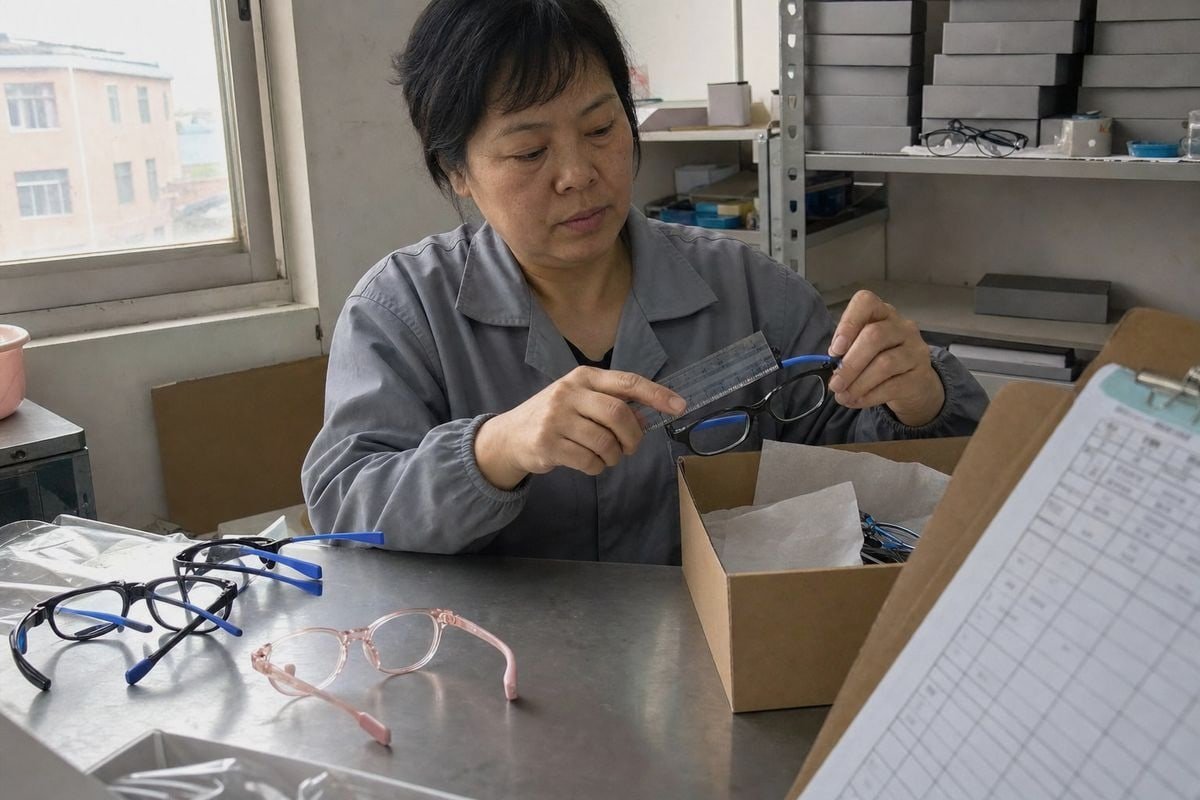
Style is the last filter, not the first. Start with the size notation printed on the inner temple — for example, 46-17-130 — which gives lens width, bridge width, and temple length in millimeters. If the child already wears glasses, that marking is your fastest reference point. If not, a millimeter ruler can estimate current frame width, bridge space, and temple length against a supplier size chart.
Build variety into the kit
| Kit slot | Style direction | Why include it |
|---|---|---|
| 1–2 | Rounded rectangular TR90 with flexible TPEE temples | The safest fit for most active kids |
| 3 | Translucent soft-tone frame (jelly-look pink, blue, or clear) | Tests style preference on lighter faces |
| 4 | Sporty frame with curved ear-hook silicone temples | For kids who play sports or remove glasses often |
| 5–6 | One size up and one size down of the best-fitting shape | Confirms the right size, not just the right look |
Many online optical retailers now use virtual try-on tools 5 to narrow the shortlist before shipping a physical kit. I encourage this. Virtual try-on reduces waste and shipping cost. But it cannot test bridge comfort, temple pressure, or stability on a child's nose. Use it to shorten the list, never to replace the physical kit.
What customization options can I add to non-sale frames without ordering a full production run?
There is a trade-off I discuss with almost every new buyer: how much branding do you want versus how many pairs are you willing to commit to? Deep structural changes need volume. Cosmetic changes often do not.
Without a full production run, you can typically customize logos on temples or packaging, select colors from existing molds, choose lens options like blue light filtering or demo lenses, and add branded cases or accessories. Structural mold changes require full OEM/ODM volumes.
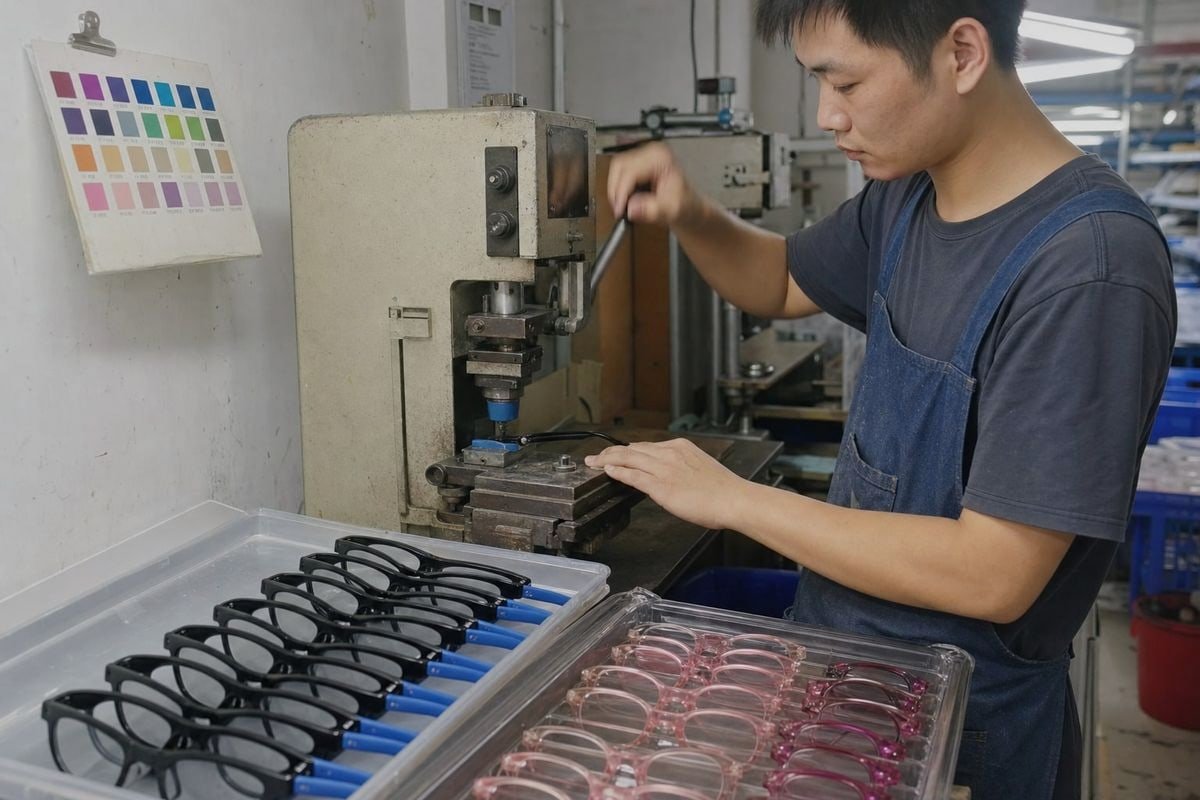
The key distinction is cosmetic versus structural customization. Cosmetic changes use existing molds and existing materials. Structural changes require new tooling, new material testing, and mold setup costs. That is why "custom" does not always mean "one-off." When a buyer asks us to customize a single pair with a new frame shape, I have to explain that the mold alone would cost more than a small bulk order.
Here is what is realistic at low quantities, based on how our workshop actually handles sample and small-batch work:
| Customization type | Typical feasibility at sample volume | Notas |
|---|---|---|
| Logo pad-printing on temple | Often feasible at low quantity | Simple setup, quick turnaround |
| Color selection from existing range | Feasible | Choose from colors already in production |
| New custom color per style | Usually needs a per-color MOQ | Material batching drives the minimum |
| Lens upgrades (blue light filtering 6, UV400) | Feasible | Swapped at assembly stage |
| Branded packaging and cases | Feasible with print minimums | Great for retail-ready try-on kits |
| Ear grips, straps, fit accessories | Feasible | Useful additions for active kids |
| New frame shape or mold change | Full OEM/ODM only | Mold setup requires volume commitment |
A note on prescription lenses and PD
If your try-on kit leads to prescription eyewear, remember that a current, valid prescription and pupillary distance (PD) 7 are required for final lens ordering — but usually not for frame-only try-on. PD may appear on the prescription, or the parent may need to measure it with a simple tool or ask the eye doctor. Deferring prescription data until the frame is chosen is fine, but it does slow final fulfillment, so many kits now include PD measurement instructions to save a round trip.
One more raised objection worth resolving: some buyers assume manufacturer samples are always worse value than a retailer's try-on kit. Retailer kits are convenient, but they limit you to stocked frames and rarely support your own branding. Manufacturer samples require more specification work, yet they let you test the exact product you will eventually sell — logo, packaging, lens spec and all.
How do I ensure the frames are safe and durable enough for kids to try on at home?
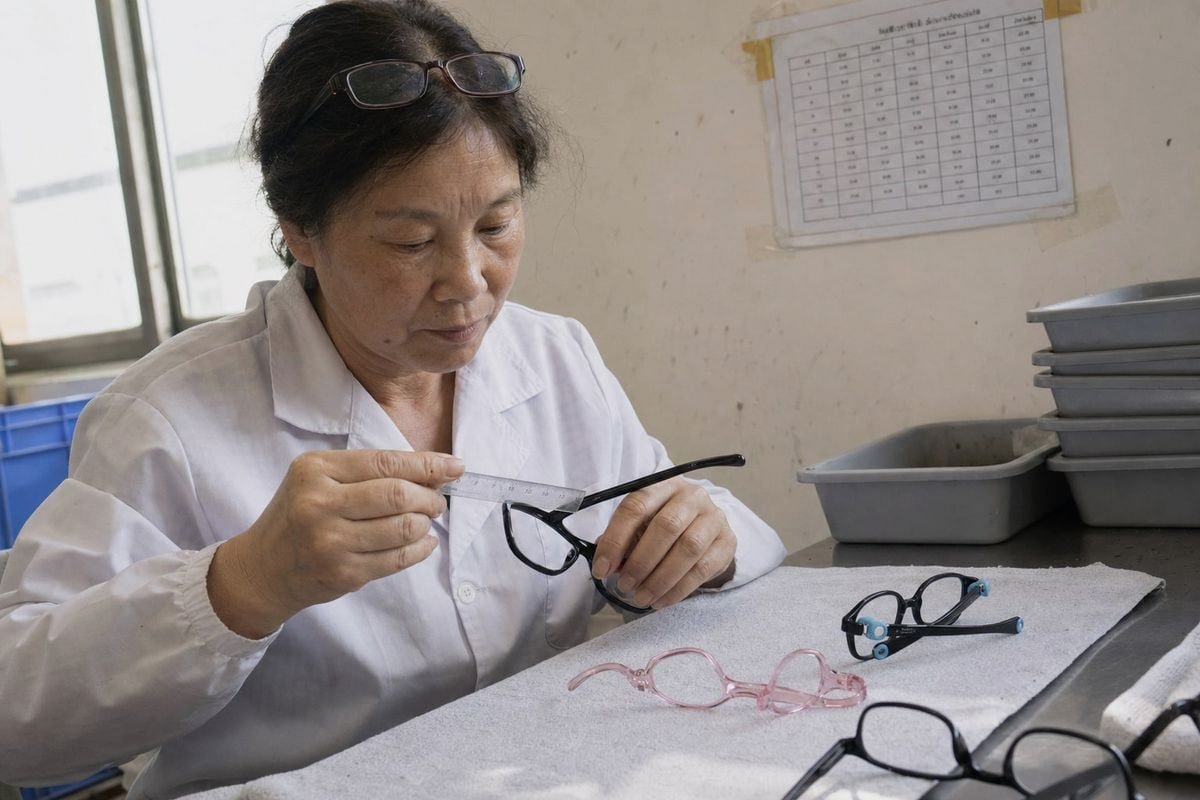
Early in my career at our Taizhou factory, I watched a QC technician bend a TR90 temple back on itself repeatedly before approving a batch. That test stuck with me. A try-on kit gets handled roughly by multiple children — safety cannot be an afterthought.
Ensure safety by specifying flexible materials like TR90 and TPEE, soft or integrated nose areas, hypoallergenic finishes, and no sharp hinge edges. Then physically test sample frames for flexibility, weight, and comfort before shipping any kit to families.
Children's vision care starts with the frame, not the lens. A frame that pinches, slides, or snaps will end up in a drawer, and the child's vision correction fails with it. That is why our engineers build kids' frames around flexibility first. TR90 fronts resist impact and hold their shape. TPEE temples flex, twist, and recover without cracking. Soft silicone temple tips and curved ear-hook designs keep frames stable when kids run, jump, or pull them off one-handed — which they always do.
The safety checklist I use before any kit ships
- Bend each temple outward well past normal wearing angle. It must return without whitening or cracking.
- Check the hinge area with a fingertip. No sharp edges, no exposed metal points near the skin.
- Weigh the frame. Lightweight frames reduce nose-bridge pressure during long wear.
- Inspect nose contact points. Soft, smooth, and hypoallergenic surfaces prevent irritation on sensitive skin.
- Confirm demo lenses are secure. Loose demo lenses in a try-on kit are a hazard and look unprofessional.
- Test the temple tips. Textured silicone should grip without pulling hair.
Why sample testing before scaling matters
Suppliers increasingly recommend a sample-first workflow: test flexibility, weight, and comfort on real frames before committing to larger orders. I strongly agree. A spec sheet cannot tell you how a frame feels on a four-year-old's face after two hours. Order the samples, hand them to real children in your target age range, and note where frames slide or press. The child's eyes should sit centered in the lenses, the bridge should rest securely without sliding, and the temples should wrap comfortably behind the ears. Durable frames that fail the comfort test are still failed frames.
What should I expect for lead time, packaging, and MOQ when ordering non-sale trial frames?
A buyer in Japan once budgeted three weeks for a program that mixed stocked samples with custom-color frames. The stocked items shipped fast. The custom colors did not. The lesson: stocked frames and customized frames follow completely different timelines, and your kit plan must respect both.
Expect low MOQs of roughly 10–50 pairs for in-stock trial frames, around 100 pairs per style for private-label logo work, and 600–1,200 pairs for full OEM production. Stocked samples ship in days; customized batches need weeks; molds need longer.
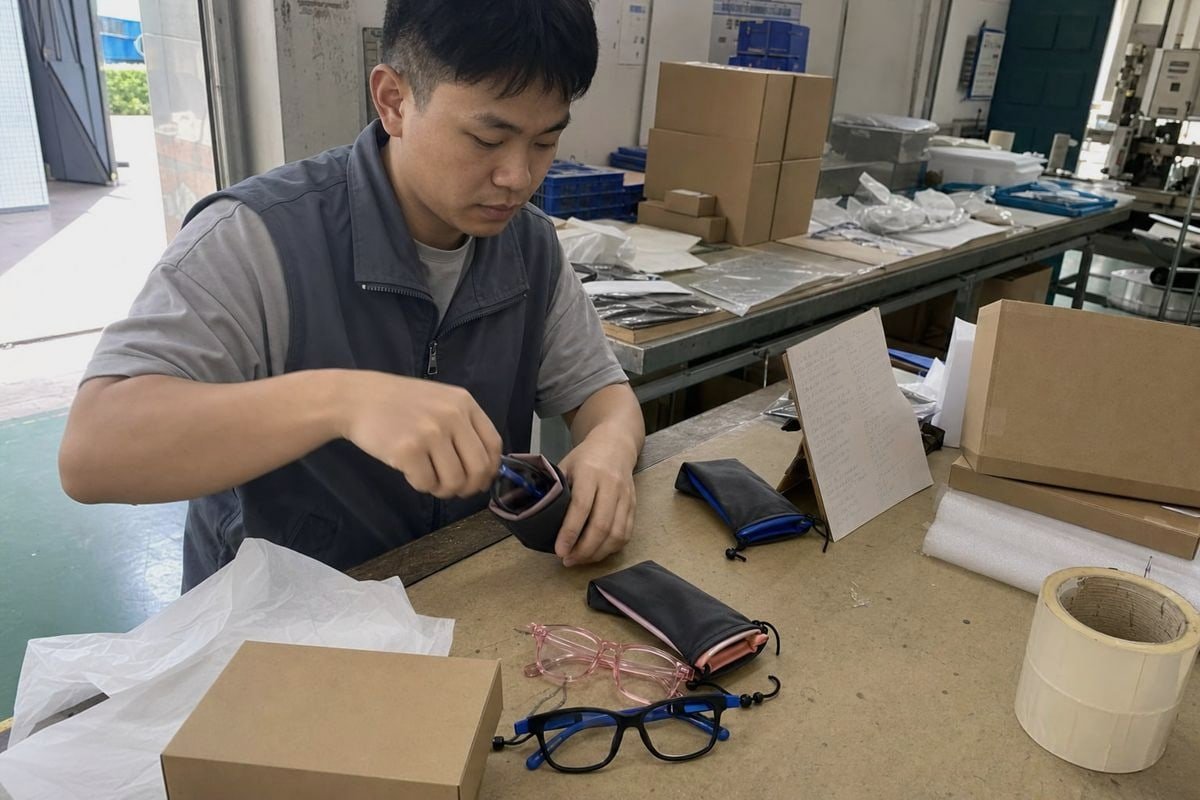
The single biggest mistake I see is treating all "custom orders" as one category. They are three categories, each with its own economics:
| Tipo de pedido | Cantidad mínima de pedido típica | Typical lead time | Lo mejor para |
|---|---|---|---|
| In-stock wholesale samples | 10–50 pairs | Days to about a week plus shipping | Fast try-on kits, market testing |
| Private-label customization | ~100 pairs per style; some suppliers ~300 pieces per color per style | Several weeks | Branded kits and small launches |
| Full OEM/ODM production | 600–1,200 pairs per style | Longest, due to mold setup and materials work | Established lines with proven demand |
If you only need a home try-on kit, you are almost always better off requesting sample sets, digital spec sheets, or stocked frames rather than full custom production. Order just enough. You can scale later with confidence, because you will have real fit data from real families.
Packaging and kit presentation
Packaging is where a trial kit earns trust. In our workshop, we prepare branded boxes, protective cases, cleaning cloths, and insert cards on request, so the kit arrives retail-ready. If you run a consumer-facing program, mirror what established online optical retailers do: a defined trial window of 5–10 days, a pre-paid return shipping label, and a clear return policy covering unreturned or damaged frames. Include PD measurement instructions if prescription lenses come next.
Payment and policy details to confirm upfront
Confirm these before paying: whether customized or personalized frames can be returned (usually they cannot, so plan trial frames accordingly), whether custom prescription lenses are non-returnable (they typically are), and whether your end customers can use eyewear insurance, a flexible spending account (FSA), or a health savings account (HSA) toward the final purchase. These details rarely block a sample order, but they shape your consumer-facing terms — and surprises here damage a young brand fast.
Conclusión
Guessing at kids' frame fit wastes money and delays launches. A sample-first, non-sale try-on kit removes that risk — and I am glad to help you build one, style by style.
Notas al pie
1. Defines Minimum Order Quantity (MOQ) and its importance in business and supply chain. ↩︎
2. Describes acetate frames as plant-based plastic, known for strength, flexibility, durability, and diverse styles. ↩︎
3. Detailed explanation of hypoallergenic frame materials, what causes skin reactions, and which materials are safe for sensitive skin. ↩︎
4. Explains TR-90 as a high-performance thermoplastic material for durable, flexible, and lightweight eyewear frames. ↩︎
5. Explains virtual try-on technology for eyewear, enhancing online shopping with realistic 3D renderings and fit. ↩︎
6. Discusses blue light filtering technology in lenses, its purpose, and potential benefits for eye health. ↩︎
7. Defines pupillary distance (PD) as the measurement between pupils, crucial for accurate prescription lens placement. ↩︎
Más artículos que te podrían gustar
5 de agosto de 2026
Bio-Based vs Regular Cellulose Acetate: What's the Difference for Kids' Frames?
5 de agosto de 2026
How Recyclable Are Kids' Optical Frame Materials, and What Eco-Friendly Alternatives Exist?
5 de agosto de 2026
Do Kids Optical Frames Whiten or Age in Storage, and How to Control Warehouse Conditions?
¿Buscas un socio confiable en gafas para niños?
Explore más de 800 estilos listos y soporte OEM/ODM completo adaptado a su marca.
Ponte en contacto English
  Español de México
  Deutsch
  Français
  日本語
日本語  العربية
  Português do Brasil