How to Choose Kids’ Optical Frames With Easy Self-Replaceable Hinges?
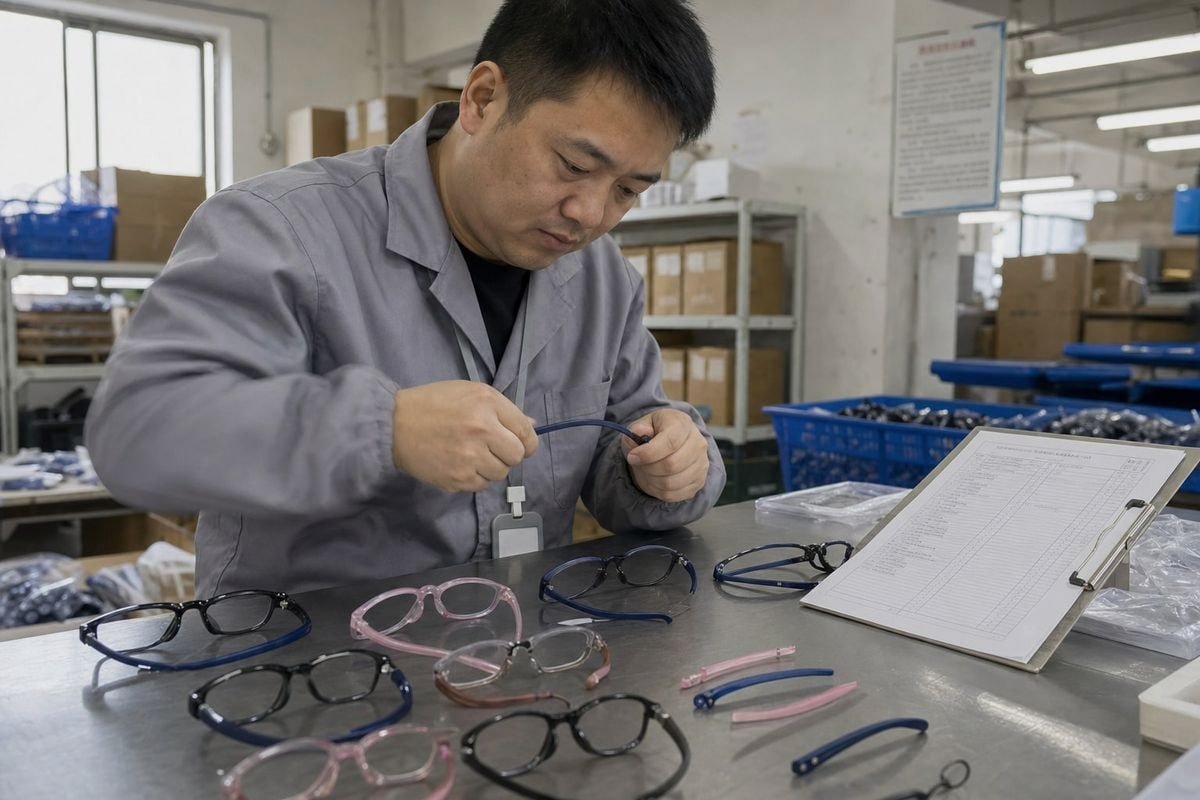
Kids’ optical frames with easy self-replaceable hinges save your brand from returns CE and FDA compliance 1. On our production line, we see how one weak hinge can sink an entire product launch.
Choose kids’ optical frames with easy self-replaceable hinges by checking four things: a screwless or snap-on hinge design, flexible TR90 or TPEE construction, verified child-safety certifications like CE and FDA compliance, and a supplier offering spare hinge parts plus full OEM customization.
Each of those four points deserves a closer look monturas TR90 2. Below, I break down what to check, why it matters, and what questions to ask your supplier before you place an order.
What Makes a Hinge Design Truly Self-Replaceable Without Special Tools?
Last spring, our engineers disassembled thirty competitor frames on one workbench. Only four could be repaired without a screwdriver. That test shaped how we now design every hinge in our Taizhou factory.
A truly self-replaceable hinge uses a screwless snap-on or barrel-and-pin design that a parent can detach and reattach by hand. It needs no eyeglass repair kit, no tiny screwdriver, and no optician visit — only firm finger pressure and a replacement part.
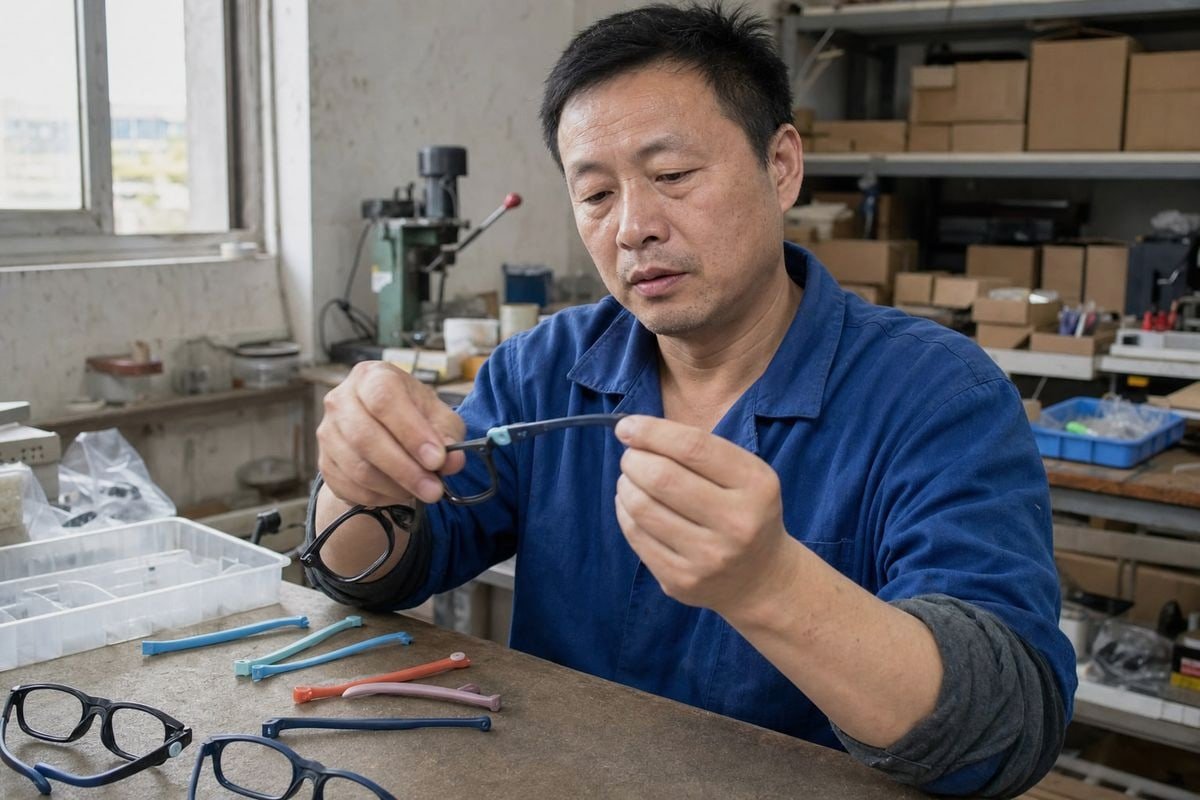
Let me explain what separates marketing talk from real repairability. Many frames are sold as "flexible" or even as unbreakable glasses. But flexibility and self-replaceability are two different things. A frame can bend without breaking yet still need a professional when the hinge finally fails. When we develop a new style, we ask one blunt question: can a parent fix this at the kitchen table?
The Three Hinge Types You Will Encounter
Here is how the common hinge systems compare for a children's eyewear line:
| Hinge Type | How It Works | Parent-Repairable? | Mejor para |
|---|---|---|---|
| Traditional screw hinge | Metal barrel held by a screw | Only with tools; loose hinge screws are common | Budget adult frames |
| Spring hinges | Spring-loaded barrel flexes outward | Rarely; spring assembly is sealed | Older, careful kids |
| Screwless snap-on hinges | Temple clicks into a molded socket | Yes, by hand in seconds | Active kids, toddlers |
Spring hinges are genuinely useful. They flex outward when a child yanks the glasses off one-handed, and they reduce the constant re-tightening that traditional hinges demand. But here is the objection I raise with buyers who ask only for spring hinges: a spring mechanism is usually a sealed proprietary assembly. When it wears out, the whole temple often needs professional replacement. That is not self-replaceable in any practical sense.
Snap-on hinges solve this differently. The temple arm clicks into a socket molded directly into the frame front. There are no loose hinge screws to lose because there are no screws at all. If a temple gets chewed, sat on, or lost at school, the parent snaps a spare one into place. On our two-tone styles — like our black TR90 front with navy flexible temples — the silicone hinge connector doubles as the attachment point, so replacement takes under ten seconds.
What to Ask Your Supplier
Ask whether spare temples ship with each unit, whether the hinge socket survives repeated removal cycles, and whether the design is standard enough for opticians to service. We cycle-test our snap-on joints hundreds of times before a style enters our catalog.
How Do I Know If a Hinge Material Will Hold Up to My Customers' Active Kids?
A distributor in Australia once sent us a rival's frame that had snapped at the hinge after three weeks. The plastic was brittle acetate paired with a rigid metal joint — a mismatch we see constantly.
A hinge holds up when the surrounding material absorbs stress instead of transferring it to the joint. Look for TR90 frames or TPEE temples that bend and recover, paired with hinge sockets that survive repeated twisting, pulling, and drop impacts without cracking.

The hinge never fails alone. It fails because the material around it either cracks or transfers every twist directly into the joint. So when you evaluate durable children's eyewear, judge the hinge and the frame material as one system, not two separate specs.
Material Behavior Under Real Stress
In our 5S-managed workshop, we run bend tests on every incoming batch of TR90 and TPEE. Fifteen years of doing this has taught us where each material shines:
| Material | Flex Behavior | Hinge Compatibility | Peso |
|---|---|---|---|
| TR90 | Bends far and springs back | Excellent for molded snap sockets | Muy ligero |
| TPEE | Extremely soft, almost rubber-like | Ideal for temples and silicone glasses hybrids | Muy ligero |
| Acetate | Moderate flex, can go brittle | Needs metal reinforcement at hinge | Medio |
| Titanium / memory metal | Strong, resists deformation | Durable but heavier and costlier | Light–medium |
Some buyers push back here. They say titanium or thick acetate looks more premium, so why bother with polymers? My answer is a trade-off I weigh on every project: rigid materials resist deformation, but in playground conditions, rigidity means the stress goes somewhere — usually the hinge or the child's face. A TR90 front with TPEE temples bends safely, absorbs the impact, and returns to shape. That is why we build most of our roughly 800 styles around this combination, including hybrids with silicone hinge connectors and adjustable temple tips or cable-style ear hooks for sports.
Simple Tests You Can Run on a Sample
Before ordering, do what we do at final QC. Twist the temples a full ninety degrees. Flatten the frame against a table. Pull the temples outward past the natural stop. Drop the frame onto tile from desk height. Then detach and reattach the temple twenty times. If the hinge socket shows whitening, cracking, or looseness, reject the sample. A frame that survives all five checks will survive most children.
Also confirm the material grade in writing. "TR90" on a quote sheet can hide recycled or blended resin that turns brittle in cold climates. We share material datasheets with buyers precisely because this shortcut is so common in the market.
Which Certifications and Safety Standards Should I Check Before Ordering?
One lesson cost a client of ours dearly before we met: a customs hold in Europe over missing documentation. Since then, I walk every new buyer through compliance before we ever discuss colors.
Check for CE marking (EN ISO 12870 for frames) for Europe, FDA impact-resistance compliance for the US, and AS/NZS standards for Australia. Also verify restricted-substance testing for lead, cadmium, and phthalates, since children's products face stricter chemical limits than adult eyewear.

Certifications are not paperwork theater. For children's products, they are the difference between smooth customs clearance and a container sitting in a bonded warehouse. They also protect your brand from the liability nightmare of a product recall.
The Core Standards by Market
| Mercado | Key Frame Standard | Chemical / Child Safety Checks |
|---|---|---|
| Unión Europea | CE, EN ISO 12870 3 | REACH substances, phthalate limits |
| Estados Unidos | FDA drop-ball impact rules for lenses | CPSIA lead and phthalate limits for children's products |
| Australia / Nueva Zelanda | AS/NZS eyewear standards | ACCC child product safety guidance |
| Japan | JIS-aligned optical requirements | Voluntary but strict retailer specifications |
Beyond the certificates, inspect the physical safety details. A compliant kids' frame should have no sharp edges anywhere a fingertip can reach. Hinge areas deserve special attention on self-replaceable designs: the socket must have smooth, rounded openings, and any detachable part must be large enough that it is not a swallowing hazard for younger siblings. When our team reviews a new snap-on hinge design, we check the detached temple against small-parts sizing guidance before the mold is even approved.
Preguntas que separan fábricas reales de comerciantes
Ask your supplier three things. First, can they show test reports issued in the factory's own name, not a trader's? Second, do reports match the exact material batch, since TR90 from different resin suppliers tests differently? Third, will they support your own third-party inspection before shipment? A genuine factory says yes to all three without hesitation. In our experience exporting to buyers in more than twenty countries, the brands that verify these points early never face compliance surprises later. The ones that skip this step to save two weeks often lose two months at the border.
Also confirm lens compliance separately. Impact-resistant polycarbonate demo lenses should be standard on child-proof glasses, and UV400 protection matters if your line includes any outdoor or sun-optical crossover styles.
Can I Get Custom Colors and Branding on Frames With This Hinge System?
A Japanese baby-brand buyer once asked me whether snap-on hinges limited color options. She expected a compromise. Instead, our sample room sent her eleven Pantone-matched combinations within three weeks.
Yes. Snap-on and screwless hinge systems support full OEM/ODM customization, including Pantone-matched frame colors, two-tone temple combinations, printed or embossed logos, custom demo lenses, and retail-ready packaging. The modular design actually expands options, since fronts and temples can be mixed independently.
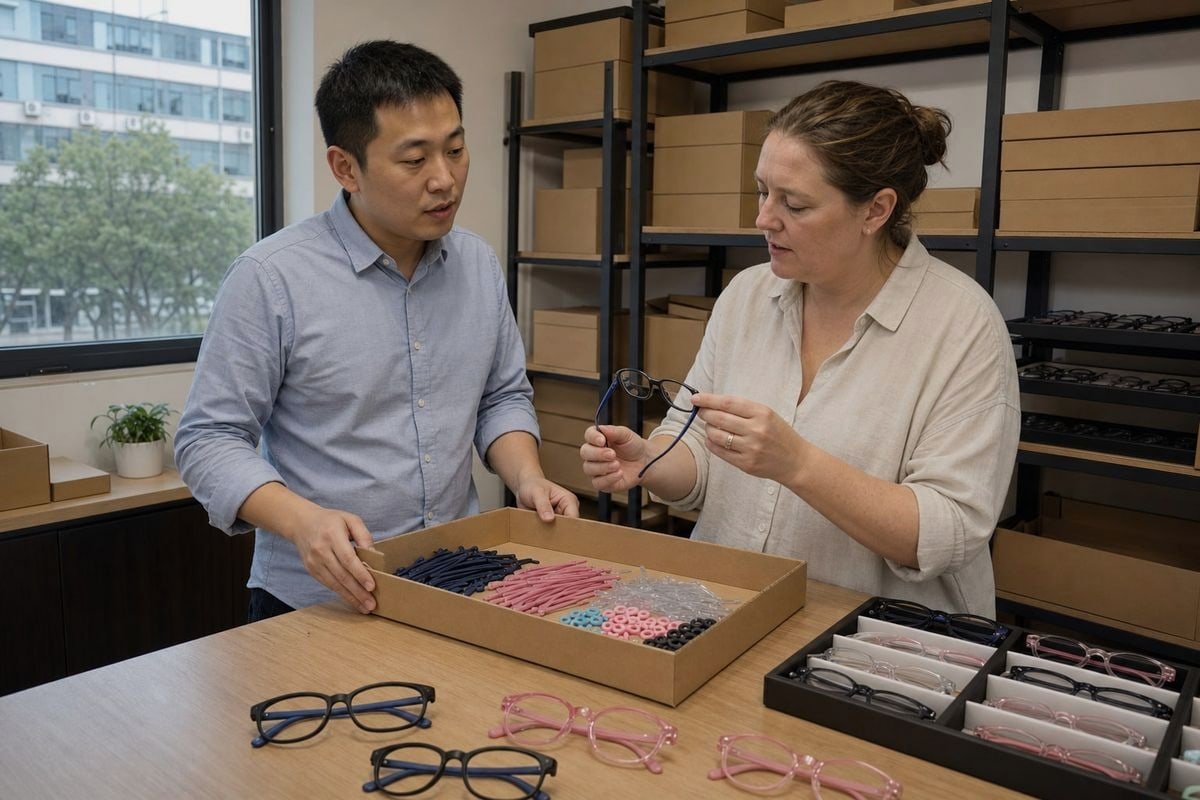
Here is why modular hinges are a branding advantage rather than a limitation. Because the temple detaches from the front, each component gets colored, printed, and finished separately. That opens combinations a one-piece frame cannot offer.
What You Can Customize
Think of the frame as four independent canvases:
- Frame front. Solid glossy colors, translucent jelly finishes like our light pink acetate-look TR90, or two-tone molding.
- Temple arms. Contrast colors, gradient transitions from clear to pastel, embossed dot patterns, or printed motifs along the surface.
- Hinge connectors and temple tips. Silicone parts in accent colors — the light blue connectors on our sporty black-and-navy style are a customer favorite — plus adjustable temple tips or cable ear hooks for active use.
- Branding touchpoints. Laser-engraved or pad-printed logos on the inner temple, custom lens cloths, cases, hang tags, and retail boxes.
For a new brand, this modularity lowers your launch risk in a very concrete way. You can pick from our existing styles — we keep around 800 in the catalog — and simply apply your colors and logo, avoiding heavy mold investment entirely. Test the market with a small mixed order. Then, once you know which shapes sell, invest in a fully custom mold with confidence.
One practical branding tip from our OEM projects: put your logo on the replaceable temple, not only the front. When a parent orders spare temples, every replacement part reinforces your brand instead of erasing it. Spare-part packs themselves can become a revenue line, and they signal to parents that your brand stands behind repairability. Combine that with a clear warranty and you have a durability story that marketing copy alone can never deliver.
Conclusión
Broken hinges frustrate parents and drain brands. Kids' optical frames with easy self-replaceable hinges — screwless design, flexible TR90/TPEE, verified certifications, full customization — turn that weakness into your selling point.
Notas al pie
1. Explains key safety certifications for eyewear. ↩︎
2. Provides information on TR90 material used in eyewear. ↩︎
3. Details the specific ISO standard for spectacle frames. ↩︎
Más artículos que te podrían gustar

5 de agosto de 2026
Bio-Based vs Regular Cellulose Acetate: What's the Difference for Kids' Frames?

5 de agosto de 2026
How Recyclable Are Kids' Optical Frame Materials, and What Eco-Friendly Alternatives Exist?

5 de agosto de 2026
Do Kids Optical Frames Whiten or Age in Storage, and How to Control Warehouse Conditions?
¿Buscas un socio confiable en gafas para niños?
Explore más de 800 estilos listos y soporte OEM/ODM completo adaptado a su marca.
Ponte en contacto English
  Español de México
  Deutsch
  Français
  日本語
日本語  العربية
  Português do Brasil