How to Achieve Prop 65 Compliance for Kids Optical Frames Sold Online in California?

Prop 65 compliance 1 for kids optical frames worries many buyers we work with. One overlooked chemical, one missing California warning label, and your online store faces real legal exposure.
Prop 65 compliance for kids optical frames means testing frames for listed chemicals like BPA, lead, and phthalates, keeping exposures below safe harbor levels through material selection, and displaying a clear and reasonable warning on your product page before checkout if exposures exceed those thresholds.
The good news is this: Prop 65 is a disclosure law, not a product ban listed carcinogens or reproductive toxicants 2. Let me walk you through how we help brands manage it, step by step.
What Prop 65 Requirements Apply Specifically to Kids Optical Frames I Sell in California?
A buyer from Australia once asked me if Prop 65 banned polycarbonate kids frames entirely. It does not. Our export team fields this question almost every month.
Prop 65 requires businesses with 10 or more employees to warn California consumers before exposing them to any of over 1,000 listed carcinogens or reproductive toxicants above safe harbor levels. For kids optical frames, the key chemicals are BPA, lead, nickel, cadmium, and phthalates in plastics, coatings, and metal parts.
Prop 65 is officially the Safe Drinking Water and Toxic Enforcement Act, managed by OEHHA. It is a right-to-know law. It does not ban chemicals or products. Instead, it requires chemical exposure warnings when consumers may be exposed above defined thresholds. Those thresholds are called safe harbor levels 3: No Significant Risk Levels for carcinogens on the list, and Maximum Allowable Dose Levels for reproductive toxicants.
Here is what matters for eyewear sellers. Kids optical frames are not a special exemption category under Prop 65. They are treated like any other consumer product. But children's product safety expectations are higher in practice, and related standards often apply tighter material limits to children's items. So most of our brand clients choose stricter internal thresholds for kids frames than for adult frames.
Who Carries the Legal Duty?
Responsibility flows through the supply chain. Manufacturers, importers, and distributors carry primary responsibility. But online retailers selling into California must make sure the warning actually appears. If you rely on a supplier's warning notice, that written notice must identify the product, include the warning materials, and be renewed periodically.
| Requisito | Who It Applies To | Key Detail |
|---|---|---|
| Warning obligation | Businesses with 10+ employees | Small businesses with 9 or fewer employees are exempt |
| Warning placement online | The retail seller | Must appear before purchase completion |
| Supplier notice | Manufacturers and importers | Written notice identifying product, renewed periodically |
| Penalties | Any violating business | Up to $2,500 per day per violation |
That penalty figure is why we take documentation so seriously on our production line. One violation notice can wipe out the margin on an entire container of frames.
How Do I Choose Frame Materials That Help Me Meet Prop 65 Standards?
Material choice is the trade-off we weigh on every new kids project: flexibility and impact resistance on one side, chemical risk profile on the other. After 15 years, we lean heavily toward TR90 and TPEE.
Choose materials with low or non-detectable levels of listed chemicals: TR90 and TPEE for frames and temples, BPA-managed polycarbonate for lenses, phthalate-free silicone for nose pads and temple tips, and nickel-safe or coated hardware. Reformulation below safe harbor levels can eliminate the warning requirement entirely.

The chemical risk in a kids frame is rarely spread evenly. It concentrates in specific components. Decorative coatings can carry lead or cadmium. Metal hinges and cores can contain nickel. Soft plasticized parts, like some nose pads and temple tips, can contain phthalates in products that were never tested. And Bisphenol A (BPA) is the known issue in polycarbonate.
The BPA Question and the Eyewear Safe Use Determination
Here is a precedent worth knowing. The Vision Council obtained a Safe Use Determination 4 from OEHHA covering certain polycarbonate eyewear, including prescription glasses, sunglasses, and reading glasses. Measured dermal BPA exposure was 0.53 micrograms per day, well below the 3 micrograms per day safe harbor for that scenario. That is reassuring. But the SUD applied to the specific products and exposure conditions it described. A compliant material can still require a warning if your finished product's exposure profile differs from the tested scenario. Do not assume every kids frame is automatically covered.
Material Comparison for Kids Frames
| Componente | Higher-Risk Option | Lower-Risk Option We Recommend | Chemical Concern |
|---|---|---|---|
| Front frame | Painted metal, cheap recycled plastic | TR90 with integral color | Lead, cadmium in coatings |
| Temples | Rigid PVC-based plastics | TPEE flexible temples | Phthalates as plasticizers |
| Temple tips / nose pads | Plasticized soft PVC | Silicona de grado alimenticio | Phthalates |
| Hinges / hardware | Untreated nickel alloys | Coated or nickel-managed hardware | Nickel |
| Lenses | Unverified polycarbonate | BPA-managed PC or alternative lens resins | BPA |
On our line, TR90 fronts with TPEE temples give us both a strong children's product safety story and the flexibility active kids need. When a client requests decorative elements, like embossed dot patterns or two-tone rubber finishes on temples, we specify the coating and masterbatch chemistry up front, before tooling starts.
What Testing and Documentation Do I Need From My Manufacturer to Prove Prop 65 Compliance?
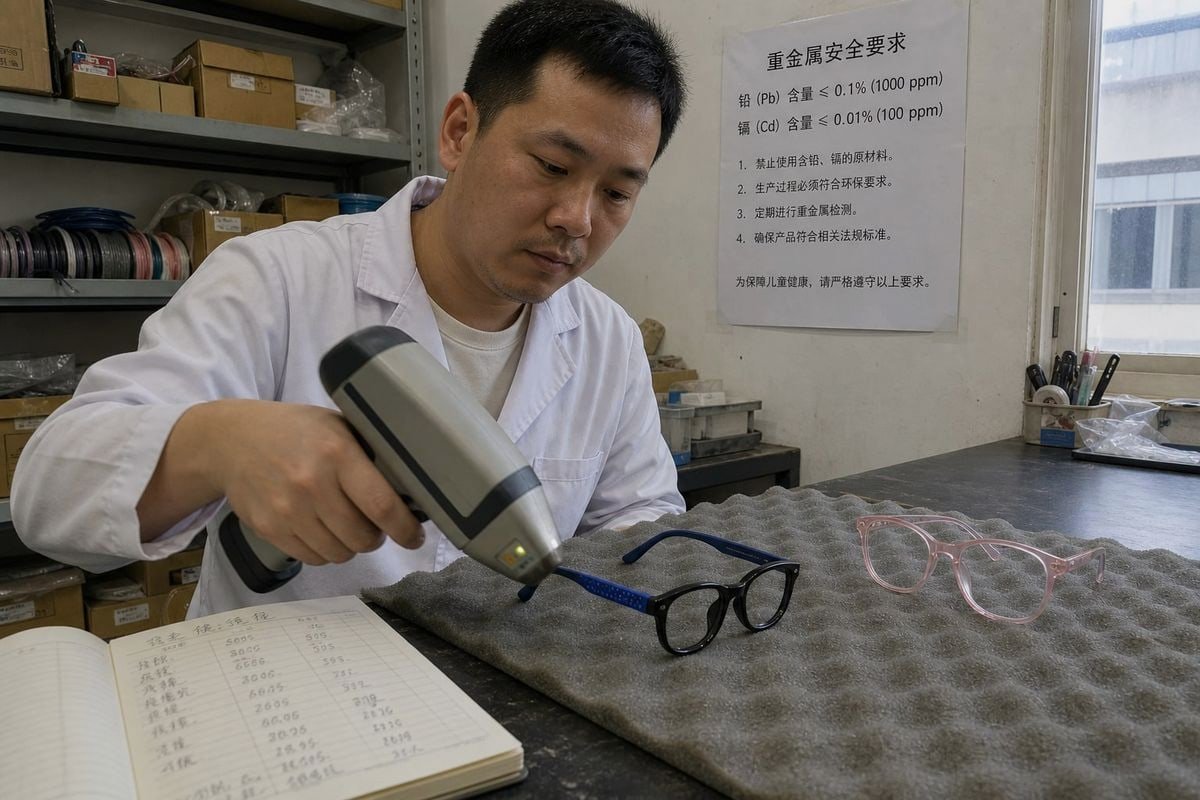
Early in my export career, I learned a hard lesson: a raw resin certificate means little if the finished frame gets painted, printed, or assembled with untested hardware. Test what ships, not just what arrives.
You need a bill of materials, Prop 65 chemical declarations from every component supplier, and third-party test reports on finished frames covering BPA, lead, cadmium, nickel, and phthalates. Results must be compared against safe harbor levels, and all records kept with renewal reminders for supplier notices.

Documentation is your defense if you ever receive a violation notice. Warnings alone are not enough; you need proof of why you did or did not warn. In our experience exporting kids eyewear to 20+ countries, buyers who arrive with a clear documentation checklist launch faster and sleep better.
A Practical Testing Sequence
- Inventory every material and finish in the frame: front, temples, tips, nose pads, hinges, screws, coatings, printed logos, and packaging in contact with the product.
- Request a full lista de materiales 5 and chemical declarations from your factory and its upstream vendors.
- Commission product material testing on finished goods at an accredited lab, focusing on components with real exposure pathways — the parts touching skin for hours daily.
- Compare results against safe harbor levels and relevant settlement-based thresholds before deciding on warnings.
- Decide: reformulate to eliminate the trigger, or apply a compliant warning.
- File everything, and set calendar reminders to renew supplier notices and retest when materials or vendors change.
The Documentation Package We Prepare for Clients
| Documento | Purpose | Refresh Cycle |
|---|---|---|
| Bill of materials | Maps every component and finish | Every design change |
| Supplier chemical declarations | Confirms no undeclared listed chemicals | Annually |
| Finished-product lab reports | Verifies exposure below thresholds | Per production program or material change |
| Prop 65 compliance statement | Supports the retailer's warning decision | Annually |
| Written warning notice (if needed) | Transfers warning content downstream | Renewed periodically |
Focus your testing budget where exposure is highest: temple tips and nose pads sit on a child's skin all day, while an internal hinge core barely contacts skin at all. That risk-based logic keeps testing costs sensible without leaving gaps. Also monitor OEHHA regulations 6 and its quarterly updates to the carcinogens list and reproductive toxicants list. A newly listed chemical can change your position between production runs.
How Can I Work With a Factory Partner to Avoid Prop 65 Compliance Risks Before Launch?
A European baby-brand buyer once told me she chose our factory over a cheaper quote because we raised Prop 65 in the first sampling call, before she did. That conversation shaped how we onboard every new client now.
Work with a factory that offers pre-tested existing styles, controlled material sourcing, and full documentation support. Confirm chemical declarations before tooling, test pre-production samples, agree on warning responsibilities in writing, and set up your California warning label and online product page disclosures before launch.

Prevention is cheaper than remediation. Once frames land in a US warehouse with an unexpected phthalate result, your options shrink to relabeling, reworking, or destroying stock. The right factory partnership pushes compliance decisions upstream, where fixes cost almost nothing.
Start With Pre-Tested Styles to Lower Launch Risk
New brands often cannot afford custom molds plus a full testing program. This is where choosing from an existing catalog helps. At our Taizhou workshop, clients can pick from roughly 800 existing styles with known material recipes — TR90 fronts, TPEE temples, silicone tips — so the chemical profile is understood before the first purchase order. You test to confirm, not to discover.
Agree on Online Warning Mechanics Before You List
Online retail compliance has specific rules. For internet purchases, the consumer product warning must appear on the product display page, through a clearly marked hyperlink using the word WARNING, or otherwise be prominently displayed before purchase completion. A warning buried in a website footer is risky. The seller is responsible for warning placement and maintenance online, so decide early who drafts the language, and use the exact current warning format for your product and exposure route rather than ad hoc wording. If multiple listed chemicals are present, the required naming depends on the warning structure, so follow the official format precisely.
One more objection I hear from buyers: why not just warn on everything to be safe? We push back on that. Over-warning creates warning fatigue, confuses parents, and can hurt a children's brand's trust. Where data or a Safe Use Determination shows exposure below safe harbor levels, use that data and skip the unnecessary warning. Precision beats fear.
Before launch, run this joint checklist with your factory: materials mapped, declarations collected, finished samples tested, thresholds compared, warning decision documented, product pages updated, and renewal dates set.
Conclusión
Prop 65 compliance is manageable: pick low-risk materials, test finished frames, document everything, and warn precisely online only when needed. The right factory partner makes it routine.
Notas al pie
1. Provides an authoritative overview of Proposition 65 and its compliance requirements. ↩︎
2. Official source for the list of chemicals requiring warnings under Proposition 65. ↩︎
3. Defines and explains the No Significant Risk Levels and Maximum Allowable Dose Levels for Prop 65. ↩︎
4. Official OEHHA page detailing the process and purpose of Safe Use Determinations under Prop 65. ↩︎
5. Provides a comprehensive definition and explanation of a bill of materials in manufacturing. ↩︎
6. Official website of the California Office of Environmental Health Hazard Assessment, the lead agency for Prop 65. ↩︎
Más artículos que te podrían gustar

5 de agosto de 2026
Bio-Based vs Regular Cellulose Acetate: What's the Difference for Kids' Frames?

5 de agosto de 2026
How Recyclable Are Kids' Optical Frame Materials, and What Eco-Friendly Alternatives Exist?

5 de agosto de 2026
Do Kids Optical Frames Whiten or Age in Storage, and How to Control Warehouse Conditions?
¿Buscas un socio confiable en gafas para niños?
Explore más de 800 estilos listos y soporte OEM/ODM completo adaptado a su marca.
Ponte en contacto English
  Español de México
  Deutsch
  Français
  日本語
日本語  العربية
  Português do Brasil