What Are Common Complaints About TR90 Kids Optical Frames—How to Avoid Them?
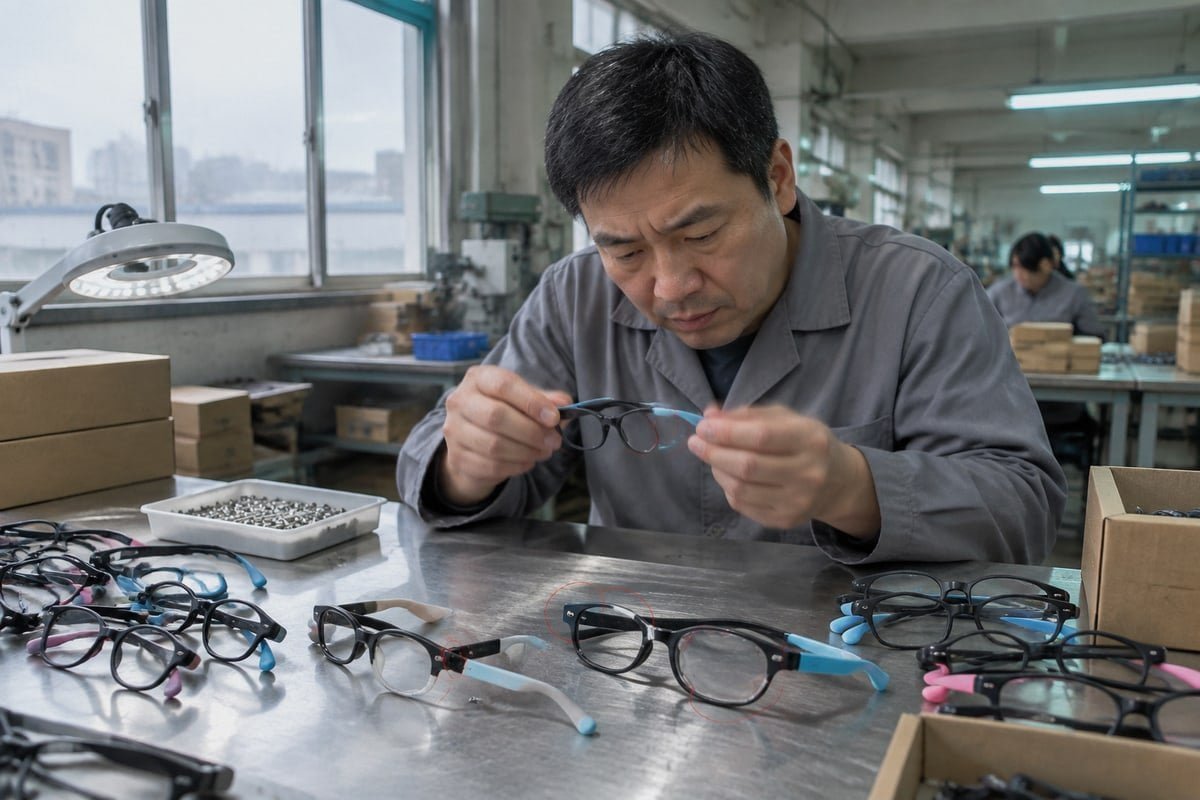
Buyers often send our Taizhou workshop TR90 Kinderbrillen 1 that slipped, peeled, or lost screws. The material was fine. The build was not. Here is what we learned.
Zu den häufigen Beschwerden über TR90-Kinderbrillengestelle gehören das Rutschen auf kleinen Nasen, lockere Scharnierschrauben, abblätternder Lack, Verzug durch Hitze, zerkratzte Gläser und uneinheitliche Größen. Die meisten davon lassen sich eher auf Beschläge, Passform und Finish zurückführen als auf das Polymer selbst. Käufer vermeiden diese Probleme, indem sie Scharniertyp, Nasenpads, Beschichtung und genaue Maße vorgeben.
Below, I break these complaints into four buyer questions hypoallergene Eigenschaften 2. Each section covers what goes wrong, why it happens, and what to ask for before you place an order.
Auf welche Qualitätsprobleme sollte ich achten, wenn ich TR90-Kinderbrillenfassungen von einem neuen Lieferanten beziehe?
Our incoming inspection once flagged a subcontracted color run because the paint lifted under a simple tape pull. That day shaped the checklist below.
Achten Sie beim Bezug von TR90-Kinderbrillenfassungen von einem neuen Lieferanten auf abblätternden Lack, sich herausdrehende Scharnierschrauben, ungleichmäßige Wandstärken, spröde Stellen durch schlechten Spritzguss, zu eng geschnittene Glasnuten und fehlerhafte Größenangaben. Fordern Sie Materialzertifikate, Salzsprüh- und Klebebandtests sowie einen Inspektionsbericht vor dem Versand an.
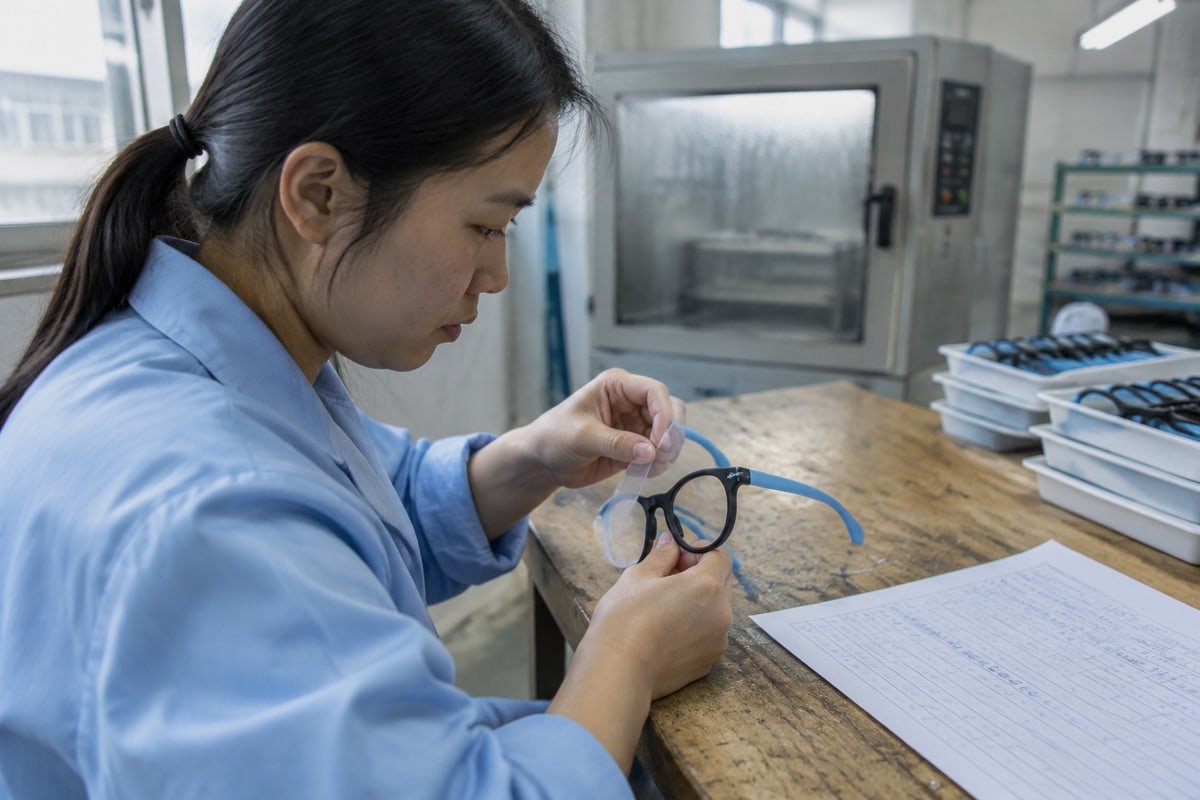
A frame labeled TR90 tells you one thing only. It tells you the base resin is a thermoplastisches Polyamid 3. It does not tell you how the frame was molded, painted, or assembled. In my experience, that gap is where most complaints are born.
The material claim is not the product
TR90 is a memory resin. It bends and returns. It is also a BPA-freies Material 4 with good hypoallergenic properties, which is why parents like it. But injection molded frames can still be poor. Short cycle times, wet resin, or cold molds leave internal stress. The frame looks fine on day one. Then it cracks at a thin corner in month three. So I always ask a new supplier which resin brand they use and how they dry it before molding.
Finish problems that show up after shipping
Painted or coated TR90 surfaces frequently peel or flake. The reason is physical. TR90 has Kunststoffe mit geringer Oberflächenenergie 5, so pigments and topcoats do not bond strongly to it without preparation. A factory that skips priming or surface treatment will pass your first sample and fail in retail. In-mold coloring avoids this problem entirely, which is why most of our own kids' optical styles rely on it.
Hardware and lens mounting
Two failures hide inside the frame. First, the flexible nylon base does not grip screw threads the way rigid plastics do. Screws back out under a child's constant movement. Second, oversized lenses forced into the groove with heavy cold-mount tension create delayed stress fractures. The frame keeps trying to return to its molded shape, and the lens keeps fighting it.
| Issue to watch | How it appears | What to request from the supplier |
|---|---|---|
| Paint flaking | Color lifts at edges and hinges | Tape adhesion test, primer or in-mold color |
| Screw back-out | Loose temples after weeks | Thread-locked screws, spring hinges |
| Cold-mount stress | Cracks near lens groove months later | Groove tolerance spec, lens fitting method |
| Brittle spots | Snapping at thin sections | Resin brand, drying record, wall thickness check |
| Size mislabel | Frame does not match spec sheet | Measured dimensions on every carton |
If a supplier cannot explain any row in this table, that is a warning sign. A real factory will answer in detail. A trading company will often change the subject.
Warum fühlen sich manche TR90-Brillengestelle im Gesicht von Kindern weniger komfortabel an als andere?
Lighter is not always better. When we thin a temple to shave grams, we trade away the grip that keeps a frame in place on a running child.
TR90-Fassungen fühlen sich weniger komfortabel an, wenn Stegbreite, Bügellänge oder Glasbreite nicht zum Gesicht des Kindes passen, wenn einem festen Steg Silikon-Pads fehlen oder wenn steife Bügelbiegungen hinter den Ohren drücken. Der Tragekomfort hängt von exakten Abmessungen und weichen Kontaktpunkten ab, nicht allein von leichtgewichtiger Flexibilität.

Parents buy TR90 for comfort. So it surprises many buyers when kids still complain. The frame is light. The frame bends. Yet the child keeps pushing it back up or takes it off after school. I hear this often, and the cause is almost never the resin.
Age labels hide real measurements
Many kids' frames are sold by age band, such as "ages 3 to 10." That range is too wide to mean anything. A three-year-old and a ten-year-old do not share a bridge. When a brand relies on the age label instead of the spec sheet, some children get a frame that pinches and others get one that slides. I always tell buyers to compare measurements to a pair that already fits their target child well.
| Messung | Zu klein | Zu groß |
|---|---|---|
| Stegbreite | Pinches nose, red marks | Slides down, sits crooked |
| Glasbreite | Eyes look cramped, temples splay | Frame overhangs cheeks |
| Bügellänge | Pressure at ear top, headaches | Frame drifts forward |
| Frame depth | Limits prescription lens area | Rests on cheeks when smiling |
Slipping and the fixed bridge
Because TR90 is so light, it has little mass to hold itself in place. Active children sweat, and a bare fixed bridge loses grip fast. Frames with integrated silicone nose grips or adjustable nose pads stay put far better. In our own designs, we often pair a TR90 front with TPEE temples. The softer temple material grips the side of the head gently and reduces the slide without adding pressure.
Temples, ears, and skin sensitivity
Pressure behind the ears usually comes from temple curvature molded for an average head. Here is the catch with memory resin: its shape memory resists standard manual adjustment. An optician cannot simply bend a TR90 temple by hand and expect it to stay. Permanent changes need controlled heating. That is why adjustable temple tips, or soft TPEE tips, matter so much on children's frames. They give the fit some range without fighting the material. Rounded tips also help children with skin sensitivity avoid irritation after long wear.
One more point. Comfort should be tested with the child moving, not sitting. A frame that feels fine at the fitting table can fail on the playground.
Wie kann ich sicherstellen, dass die von mir bestellten TR90-Brillengestelle bei täglicher Nutzung durch Kinder langlebig bleiben?
Fifteen years of making children's eyewear taught me one hard lesson: the frame that bends survives, but the screw that loosens ends the sale.
Um TR90-Fassungen für den täglichen Gebrauch durch Kinder langlebig zu halten, sehen Sie Federscharniere oder verstärkte Scharnierblöcke, gesicherte Schrauben, passgenau dimensionierte Glasnuten zur Vermeidung von Spannung bei der Kaltmontage, UV-stabile Farbstoffe sowie Pflegehinweise vor, die vor Hitze und alkoholhaltigen Desinfektionsmitteln warnen. Die Schlagfestigkeit kommt vom Polymer; die Langlebigkeit entsteht durch diese Details.
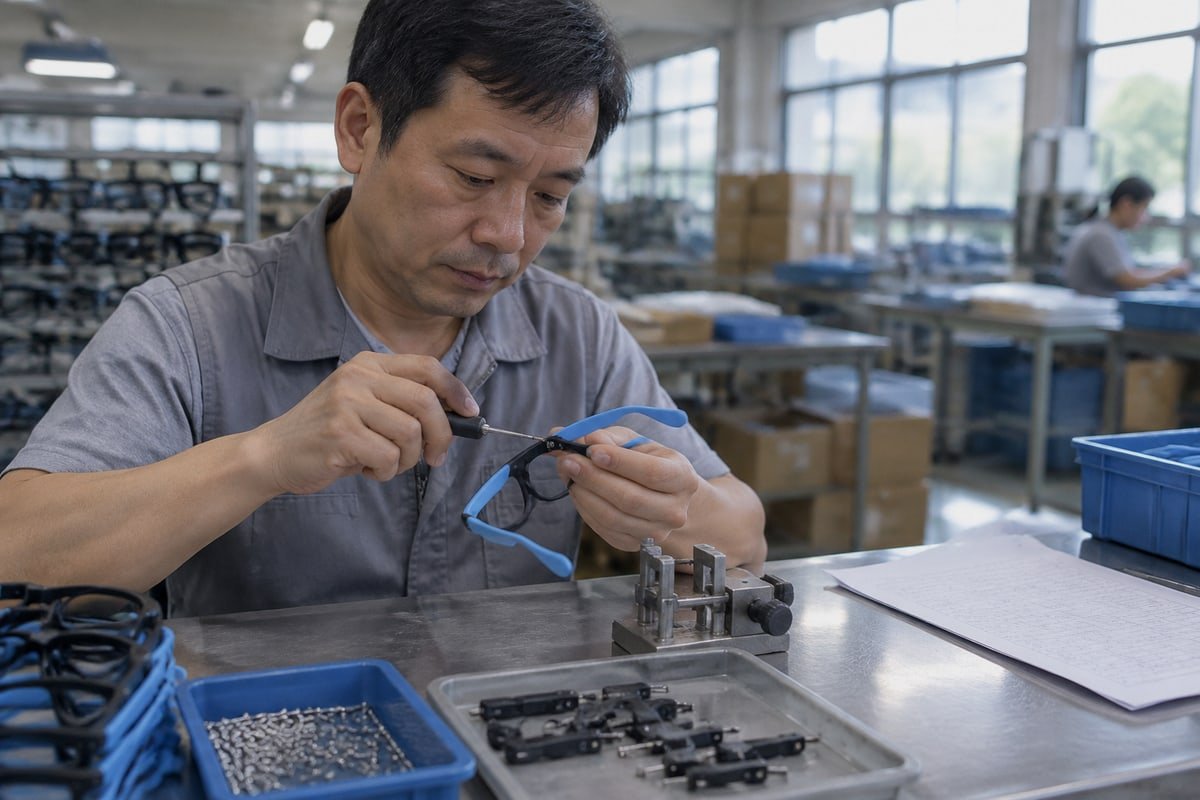
Some critics say the word "unbreakable" on TR90 kids' glasses is misleading. I agree with them, and I still make TR90 frames. Both things are true. The polymer handles bending and drops very well. The failures come from the parts around it and from how the frame is treated. Let me walk through the threats one by one, then explain what we build in to counter them.
Threats that outlast the marketing
| Threat | Effect on TR90 | Prävention |
|---|---|---|
| Heat deformation | Permanent warping on car dashboards or near radiators, throwing lenses out of alignment | Care card warning, hard case |
| Alcohol sanitizers, hairspray, acetone | Polymer turns brittle or shows surface cracks | Clean with water and mild soap only |
| Screw back-out | Flexible nylon lacks thread-lock friction, screws loosen | Thread-locked screws, spring hinges |
| Thermal expansion mismatch | Metal hinge block and TR90 expand at different rates, causing micro-fissures and hinge pop-out across seasons | Reinforced hinge design, proper embedding |
| UV plus acidic skin pH | Chalking: surface turns dull and powdery over time | UV-stable colorants, in-mold color |
| Cold-mount lens tension | Delayed stress fractures in the frame front | Groove tolerance control at fitting |
Heat is the one that surprises parents most. A frame left on a dashboard in summer can warp in an afternoon, and a warped optical frame means a misaligned prescription. That is a safety issue, not just a cosmetic one.
What we build into the frame
- Spring hinges or reinforced hinge blocks on every optical style, because children open temples wide and often.
- Screw treatment so threads hold in the softer nylon base.
- Lens groove checks so the lens seats without excess pressure.
- In-mold color for the front, which also resists chalking better than sprayed paint.
- Soft TPEE temples where the style allows, so the temple takes the abuse instead of the hinge.
A note on newer resins
Emerging bio-based TR90 resins are appealing to eco-focused brands, and we watch them closely. But their mechanical fatigue profile differs from petroleum-based grades. They may lose their elastic snap-back sooner. If a supplier offers a bio-based option, ask for fatigue data before committing a whole line to it.
Finally, remember that frame durability and lens durability are separate. Many complaints about "TR90 glasses" are really about cheap lenses scratching. A hard case and a microfiber cloth from day one protect both.
Was sollte ich meinen Hersteller fragen, um eine uneinheitliche TR90-Rahmenqualität zu vermeiden?
A procurement manager from Australia once asked me why her second shipment felt stiffer than the first. The answer was resin lot control, and it changed how we document orders.
Ask your manufacturer for a sealed golden sample, resin brand and lot records, color standards with tolerance, a written QC plan covering hinge torque, tape adhesion, and dimensions, a pre-shipment inspection report, and confirmation that the factory, not a trading company, controls molding and assembly.
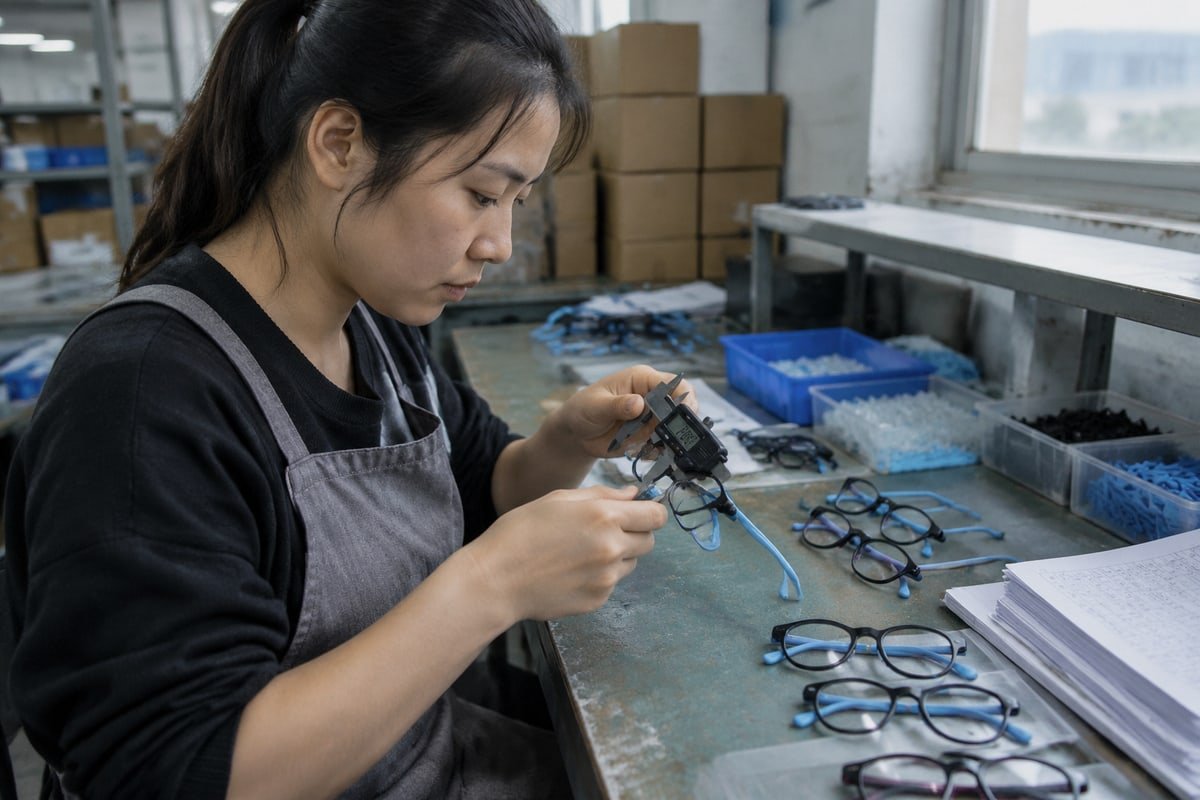
Inconsistency is a different problem from bad quality. A bad sample you can reject. An inconsistent supply you discover only after your second or third order, when customers compare pairs and notice the difference. The fix is documentation, and you have to ask for it up front.
Questions that separate factories from middlemen
The first thing I would confirm is who actually molds the frames. Trading companies move orders between workshops based on price. When the workshop changes, the resin, the mold temperature, and the hinge supplier can all change with it. At our own facility, around 120 workers handle molding, assembly, and packing under a 5S-managed layout, so the process stays in one place. That is what you want to hear from any partner.
| Frage zu stellen | Was zu vergleichen ist | Eine gute Antwort klingt wie |
|---|---|---|
| Who owns the molds and where are they run? | Prevents silent workshop changes | "Our molds, our machines, this address" |
| Which TR90 resin brand and grade? | Different grades flex differently | A named grade with a datasheet |
| How is color controlled? | Buyers complain about color mismatch | Sealed color standard, tolerance defined |
| What hinge and screw spec is used? | Loose hinges are the top hardware complaint | Spring hinge model, screw treatment |
| What is checked before shipping? | Catches drift before it reaches you | Written plan with sample sizes |
Documents that lock consistency
A golden sample is the anchor. Both sides sign it and seal one copy at the factory. Every later batch is compared against it for color, flex, hinge feel, and dimensions. Add a spec sheet that lists bridge width, lens width, temple length, and frame depth as numbers, not age ranges. Then ask for a pre-shipment inspection report with photos. This is standard practice for the kids' brands we work with across 20 or more countries, and good factories expect the request.
Confirm prescription readiness
Not every frame marketed as "optical" accepts prescription lenses well. Confirm lens height and frame depth support the prescription range your market needs. Confirm the groove profile suits an optician's edging equipment. A frame that looks like eyewear but cannot be glazed properly will generate returns.
Risiko mit bestehenden Stilen reduzieren
If you are a new brand, you do not need to fund a mold to get consistency. Choosing from an existing catalog, such as the roughly 800 styles we already run, means the mold is proven and the process is stable. You then customize color, logo, lenses, and packaging through OEM/ODM work. The frame system has already been tested by other markets. That is a lower-risk way to launch than starting from a fresh tool.
Schlussfolgerung
Most complaints about TR90 kids optical frames come from fit, hardware, and finish, not the polymer. Specify those details, verify them, and the material delivers.
Interessiert an der Beschaffung der in diesem Artikel erwähnten Produkte? Details und Angebotsanfrage hier:
Fußnoten
1. ISO provides the international standards for spectacle frames and ophthalmic optics quality control. ↩︎
2. Authoritative database for research on material biocompatibility and the hypoallergenic properties of polymers. ↩︎
3. Official site of the manufacturer that developed TR90, a high-performance thermoplastic polyamide. ↩︎
4. The FDA provides regulatory information regarding the safety and use of BPA-free materials in consumer products. ↩︎
5. Technical resource explaining how low surface energy affects the adhesion of coatings on polymer surfaces. ↩︎
Weitere Artikel, die Ihnen gefallen könnten



Auf der Suche nach einem zuverlässigen Partner für Kinderbrillen?
Entdecken Sie über 800 sofort verfügbare Modelle und umfassenden OEM/ODM-Support, der auf Ihre Marke zugeschnitten ist.
Kontakt aufnehmen English
 Español de México
 Deutsch
 Français
 日本語
 العربية
 Português do Brasil