Which Temple Design Suits Which Age Group for TR90 & TPEE Kids Sunglasses?
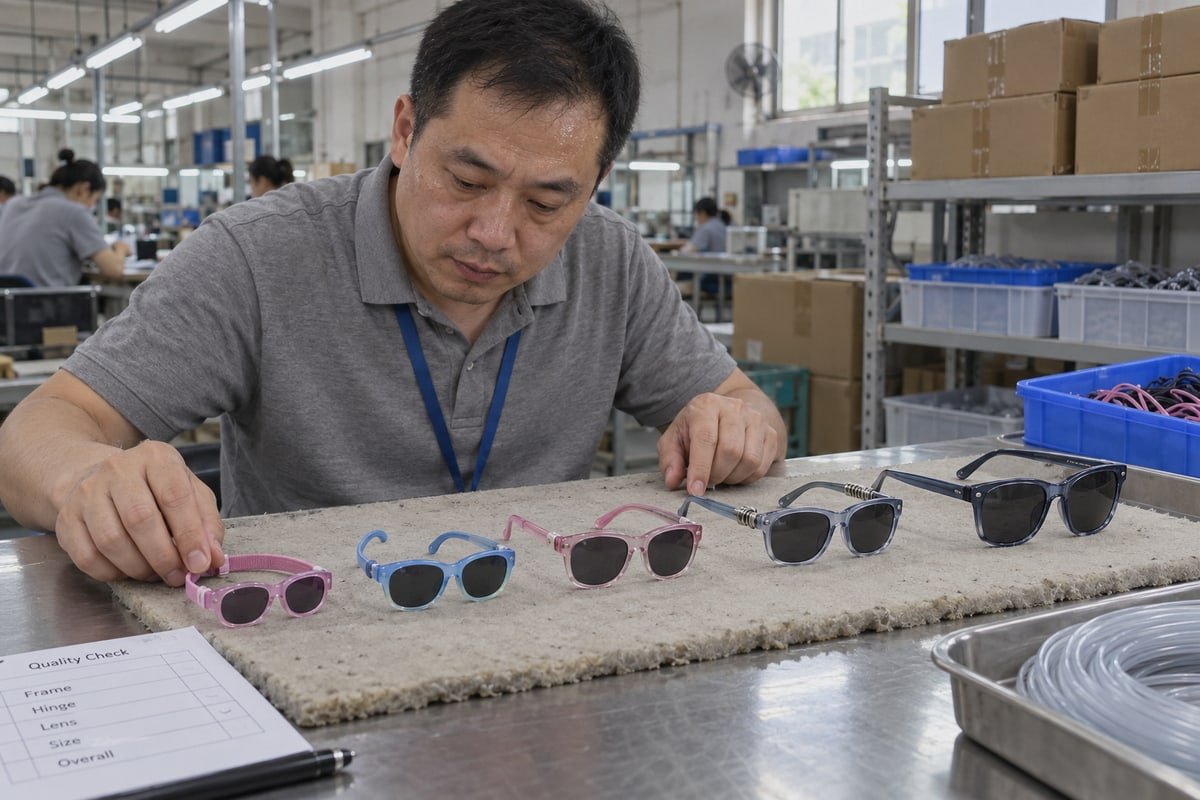
Choosing the right temple design for TR90 & TPEE kids sunglasses is where I see most buyers stumble flexible frame material 1. On our production line in Taizhou, temple geometry decides everything.
Temple design for TR90 & TPEE kids sunglasses should follow age: strap or cable-wrap TPEE temples for ages 0–2, short curved grippy TPEE temples for 2–4, hybrid flexible temples for 4–7, TR90 spring-hinge temples for 6–9, and sleeker adult-style TR90 temples for tweens 10–12.
That is the short answer. But the details matter a lot. Temple length, curvature, hinge type, and material each change as a child grows. Let me walk you through every age band, one by one, so you can spec the right frame for your market.
What temple design works best for toddlers and infants wearing sunglasses?
During a QC session last spring, I watched a sample frame for a baby brand fail a simple test: it slid off a mannequin head in seconds. Our team redesigned the temples the same week, and that lesson shaped everything below.
Infants and toddlers aged 0–2 need strap-back, band-style, or highly flexible cable-wrap temples made from soft TPEE. These designs hold sunglasses in place through retention, not clamping pressure, so the frame stays on a moving baby without creating sore spots behind the ears.
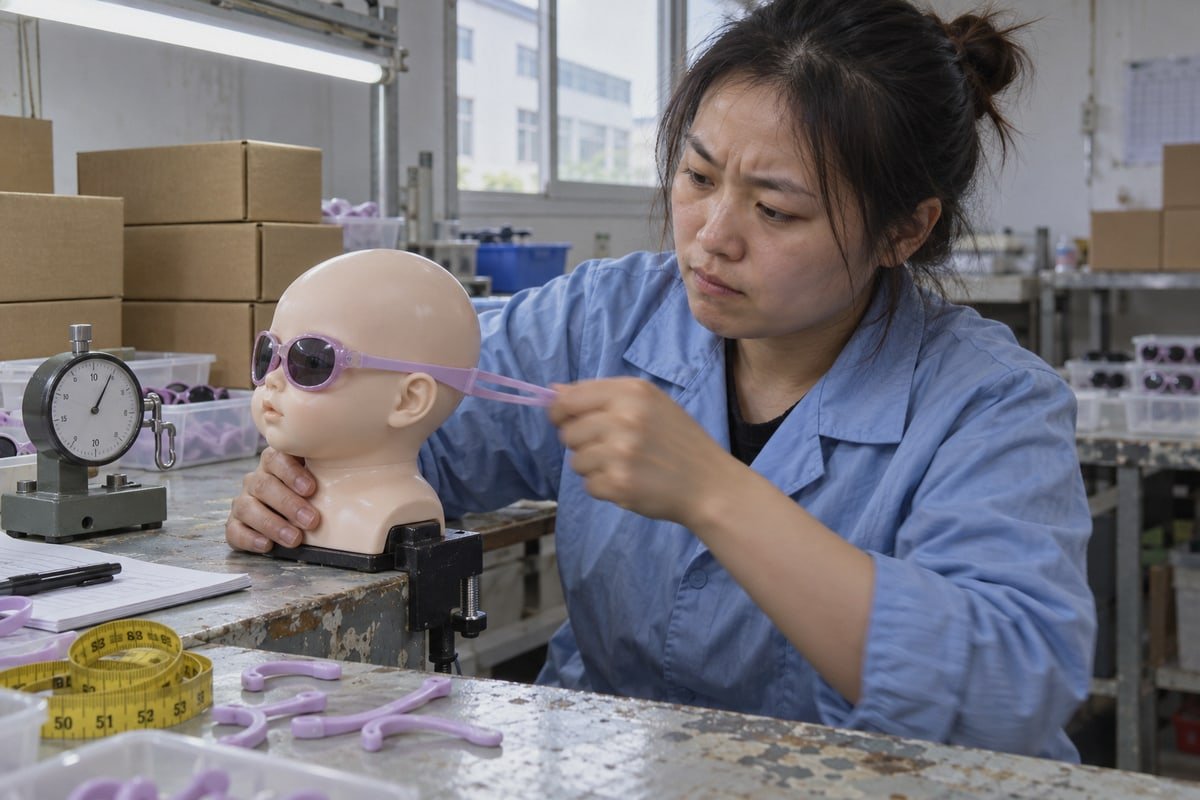
The core priority for this age group is retention without pressure. Babies have a large head-to-face ratio, very soft cartilage behind the ears, and almost no patience for discomfort. A rigid, adult-style temple simply cannot work. It either pinches or falls off. That is why we build our youngest frames around three temple solutions: adjustable elastic headbands, full wrap-around style cable temples, and very short soft temples paired with a removable strap.
Material choice reinforces the design. TPEE is soft, chew-resistant, and shape-retentive, which matters because children at this age chew, pull, and drop their sunglasses constantly. It also supports BPA-free construction 2, a point our buyers in Europe, Japan, and Australia ask about before anything else. We keep metal trim to an absolute minimum on 0–2 frames — no exposed rivets, no sharp hinge edges, and ideally a hingeless one-piece temple.
Key fit numbers for ages 0–2
Temple length for this band sits at roughly 95–115 mm, and the temple curvature radius should be wide — around 18–20 mm — to match an infant's broader cranial proportions. A tighter curve digs in. A wider curve distributes contact gently across the skull.
What to spec on an OEM order
Ask for a low bridge profile, non-slip nose pads or a molded soft bridge, shatterproof lenses with UV400 protection, and a strap attachment point tested for pull-off force. In our experience exporting baby eyewear to 20+ countries, these four details separate a returned product from a reordered one.
How do I choose between cable temples and straight temples for older kids?
A distributor from Melbourne once asked me why we quoted two different temple molds for the same frame front. The answer is simple: cable temples and straight temples solve different problems, and the child's age decides which problem you are solving.
Choose cable or curved wraparound temples for ages 2–4, when children crawl, run, and yank at their frames. Switch to straight or slightly curved temples with soft silicone tips around ages 6–9, when kids handle eyewear more independently and want a normal glasses look.
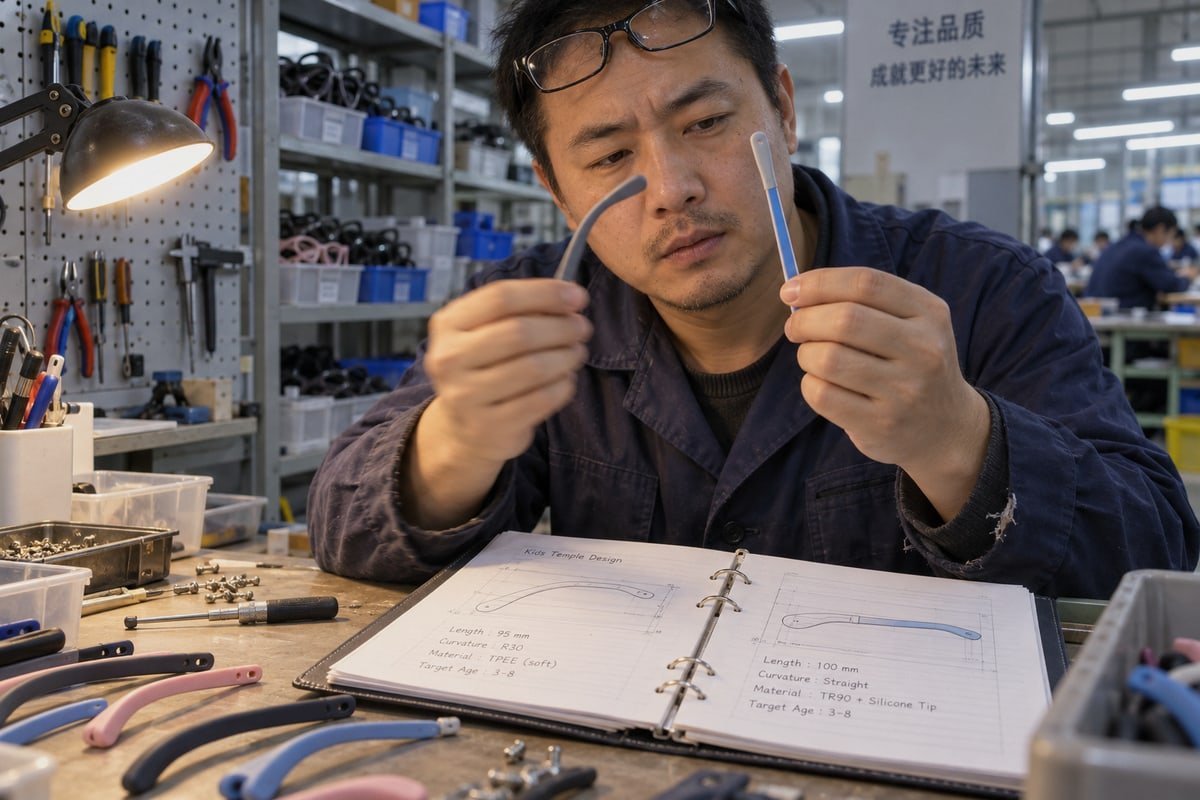
Here is the comparison I share with buyers before they pick a style from our catalog of roughly 800 existing designs:
| الميزة | Cable / wraparound temples | Straight temples with soft tips |
|---|---|---|
| أفضل فئة عمرية | 2–4 years (up to 5 for rough handlers) | 6–9 years and up |
| Retention method | Hooks behind the ear, mechanical hold | Friction from grip tips and correct length |
| Typical temple length | 105-115 ملم | 120-130 مم |
| Typical material | TPEE or TR90 with TPEE overmold | TR90 with silicone temple tips |
| Look and feel | Functional, "baby gear" appearance | Standard eyewear, more grown-up look |
| Failure mode if misused | Can feel restrictive on older kids | Slides off very young, very active kids |
Why the transition age is flexible, not fixed
Some sources place the TPEE-to-TR90 transition at age 3. Others extend soft-material suitability to age 5, or recommend TR90 only from 6 and up. Buyers often see this as a contradiction and ask us which chart is correct. My honest answer: neither, on its own. The transition depends on developmental stage, activity level, and the child's tolerance for a more structured frame. A very rough five-year-old may still suit a TPEE cable temple. A careful four-year-old may be ready for a light TR90 frame with straight temples. This is exactly why we recommend brands carry both options across the 3–6 band rather than drawing a hard line.
The fit rule parents actually remember
If the temples are too short, they pinch. If they are too long, the frame slides forward and irritates the ears. Length matters as much as shape. Also watch curvature: the radius should narrow from about 18–20 mm for infants down to 12–14 mm for preteens, because facial structure elongates as children grow.
Which temple flexibility level suits active school-age children the most?
One trade-off we weigh constantly in sample development is stiffness versus survivability. Make a school-age temple too soft and the frame twists off center during sports. Make it too stiff and it snaps in a backpack. The sweet spot is engineered flexibility.
Active school-age children aged 6–9 do best with TR90 temples fitted with spring hinges. TR90 is a flexible frame material that bends under impact and returns to shape, while spring hinges absorb outward pull from rough removal, wide heads, and playground use.
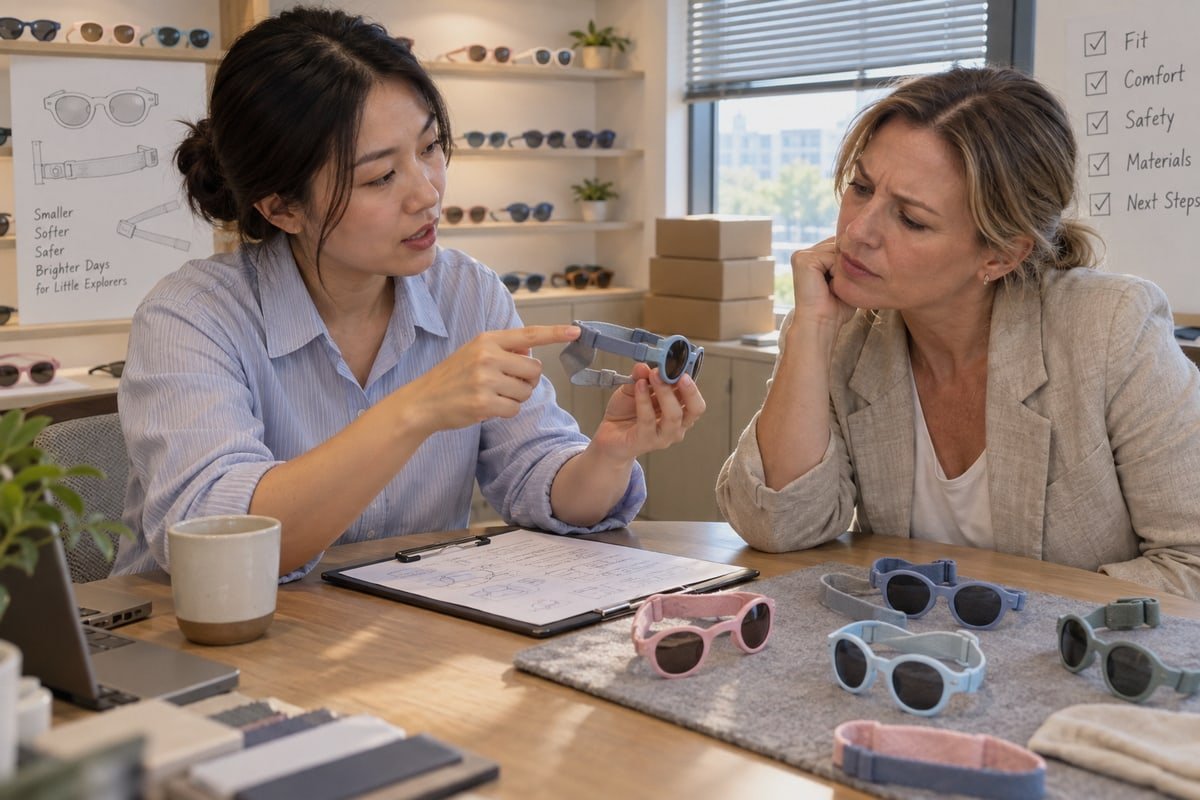
By this age, the conversation shifts from pure softness to impact resistance plus a normal look. Kids in the 6–9 band are on and off with their sunglasses dozens of times a day. They pull frames off one-handed, sideways, by a single temple. A standard barrel hinge takes all that stress at one rigid point. A spring hinge flexes outward and comes back, which is why we default to spring hinges on most of our school-age TR90 styles.
Matching hinge type to age and behavior
| Hinge / temple system | الدفع الآمن عبر المنصة | Why it works |
|---|---|---|
| Hingeless or strap-based | Infants 0–2 | No pinch points, nothing to snap, chew-safe |
| Cable / wrap, minimal hinge | Toddlers 2–4 | Mechanical retention during crawling and running |
| Spring hinges on TR90 | Ages 4–9, wider heads, active kids | Absorbs outward flex, resists breakage from rough handling |
| Standard barrel hinges | Careful tweens 10–12+ | Sleeker look, lower cost, fine for gentler wearers |
Flexibility is more than the hinge
The temple thickness-to-flexibility ratio should decrease with age. Thicker TPEE bands give stability on an infant's broader head, while thinner, tapered TR90 tips reduce peripheral bulk for older kids doing sports. On our sports-oriented styles, we pair tapered TR90 temples with silicone grip tips, an ergonomic fit at the ear bend, and non-slip nose pads, so the frame stays centered during a sprint without squeezing. Combine that with shatterproof عدسات مستقطبة 3 and you have a frame built for real playground conditions, not just the product photo. This is also the age where "babyish" becomes a dirty word — kids want durability plus a normal glasses look, and the temple silhouette is what delivers it.
How can I customize temple designs by age group when working with an OEM manufacturer?
When a Japanese kids' brand asked us to build a three-tier age range from one design language, the whole project came down to temple engineering. Same brand look, three different temple systems. That project is a useful template for any buyer planning an age-segmented line.
Work with your OEM to define temple length, curvature radius, material, and hinge type per age band, then customize colors, silicone tips, straps, logos, and packaging on top. A factory with existing molds lets you launch age-specific SKUs without heavy tooling investment.

Here is the specification framework we walk buyers through, band by band:
| الفئة العمرية | Temple type | طول الذراع الجانبي | Curve radius | المواد |
|---|---|---|---|---|
| 0-2 سنة | Strap, band, or cable wrap | ~95–115 mm | 18–20 mm | TPEE |
| 2-4 سنوات | Short curved, soft grippy tips | 105-115 ملم | ~17–19 mm | TPEE |
| 4-7 سنوات | Hybrid flexible, soft tip + flex hinge | 115-125 مم | ~15–17 mm | TPEE or light TR90 |
| 6-9 سنوات | Straight/slightly curved, spring hinges | 120-130 مم | ~14–16 mm | TR90 |
| 10–12+ years | Sleek straight, spring or barrel hinge | 130-140 ملم | 12–14 mm | TR90 or TR90/acetate |
A practical customization process
- Pick base styles from existing molds. We hold around 800 styles, so most age bands are covered without new tooling. That lowers your launch risk dramatically.
- Lock the temple spec per band. Length, curve, tip hardness, and hinge type get written into the tech pack, referencing pediatric eyewear standards for your target market.
- Add brand-level customization. Custom colors, logo placement, lens options (UV400 or polarized), and packaging. Color-coded silicone temple tips are a smart touch here — they give toddlers sensory engagement and help parents tell siblings' eyewear apart at a glance.
- Consider growth-adaptive features. Multi-notch or adjustable temple designs extend a single pair across adjacent age brackets, which is a strong selling point for value-focused retailers.
- Sample, test, and audit. Ask for pull tests on straps, flex-cycle tests on spring hinges, and material documentation confirming BPA-free construction before you commit to a production run.
One more honest note. Some suppliers will tell you one flexible frame covers ages 2–10. In fifteen years of eyewear production, I have never seen that work at retail. Temple geometry, hinge type, and grip features matter as much as the raw frame material, and children outgrow geometry faster than they wear out TPEE or TR90.
الخلاصة
Match temple design to three variables: the child's age, activity level, and whether they need soft retention or a structured school-age frame. Get those right, and the rest follows.
Too many kids' sunglasses lines fail because the frame fit the catalog photo, not the child. The frame slips, the child refuses it, the parent returns it, and your retailer remembers. The fix is straightforward: strap and cable TPEE temples for 0–4, hybrid flexibility for 4–7, spring-hinge TR90 for 6–9, and sleeker adult-style TR90 temples for tweens — with length, curvature, and hinge type specified per band. If you are building an age-segmented range and want a partner who has already engineered these temple systems across hundreds of styles, our team is ready to help you spec it right the first time.
Interested in sourcing the products mentioned in this article? See details and request a quote here:
ملاحظات ختامية
1. ISO 12870:2018 specifies requirements for unglazed spectacle frames including material flexibility. ↩︎
2. Official EPA information regarding the regulation and safety of Bisphenol A (BPA). ↩︎
3. Expert advice from the American Academy of Ophthalmology on selecting children’s sunglasses. ↩︎
مقالات أخرى قد تعجبك



هل تبحث عن شريك موثوق به للنظارات للأطفال؟
استكشف أكثر من 800 نمط جاهز ودعم OEM/ODM كامل مصمم خصيصًا لعلامتك التجارية.
اتصل بنا English
  Español de México
  Deutsch
  Français
  日本語
日本語  العربية
  Português do Brasil