What Role Does TPEE Play in TR90 Kids Sunglasses vs Soft Rubber and Silicone?
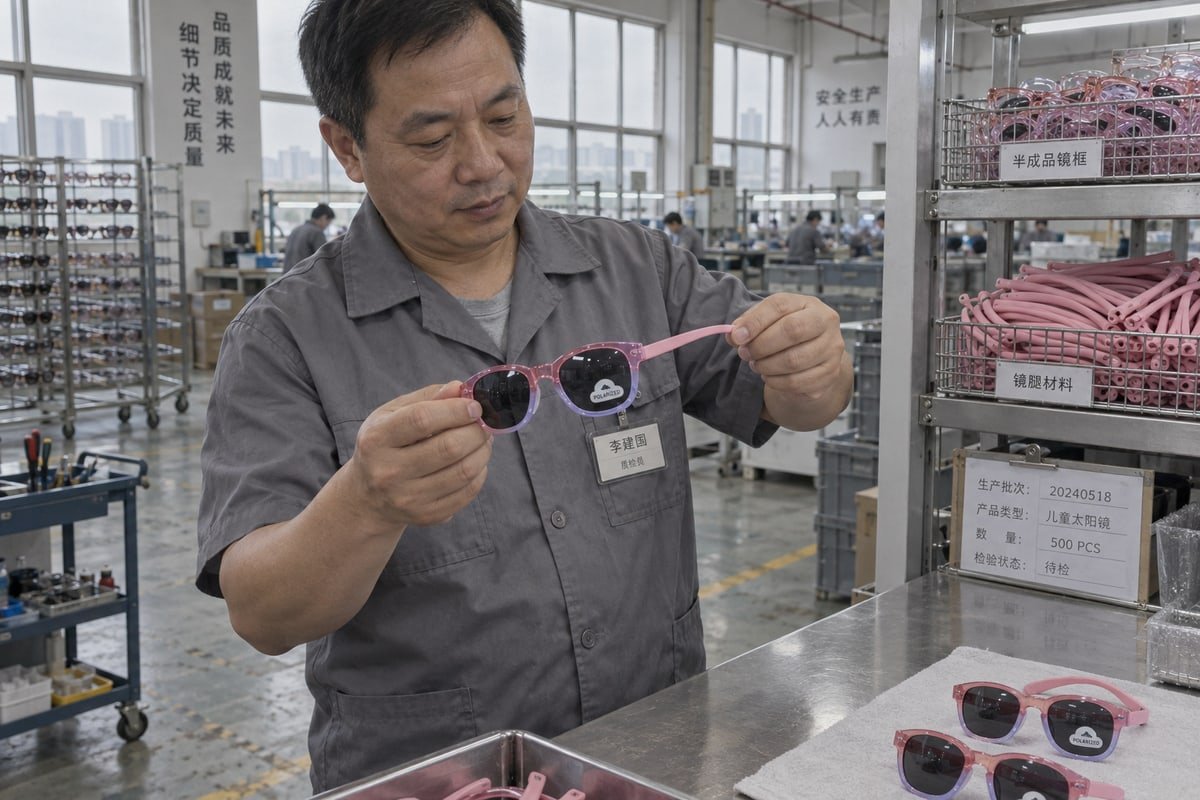
Buyers often ask me what TPEE in TR90 kids sunglasses actually does. Pick the wrong soft material and the returns pile up. Our production line taught us the answer.
TPEE in TR90 kids sunglasses acts as the soft, flexible temple and bridge material bonded to a lightweight TR90 front. It bends without cracking, keeps its shape, and resists chewing. Soft rubber degrades faster, while silicone lacks the strength for load-bearing frame parts.
That is the short version. The longer version matters more if you are building a children’s eyewear line. Below I break down safety, comfort, bonding, and durability one at a time.
How Do I Know If TPEE Temples Are Safer for My Kids' Sunglasses Than Silicone?
During an incoming-material check, our QC team once found a supplier's so-called silicone temple stock was actually TPE. That mislabel is common in this industry, and it matters for safety.
TPEE temples are safer than silicone for kids' sunglasses because they combine soft-touch comfort with real tensile strength. True silicone is skin-friendly but too weak for load-bearing temples, and many silicone frames are actually TPE. TPEE keeps lenses secure and survives twisting without tearing.
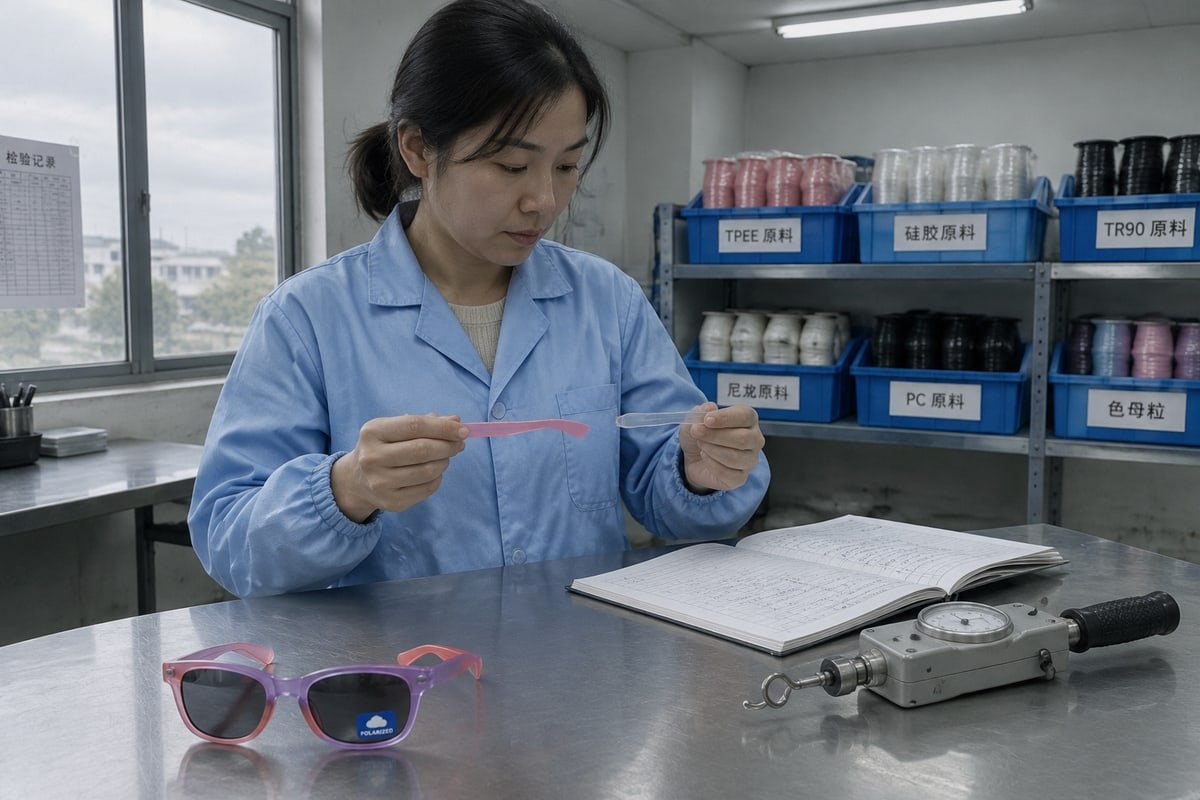
Let me start with a side-by-side view. This is how I explain the three soft materials to new buyers.
| خاصية | TPEE | True silicone | Soft rubber (TPR) |
|---|---|---|---|
| Feel on skin | Soft-touch, slightly firm | Very soft, tacky | Soft, can feel greasy |
| Tensile strength performance | مرتفع | منخفض | متوسط |
| Shape retention after bending | ممتازة | ضعيف إلى مقبول | مقبول |
| Chew and tear resistance | مرتفع | Low (tears at edges) | متوسط |
| Best use in a frame | Temples, bridge, full toddler frames | Nose pads, grip inserts | Budget temple sleeves |
| Common mislabeling | Sometimes sold as silicone | Often not real silicone | Sometimes sold as silicone |
What parents think they are buying versus what they get
Here is the confusion. Silicone has a strong reputation in the baby market. Parents trust it for bottles and teethers. So a listing that says silicone sunglasses feels safe. But true silicone rubber is a thermoset. It has low tensile strength. If you make a whole temple from it, the temple stretches, sags, and eventually tears at the hinge. It also does not hold a lens rim tightly. For that reason, most flexible kids' frames sold as silicone are really thermoplastic elastomers 1 like TPE or TPEE. That is not always bad. The problem is that the buyer cannot check. When a brand asks us for silicone, I ask what they actually want. Usually they want soft, hypoallergenic eyewear materials 2 that a toddler can chew without harm. TPEE delivers that. It is also compatible with BPA-free safety standards that most children's product brands require.
Where silicone still belongs
I do not dismiss silicone. It is excellent as a component. We use silicone-type pads where non-slip grip on the nose is the main job. It is very skin friendly. But the load-bearing parts of a child's frame, meaning the temples and the bridge, need strength. That is the TPEE zone.
The softer-is-safer objection
Some buyers push back. They argue that the softest material is always the safest for a child. For a baby who mouths everything, softness is the priority, and I agree. But softness alone can hide a weakness. A temple that is too soft cannot keep a lens seated during a fall. A lens that pops out is a sharp edge near an eye. So safety is a balance of softness, strength, and lens retention. TPEE hits that balance better than silicone for anything beyond the infant stage.
Why Should I Choose TPEE Over Soft Rubber for Long-Term Comfort in Children's Eyewear?
The trade-off we weigh most often is initial softness against how a temple feels after a year of sweat and sun. Soft rubber wins day one. TPEE wins month twelve.
Choose TPEE over soft rubber because TPEE is flexible at the molecular level and needs no chemical plasticizers. Soft rubber relies on plasticizers that leach out, causing sticky, cracked temples over time. TPEE resists skin oils and sweat, keeps its elasticity across temperatures, and stays comfortable for years.
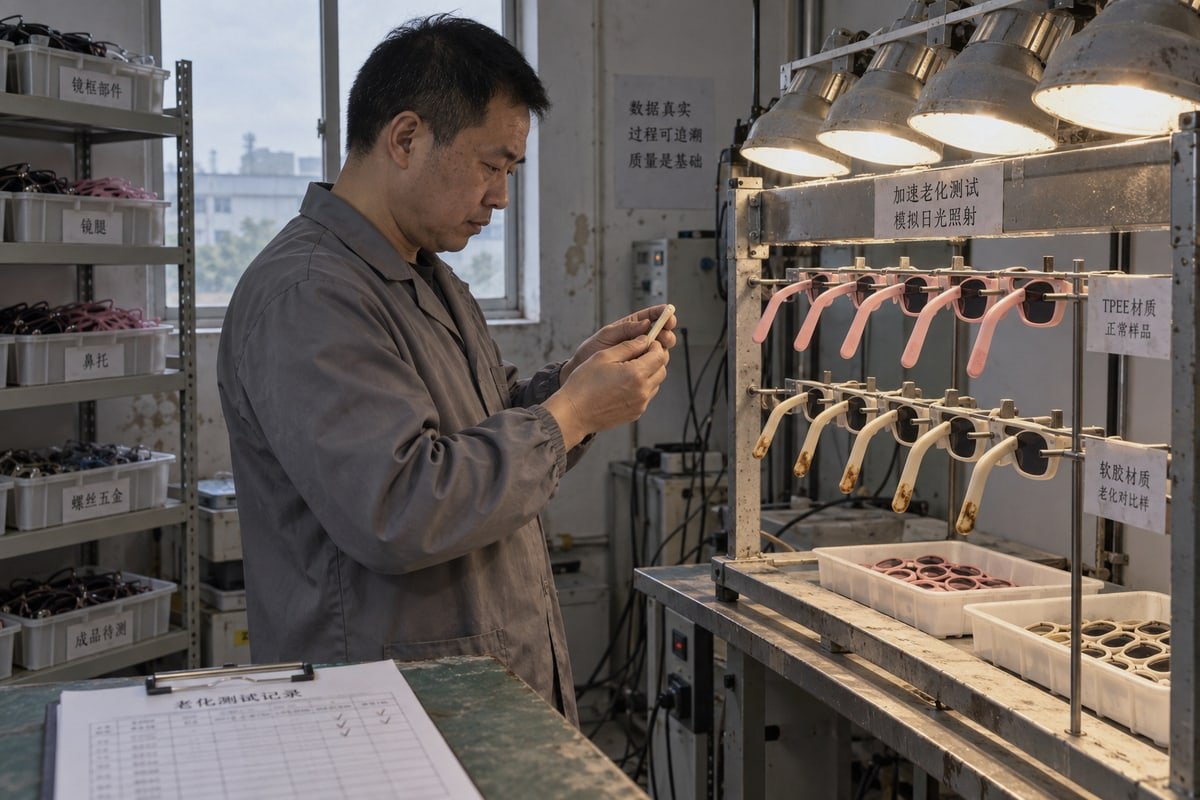
Comfort on the first day is easy. Almost any soft material feels fine when a child tries it on in a store. The real test is what happens after months of sunscreen, sweat, and being stuffed into a backpack. This is where the thermoplastic elastomer properties of TPEE start to separate it from traditional thermoplastic rubber.
Sticky frame syndrome explained
Anyone who has handled old rubber-coated frames knows the feeling. The surface turns tacky. Dust sticks to it. Then it cracks. This is what I call sticky frame syndrome. It happens because soft rubber compounds often use chemical plasticizers to stay flexible. Over time, those plasticizers migrate to the surface and leach out. Skin oils and sweat speed up the process. The material loses the thing that made it soft, and the child ends up with a rough, degraded temple against the skin. TPEE does not rely on added plasticizers. Its flexibility comes from its own molecular structure, with soft and hard segments built into the polymer. So there is nothing to leach out. That is why skin-friendly temple tips made from TPEE still feel the same after a season.
Comfort over time, compared
| Comfort factor | TPEE | Soft rubber (TPR) |
|---|---|---|
| Day-one softness | جيد | جيد جدًا |
| Feel after months of sweat and sunscreen | Unchanged | Tacky or stiff |
| Elasticity in cold weather | يبقى مرنًا | Can stiffen |
| Grip in hot weather | Stays consistent | Can soften and slip |
| Surface cracking risk | منخفض | Medium to high |
| Recyclability | Fully recyclable thermoplastic | Often mixed compounds |
Temperature and the school-gate test
Kids' sunglasses live in extreme conditions. They sit on a hot car dashboard in summer. They get left outside on a winter morning. TPEE keeps consistent elasticity across those swings, so the temples do not turn brittle in freezing weather or lose grip in high heat. Soft rubber can do both. When I talk with buyers in Australia or northern Europe, this point lands quickly because they see both extremes.
The environmental angle
There is one more reason brands ask for TPEE now. It is a fully recyclable thermoplastic, and it needs less processing energy than vulcanized silicone or complex rubber composites. For brands that market environmentally friendly children's products, that is a real story to tell, not just a comfort feature. All of our TPEE and TR90 frames are developed with that positioning in mind.
What Makes TPEE and TR90 Work Together Better Than Rubber-Based Kids Sunglasses?
A procurement manager from Australia once asked why our TR90 fronts stay bonded to the TPEE temples. Her previous supplier's rubber inserts peeled within a season. The answer is overmolding.
TPEE and TR90 work together because both are thermoplastics that fuse during overmolding. TR90 provides the lightweight, shape-memory front, and TPEE forms the flexible temples and bridge. The molecular bond prevents the peeling and delamination that rubber inserts held by friction show in budget kids' sunglasses.
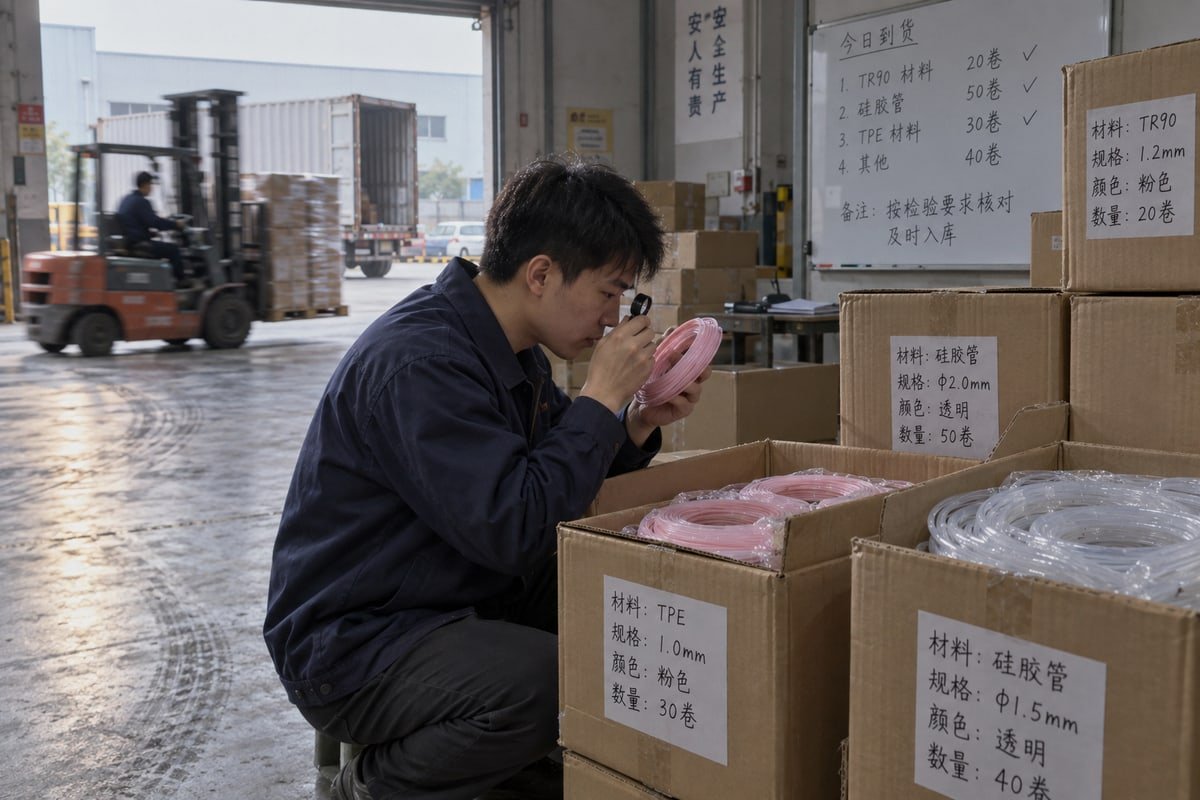
The pairing is not random. TR90 is a thermoplastic polyamide. TPEE is a thermoplastic polyester elastomer. Because both melt and flow in an قالب حقن جديد 3, they can be joined without glue. Rubber cannot do that. It has to be pressed or glued into a channel, and friction is all that holds it. Here is how we build a hybrid frame on our line.
The overmolding process, step by step
- We injection mold the TR90 front first. This piece carries the lens rims and the hinge points. Memory polymer technology in TR90 means the front springs back after being twisted.
- The TR90 part goes into a second mold. We inject an injection molding grade TPEE around the temple and bridge zones.
- The hot TPEE partially fuses with the TR90 surface. When it cools, the two materials form a permanent bond at the interface.
- QC checks the bond by flexing and pulling each sample. A friction-held rubber insert would start to lift at the edge. An overmolded part does not.
Why the front should be TR90 and not something softer
Some buyers ask why we do not just make the whole frame in TPEE for every age. The answer is structure. TR90 is lighter than traditional acetate, so it puts less pressure on a child's developing nasal bridge. It also has a high impact resistance rating 4 and holds lens shape well. That gives you shatterproof frame construction where it counts, around the lens. The TPEE then does the flexing work where a child twists and pulls. Each material does the job it is good at.
Age mapping we recommend to brands
| الفئة العمرية | Recommended build | لماذا |
|---|---|---|
| 0 to 3 years | Full TPEE soft frame | Chewing, dropping, and unpredictable folding need maximum softness |
| 3 to 5 years | Full TPEE or TR90 front with TPEE temples | Transition stage; depends on activity level |
| 5 to 12+ years | واجهة TR90 مع أذرع TPEE | Lighter, more structured, better lens retention for active play |
The translucent gradient fronts with matte TPEE temples that you see in our catalog follow exactly this logic. The glossy TR90 front holds the polarized lens and gives the fashion look. The matte TPEE temple gives the flex and the grip. Because we already have around 800 existing styles built this way, a new brand can pick a shape and skip the mold investment. That lets them test the market with lower risk before committing to a custom tool.
Can TPEE Really Withstand Daily Wear and Tear Better Than Silicone for Active Children?
One lesson our engineers learned early: a temple that survives one bend is not proof of anything. Kids repeat that bend hundreds of times. Fatigue resistance is what counts.
Yes. TPEE withstands daily wear better than silicone for active children because it has higher fatigue resistance and tensile strength. It bends 180 degrees repeatedly without cracking or losing shape, keeps lenses seated during impact, and stays elastic in freezing or hot weather where silicone-like materials lose grip.
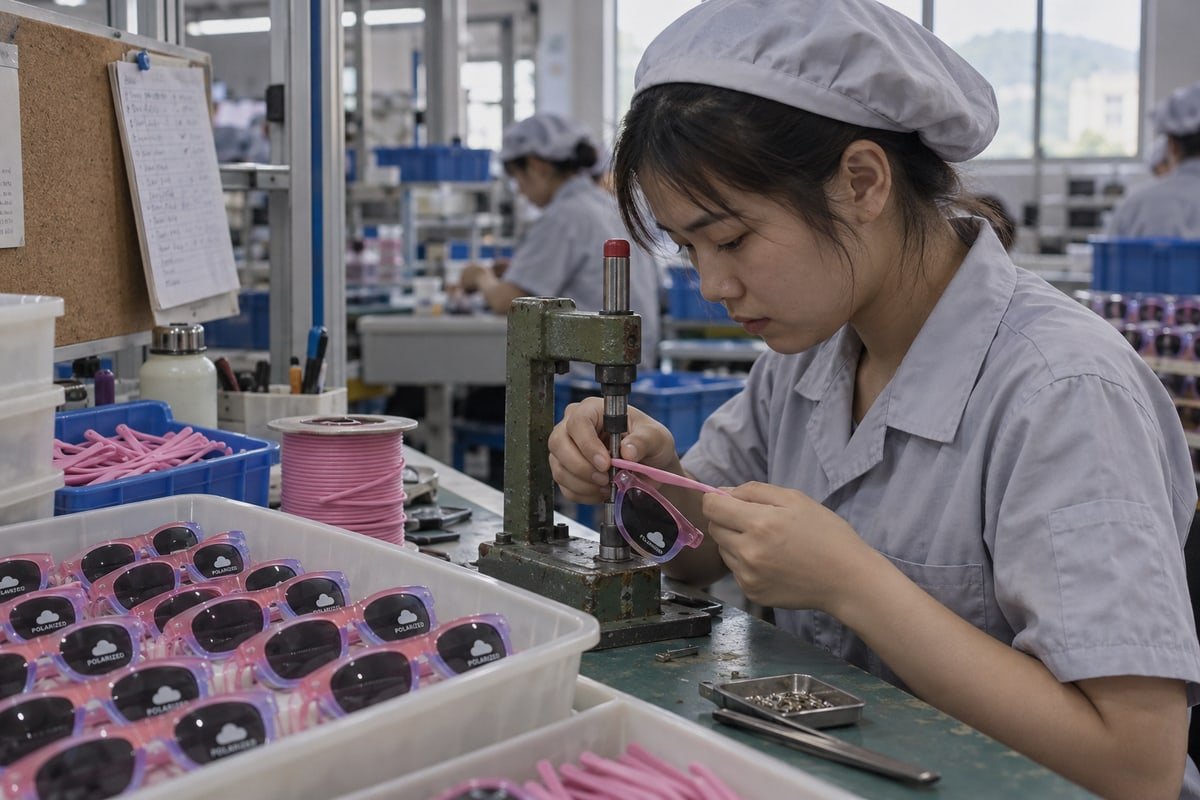
Active children do not treat sunglasses gently. They sit on them. They fold them backward. They pull them off by one temple. So the question is not whether a material is soft. The question is whether it recovers, again and again, without damage.
What frame flexibility testing looks like on our line
Our frame flexibility testing is simple and repetitive on purpose. We take temples from a production batch and fold them flat, then fold them the other way, and repeat. We also twist the front and check that the lens rims return to shape. With TPEE, the temple comes back to its original position and the surface shows no whitening or crazing. With true silicone, the material stretches and slowly loses its return. With cheap soft rubber, the surface starts to craze after repeated bending. This is what people mean when they say TPEE can be bent 180 degrees without cracking. It is the fatigue resistance, not just the flexibility, that makes the difference over a school year.
Lens retention is the hidden durability test
Durability is not only about the frame surviving. It is about the lens staying put. When a frame lands lens-first on concrete, the rim flexes. A rim made from a material that is too soft opens up and the lens pops out. That is a safety issue and a warranty issue. This is the main reason I steer brands toward TPEE, or TR90 with TPEE temples, for active children rather than silicone-type full frames. The tensile strength of TPEE 5 lets the rim flex and then grip the lens again. Paired with our UV400 or polarized lens options, the child keeps eye protection through the fall.
Daily abuse scenarios, compared
| Real-world scenario | TPEE | Silicone-type frame |
|---|---|---|
| Folded backward by a sibling | يعود إلى الشكل | May stay stretched |
| Chewed by a toddler | Resists tearing | Can tear at thin edges |
| Left on a hot dashboard | Keeps grip and shape | Can go limp and slip |
| Dropped lens-first on pavement | Lens stays seated | Lens may pop out |
| Twelve months of sweat and sunscreen | Surface unchanged | Can attract lint and degrade |
The infant exception, resolved
I should be fair to silicone here. For a baby who is not yet running, the very softest material is reasonable, and some brands prefer a silicone feel for that stage. The mistake is carrying that choice into the active years. Once a child is climbing and running, lens retention and shape recovery matter more than extra softness. That is the point where TPEE, and then TR90 with TPEE temples, becomes the practical choice.
الخلاصة
Soft-looking frames that crack, peel, or turn sticky cost brands trust. TPEE temples on TR90 fronts solve that. Our team can help you choose the right material by age.
Interested in sourcing the products mentioned in this article? See details and request a quote here:
ملاحظات ختامية
1. Defines the category of materials including TPEE used for flexible components in modern eyewear. ↩︎
2. FDA provides safety guidelines for materials used in children’s products that may be mouthed or chewed. ↩︎
3. NIST supports manufacturing innovation and provides technical resources for polymer processing and injection technologies. ↩︎
4. The FDA establishes impact resistance standards for eyewear to ensure safety during active use. ↩︎
5. Explains the physical property of tensile strength which allows eyewear materials to flex and recover. ↩︎
مقالات أخرى قد تعجبك



هل تبحث عن شريك موثوق به للنظارات للأطفال؟
استكشف أكثر من 800 نمط جاهز ودعم OEM/ODM كامل مصمم خصيصًا لعلامتك التجارية.
اتصل بنا English
  Español de México
  Deutsch
  Français
  日本語
日本語  العربية
  Português do Brasil