What Impact Resistance Standards Should Kids’ Sunglasses Meet?
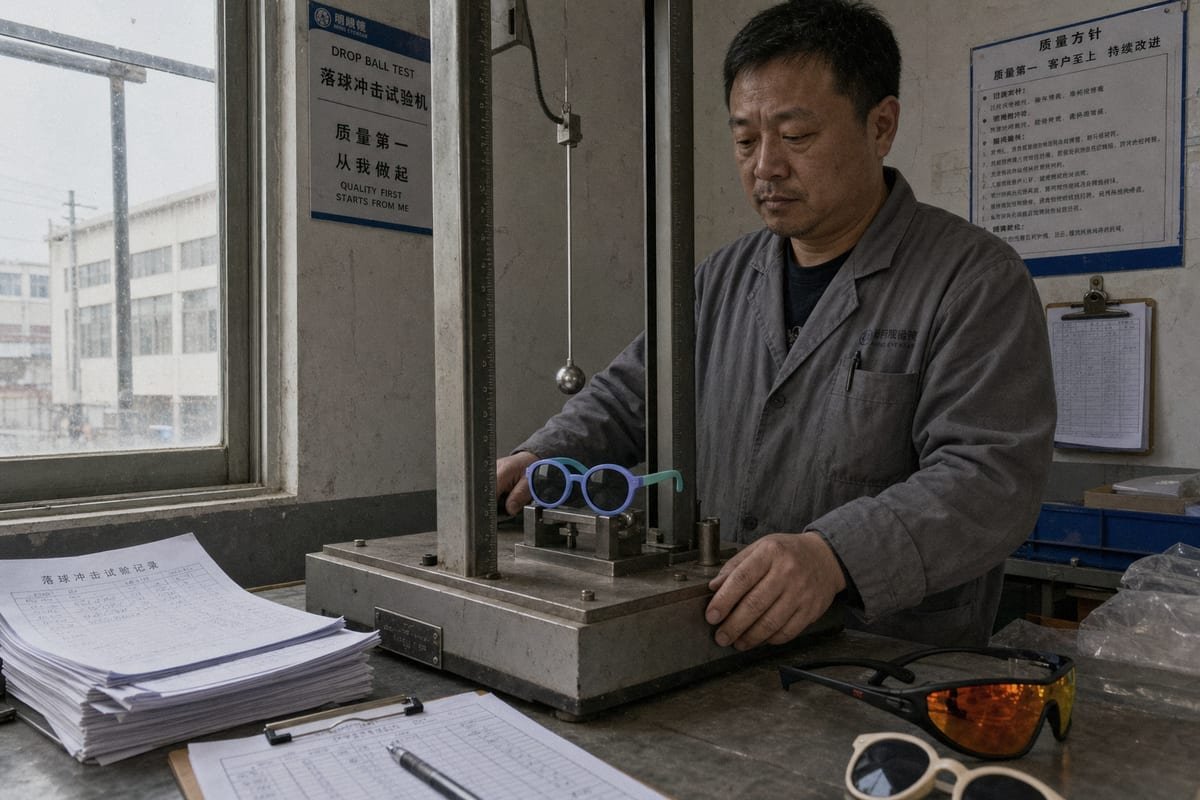
Impact resistance standards for kids’ sunglasses confuse many buyers I meet. One shattered lens can end a brand’s reputation. On our production line, we’ve seen exactly how to prevent that.
Kids’ sunglasses sold in the U.S. must pass the FDA drop ball test under 21 CFR 801.410 at minimum. Sports styles should meet ASTM F803 for high-velocity impact protection. European markets require ISO 12312-1 (CE marking), and ANSI Z80.3 covers non-prescription eyewear quality.
That short answer covers the legal floor. But the details matter when you are sourcing from a factory. Let me walk you through each standard, material, and verification step.
What safety certifications should I look for when sourcing kids' sunglasses from a manufacturer?
Last spring, a buyer from Australia asked me which certificates actually matter for children's sunglasses. Her previous supplier had sent her a stack of papers that meant almost nothing.
Look for FDA drop ball test compliance (21 CFR 801.410) for the U.S., ISO 12312-1 with CE marking for Europe, ANSI Z80.3 for optical quality, and ASTM F803 for sports styles. Also request UV400 protection reports and material safety documentation for children's products.
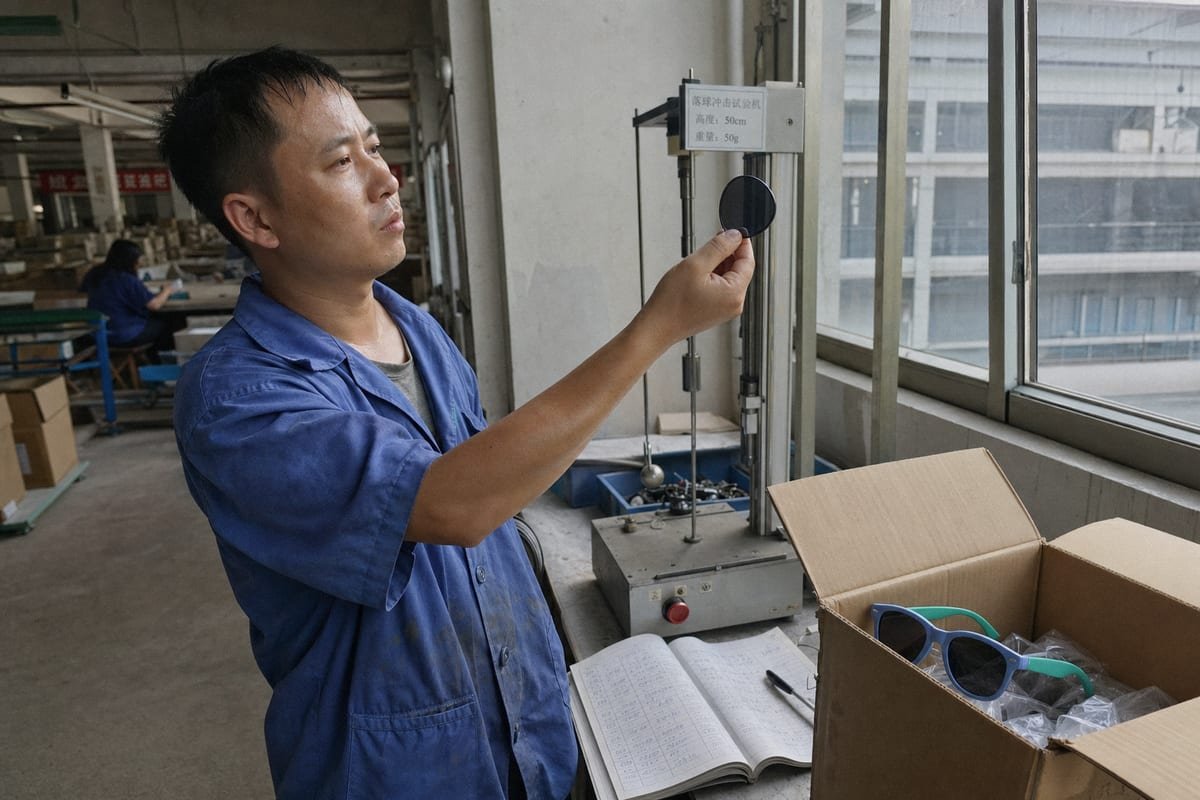
Certificates are not all equal. Some are legal requirements. Others are voluntary benchmarks. In our fifteen years of making children's eyewear, we've learned that buyers who understand this difference negotiate better and launch faster.
The core standards, side by side
Here is how the major standards compare for children's sunglasses:
| معيار | المنطقة | ما تغطيه | إلزامي؟ |
|---|---|---|---|
| إدارة الغذاء والدواء 21 CFR 801.410 1 | الولايات المتحدة | مقاومة عدسة الصدمات (اختبار الكرة الساقطة) | Yes, for U.S. sales |
| ISO 12312-1 2 | EU / International | UV filtering, impact, robustness (CE marking) | Yes, for EU sales |
| ANSI Z80.3 | الولايات المتحدة | Optical clarity and impact for non-prescription eyewear | Voluntary benchmark |
| ASTM F803 | الولايات المتحدة | High-velocity impact protection for sports eyewear | Voluntary, but expected for sports claims |
The FDA rule is the one most buyers know. Every sunglass lens sold in the U.S. must survive a steel ball dropped from a set height without fracturing. That is the baseline, not a premium feature.
ISO 12312-1 goes further for European markets. It covers UV transmission categories, lens robustness, and labeling. Your CE marking depends on it.
ANSI Z80.3 adds optical quality requirements. Distorted lenses can strain a child's developing vision, so we treat this standard seriously even though it is voluntary.
One more point. حماية UV400 3 and impact resistance are separate things. A lens can block UV perfectly and still shatter. When we run incoming lens inspections at our Taizhou workshop, we test both properties independently. Ask your supplier to do the same, and ask for the reports in writing.
How can I verify that a supplier's impact-resistant lenses actually meet international standards?
A trade-off we weigh every week is speed versus proof. Buyers want fast quotes, but real verification takes documents, samples, and sometimes third-party lab time. Skipping it is the expensive shortcut.
Verify compliance by requesting third-party lab reports from accredited labs, batch-specific test certificates, and a Declaration of Conformity for CE markets. Test random production samples yourself, confirm the drop ball test protocol was followed, and audit the factory's in-house testing equipment.
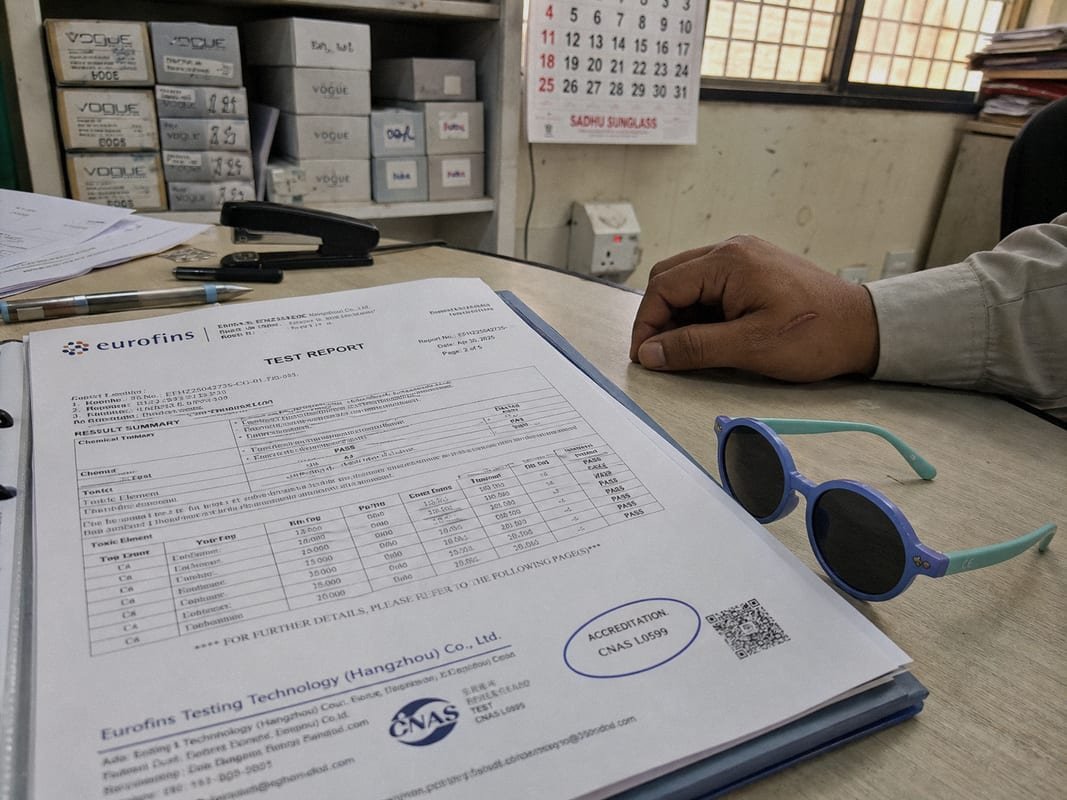
Paperwork can be faked. Real verification is a process, not a single document. Here is the sequence we recommend to every new B2B partner, based on what our most careful customers in Japan and Europe actually do.
عملية تحقق من خمس خطوات
- Request accredited third-party reports. Ask for reports from recognized labs, and check the report date, the exact product model, and the lab's accreditation number. A generic report for "sunglasses" is a red flag.
- Match reports to your actual product. The tested lens material, thickness, and coating must match your order specification. A report for a 2.0 mm polycarbonate lens does not cover a 1.0 mm acrylic lens.
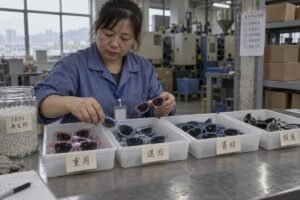
- Ask about in-house testing. A serious factory owns its own drop ball test rig and runs it on production batches, not just on golden samples. When buyers visit our workshop, we show them the test station and the batch logs.
- اسحب عينات عشوائية. Take units from a real shipment, not from a sample room, and send them to an independent lab. Even one round of blind testing keeps everyone honest.
- Get a Declaration of Conformity. For CE markets under ISO 12312-1, the importer needs this document. If a supplier hesitates to provide it, walk away.
What each document actually proves
| وثيقة | ما تثبته | ما لا تثبته |
|---|---|---|
| تقرير مختبر طرف ثالث | The tested sample passed on that date | That your production batch matches the sample |
| Batch test log | Ongoing in-house quality control | Independent verification |
| إعلان المطابقة 4 | The manufacturer claims CE compliance | Anything, if unsupported by test data |
| تقرير تدقيق المصنع | Real production capability and QC systems | Specific lens performance |
The pattern is clear. No single paper is enough. You need overlapping evidence, because shatterproof lenses are a claim you must be able to defend if a regulator or a parent ever challenges your brand.
Why do TR90 and TPEE materials matter for meeting children's sunglasses safety requirements?
Early in our factory's history, we tested a rigid acrylic kids' frame against our flexible TR90 version. The rigid frame snapped at the bridge. The TR90 frame bent flat and sprang back.
TR90 and TPEE are flexible frame materials that bend instead of snapping, which prevents sharp broken edges near a child's eyes. Combined with polycarbonate lenses, they help the whole product absorb impact energy, supporting compliance with FDA, ISO 12312-1, and sports-grade standards.
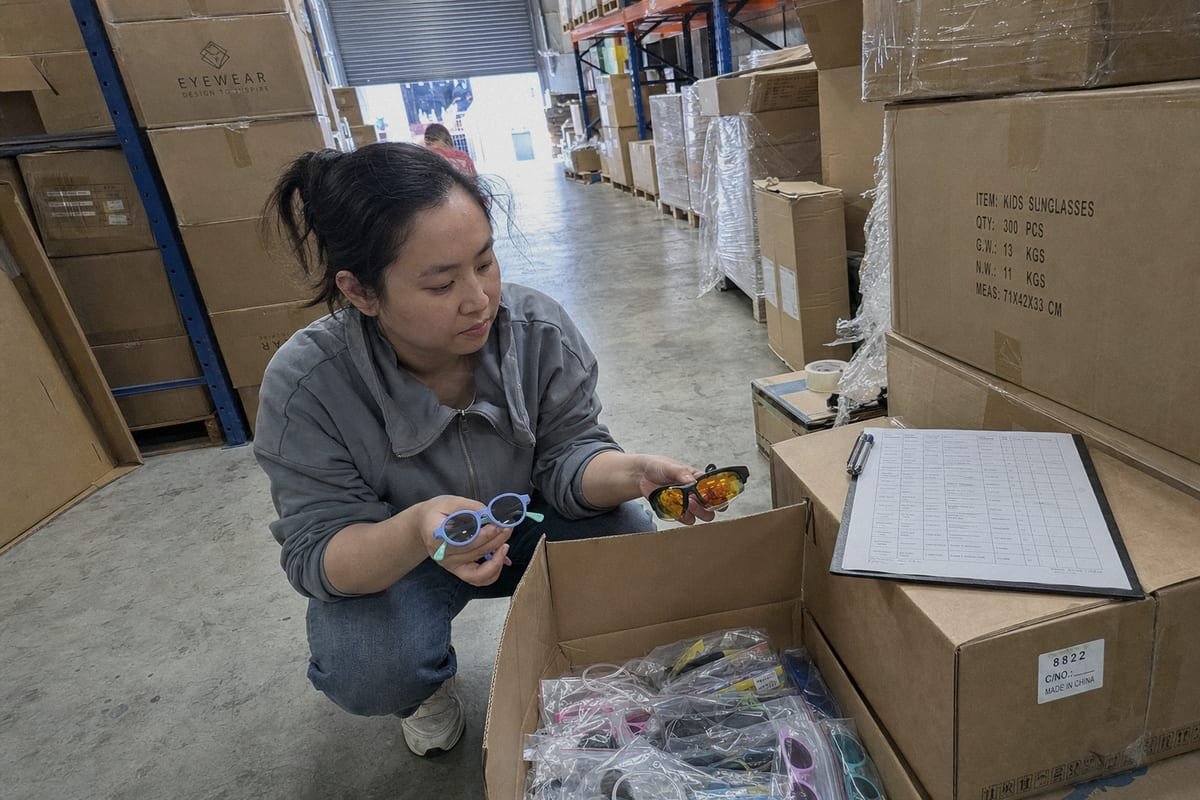
Impact standards focus mainly on lenses. But a frame that shatters creates its own hazard. Sharp plastic shards near a toddler's eye are exactly what safety regulations exist to prevent. That is why material choice matters as much as testing.
Why flexibility is a safety feature, not a comfort feature
TR90 is a thermoplastic with shape memory. It flexes under load and returns to its original alignment. TPEE goes even further. It is a soft, rubbery elastomer, which is why we use it for temples on many of our children's styles. A TR90 front with TPEE temples gives you a stiff optical zone plus soft arms that will not hurt a child who falls asleep wearing them.
Compare that with cheap rigid plastics. They pass a static test on day one. Then a child sits on them, twists them, or drops them on concrete. Micro-cracks form. The next impact finds those cracks, and the frame fails in a dangerous way. مواد إطار مرنة avoid this brittle-failure path almost entirely.
Matching frames to lenses
The lens deserves equal attention. عدسات البولي كربونات 5 are the industry default for children because of their outstanding impact absorption. مادة Trivex 6 is a strong alternative with excellent optics and low weight. Both far outperform standard plastic or glass.
| المكون | Recommended material | Why for kids |
|---|---|---|
| الجزء الأمامي من الإطار | TR90 | Flexible, lightweight, shape memory |
| المعابد | TPEE | Soft, rubbery, comfortable, nearly unbreakable |
| العدسات | Polycarbonate or Trivex | Shatterproof, lightweight, inherent UV blocking |
Our engineers have also found that hinge design matters. Small metal screws can loosen and become a secondary hazard, so screw-less or reinforced hinge constructions are worth discussing during development. Across the roughly 800 existing styles in our catalog, this frame-plus-lens material logic is the common thread, because environmentally friendly TPEE and TR90 let us build eyewear that is genuinely safe on a child's face, not just cheap.
What testing and quality control steps should I ask my factory partner to prove compliance?
A procurement manager from Europe once told me she judged factories by their QC checklists, not their showrooms. She was right. Our 5S-managed workshop was built around that same idea.
Ask your factory for incoming material inspection, batch drop ball testing, UV transmission checks, torsion and flex testing on frames, coating adhesion tests, and a documented final AQL inspection. For sports styles, request high-velocity impact testing aligned with ASTM F803 protocols.

Testing is not one event. It is a chain of checkpoints from raw material to sealed carton. If any link is missing, a compliant design can still ship as a non-compliant product. Here is the QC chain we recommend you write into your purchase agreement.
The QC chain, checkpoint by checkpoint
الفحص الوارد. Every batch of TR90 pellets, TPEE material, and lens blanks should be checked against specification before production starts. Material substitution is the most common hidden cause of failed impact tests.
فحوصات أثناء العملية. خلال قولبة بالحقن 7 and assembly, operators should verify frame dimensions, hinge torque, and lens fit. A lens that sits loosely in the rim can pop inward on impact, which defeats the purpose of a shatterproof lens.
اختبار العدسة. The FDA drop ball test should run on statistical samples from each lens batch. UV transmission testing confirms real UV400 protection, because tint depth tells you nothing about UV performance.
Frame durability testing. Flex the temples through repeated open-close cycles. Twist the frame front. Children treat sunglasses roughly, so the frame must survive abuse that adult eyewear never sees.
Coating checks. Anti-scratch coatings must adhere well and stay slightly elastic. An overly brittle coating can crack under impact and propagate fractures into the lens substrate, quietly weakening its impact resistance.
الفحص النهائي. A documented AQL inspection before packing should cover cosmetics, function, labeling, and packaging. Retail-ready presentation matters, but the safety checks must be recorded in the same report.
For sports-oriented designs, such as wraparound shield styles for cycling or ball sports, ask specifically about high-velocity impact protection testing consistent with ASTM F803. A fashion-grade pass is not enough once your marketing mentions sport use. We flag this to buyers during development, because the claim on your packaging determines the standard you must meet.
الخلاصة
Weak standards knowledge creates real risk for kids' brands. One recall can erase years of trust. The solution is clear: demand FDA, ISO 12312-1, and ASTM F803 compliance, insist on TR90, TPEE, and polycarbonate construction, and verify everything through documented, batch-level testing with a factory partner who treats child safety as the product itself.
ملاحظات ختامية
1. Official government source for the 21 CFR 801.410 impact resistance regulation. ↩︎
2. Official ISO standard page defining sunglasses requirements and CE marking criteria for eyewear. ↩︎
3. WHO background on ultraviolet radiation exposure explains why UV400 filtering protects children’s eyes. ↩︎
4. Official European Commission portal for CE marking and conformity assessment requirements. ↩︎
5. Wikipedia background on polycarbonate explains its impact resistance properties used in lenses. ↩︎
6. Wikipedia entry describing Trivex composition and optical performance as a lens alternative. ↩︎
7. Wikipedia background on injection molding process referenced during frame manufacturing checks. ↩︎
مقالات أخرى قد تعجبك


هل تبحث عن شريك موثوق به للنظارات للأطفال؟
استكشف أكثر من 800 نمط جاهز ودعم OEM/ODM كامل مصمم خصيصًا لعلامتك التجارية.
اتصل بنا English
  Español de México
  Deutsch
  Français
  日本語
日本語  العربية
  Português do Brasil