What Is the Drop-Resistance Test Standard for Kids’ Sunglasses?
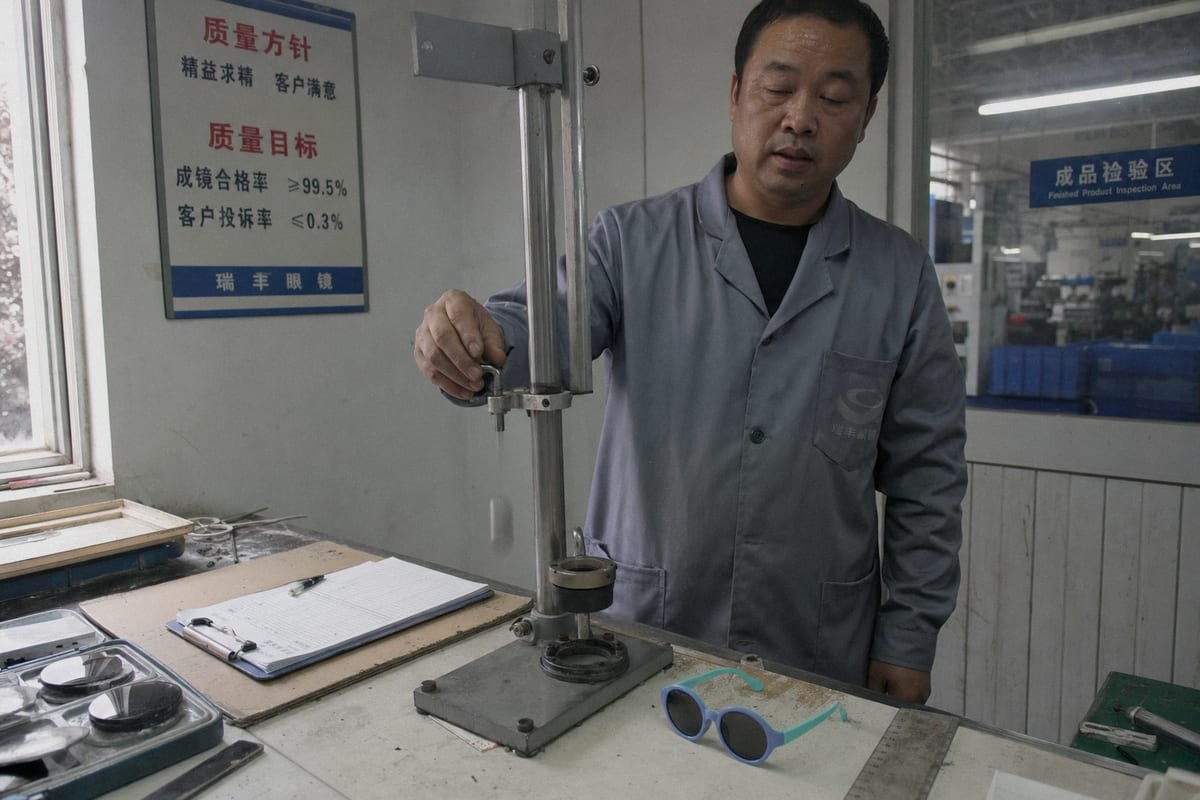
The drop-resistance test standard for kids’ sunglasses confuses many buyers, and I see it weekly on our production line — a wrong assumption here can sink an entire import shipment.
The core drop-resistance test standard for kids’ sunglasses in the U.S. is FDA 21 CFR 801.410, the drop-ball test. A 5/8-inch steel ball is dropped from 50 inches onto the lens center, and the lens must not fracture, chip, or shed material.
That is the short answer. But there is much more a buyer needs to know before placing an order. Let me walk you through the details, factory-side.
How do I know if a kids' sunglasses factory actually tests for drop resistance before shipment?
A few years back, a buyer from Australia visited our Taizhou workshop and asked to watch a live drop-ball test. That single request told me she understood the industry better than most.
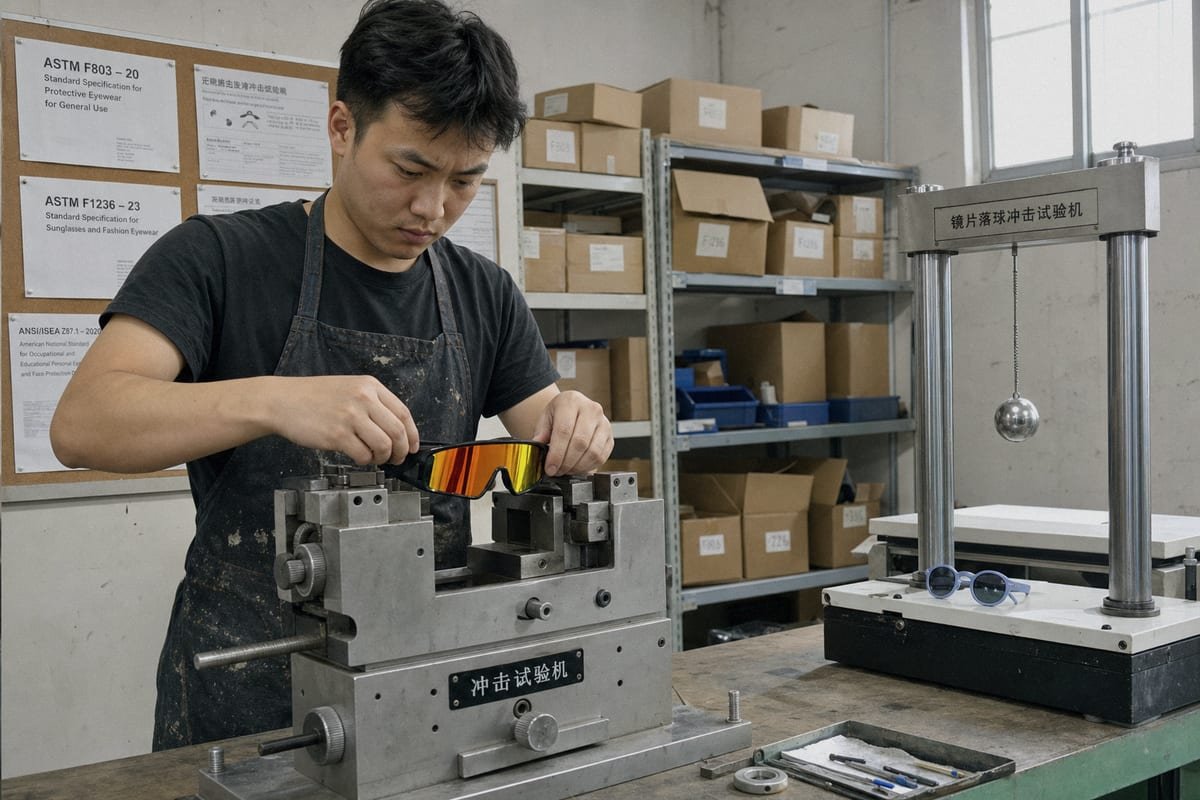
A credible factory performs the ball drop test procedure on statistically sampled lenses from each production batch, keeps written QC records with batch numbers, and can demonstrate the test live during an audit. If a supplier cannot show any of these, assume no testing happens.
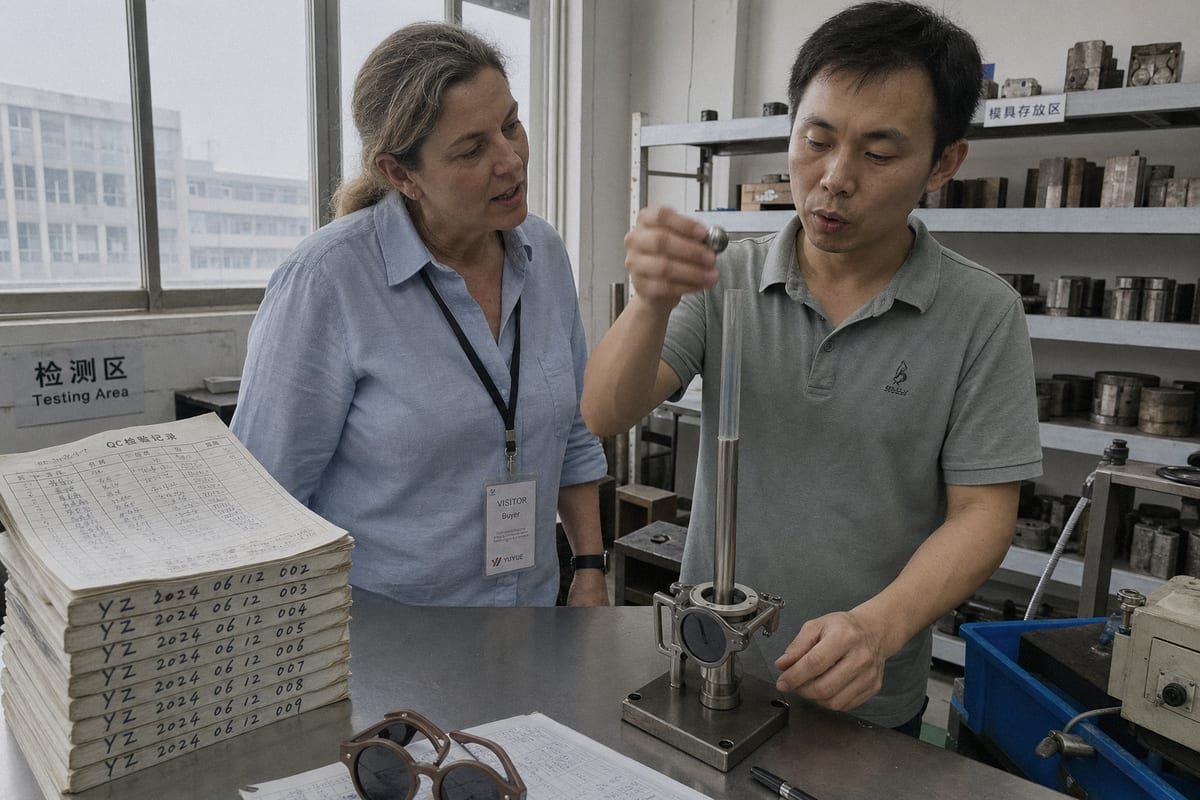
Verifying a factory's testing habits is easier than most buyers think. You just need to know what to look for. In our 15 years of eyewear experience, we have learned that testing culture shows up in small, checkable details — not in marketing claims.
Signs a factory really tests
First, ask to see the drop-ball test rig 1 itself. It is a simple device: a guide tube, a 5/8-inch steel ball weighing roughly 0.56 ounces, and a lens holder set 50 inches below the release point. A factory that tests daily will have this rig in the QC room, and it will show wear. A factory that bought it for show will have a dusty unit in a corner.
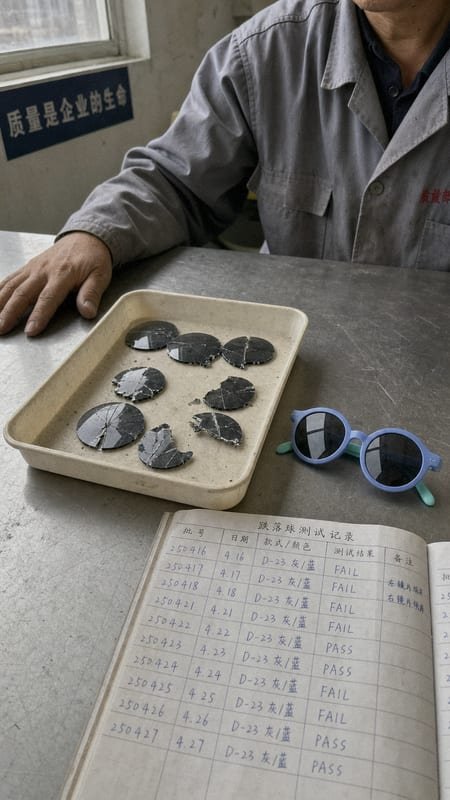
Second, ask for batch-level records. Impact resistant lens testing only means something when it is tied to your specific order. Our QC team logs the batch number, sample size, test date, and pass/fail result for every shipment. Random spot claims like "we always test" are not records.
Third, check the sampling logic. The FDA guidance expects a statistically significant sampling plan 2, such as ANSI/ASQC Z1.4 3 or ISO 2859-1. A supplier who says "we tested one pair" does not understand the requirement.
| Verification Step | ماذا تطلب | علامة حمراء |
|---|---|---|
| Test equipment | Photo or video of the drop-ball rig in use | No rig on site |
| Batch records | QC logs tied to your PO number | Generic "pass" claims |
| Sampling plan | ANSI/ASQC Z1.4 or ISO 2859-1 reference | One-piece testing |
| Live demonstration | A test performed during audit or video call | Refusal or delay |
| Destroyed samples | Fractured rejects from failed tests | "We never fail" answers |
Finally, remember that destructive testing consumes product. A factory that tests properly budgets sacrificial lenses into every run. When we quote an order, those test pieces are already built into our costing. If a supplier's price leaves no room for destroyed samples, testing is probably not happening.
What drop-resistance standards should I ask my supplier to certify against?
When we onboard a new brand client, the first thing our sales engineers map out is the destination market — because the certification checklist changes completely between the U.S., Europe, and Japan.
Ask your supplier to certify against FDA 21 CFR 801.410 for the U.S., ANSI Z80.3 impact standards for broader sunglass compliance, ISO 12312-1 requirements for Europe, and ASTM F803 standards only if the product is marketed as sports-protective eyewear.
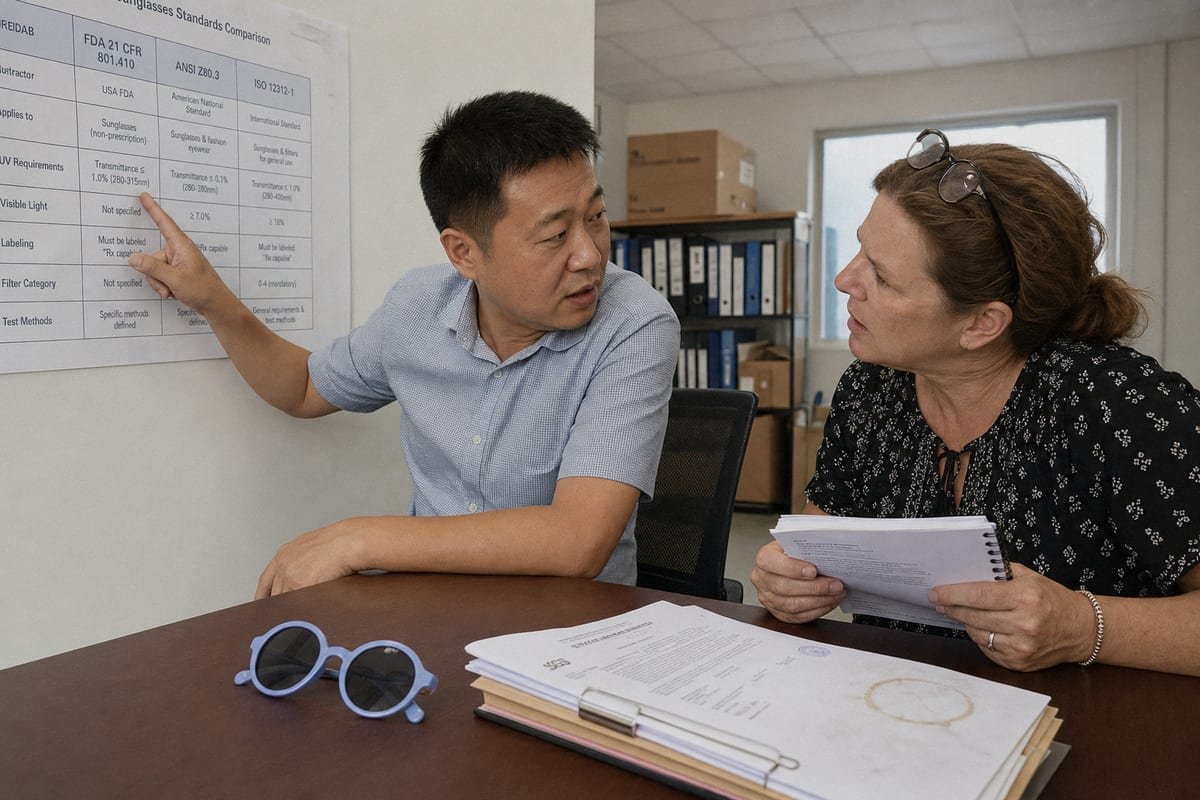
Here is the quick comparison every procurement manager should keep on file:
| معيار | Region / Scope | What It Tests | إلزامي؟ |
|---|---|---|---|
| هيئة الغذاء والدواء 21 CFR 801.410 | U.S., all sunglass lenses | Lens impact via drop-ball (referee) test | Yes, federal law |
| ANSI Z80.3 | U.S., nonprescription sunglasses | Impact plus UV transmittance and frame flammability | Voluntary industry standard |
| ISO 12312-1 | EU and many global markets | Optical quality, UV filtering, robustness | Required for CE marking |
| ASTM F803 | Sports eye protection | Full frame-and-lens assembly vs. high-velocity impacts | Only if sold as sports protective |
| ANSI Z87.1 | Occupational safety eyewear | High-mass and high-velocity impact | Not for casual kids' sunglasses |
Understand what each standard actually covers
The FDA rule is the legal floor for the American market. It applies to the lens, not the whole frame, and it uses the referee test — the 50-inch drop of a 5/8-inch steel ball — as the benchmark the FDA itself would apply. Importantly, children's sunglasses intended to protect eyes from bright sunlight fall squarely under this rule. Even promotional toy-style sunglasses given away at events need compliant lenses if they claim sun protection.
ANSI Z80.3 goes further. It aligns with the FDA impact requirement but layers on UV protection criteria 4 and frame flammability. Buyers should note that UV400 labeling and impact resistance are separate issues; a lens can block UV perfectly and still shatter. This is a gap we explain to nearly every new client, because parents conflate the two constantly.
ISO 12312-1 governs the European market and takes a different approach, focusing on optical lens integrity 5, filter categories, and robustness. A product compliant in the U.S. is not automatically compliant in the EU. When our clients sell into 20+ countries, we build a compliance matrix per SKU so nothing slips through.
One warning from experience: do not let a supplier hand you an ANSI Z87.1 certificate 6 for kids' fashion sunglasses. That is an occupational standard with different test methods. It sounds impressive, but it is the wrong document for your product category and will not satisfy a customs review that expects 21 CFR 801.410 documentation.
Can TPEE and TR90 materials really survive impact and drop tests better than standard plastic frames?
There is a trade-off we weigh on every new mold: stiffness gives a frame its crisp shape, but flexibility is what saves it when a toddler throws it across a playground.
Yes. TR90 and TPEE absorb and disperse impact energy through elastic deformation, so frames bend instead of cracking. Standard rigid plastics like acetate or cheap PC blends concentrate stress at hinges and rims, making them far more likely to snap in drop and flex testing.
Let me be precise here, because material claims get exaggerated in this industry. Frame durability testing and lens impact testing are two different things. The FDA drop-ball rule covers the lens. Frame resilience is what determines whether the whole product survives real-world abuse — drops onto concrete, twisting in a backpack, a child sitting on them.
Why flexible polymers behave differently under impact
TR90 هو thermoplastic nylon 7 with high elastic memory. When a dropped frame hits the ground, the material flexes, absorbs the shock, and springs back. TPEE goes even further on softness and flexibility, which is why we often pair TR90 fronts with TPEE temples on our children's styles — the front keeps the lenses stable, while the temples bend safely against a child's head. Our pastel round frames for toddlers use exactly this soft-touch, rubberized feel that parents notice immediately when they handle a sample.
Standard rigid plastic works differently. Impact energy has nowhere to go, so it travels to the weakest point — usually the hinge screw area or the thin rim around the lens — and initiates a crack. Two other factors matter:
- Coating brittleness. Hard-coatings and mirror finishes, like the orange-to-gold gradient lenses on our sport shield styles, can slightly reduce impact resistance by creating a brittle surface layer where cracks start. Good lens suppliers balance coating hardness against toughness, which is why coated lenses must still be batch-tested.
- Environmental aging. Heat and UV exposure slowly embrittle polymer chains. A frame that passes a drop test fresh from the mold can fail after months in a hot car. Flexible polymers with good stabilizer packages age far more gracefully than commodity plastics.
For the lenses themselves, shatterproof عدسات بولي كربونات 8 remain the sensible pairing for children's eyewear. Polycarbonate passes the drop-ball test at thinner profiles than glass or CR-39, keeping the finished sunglasses light on small noses. But remember: material choice never replaces compliance testing. We still test every batch, because a great material processed badly can still fail.
What documentation should I request to prove my kids' sunglasses meet safety and durability requirements?
A procurement manager in Japan once taught me a lesson: she rejected a competitor's shipment not because the product failed, but because the paperwork could not prove it had passed. Documentation is the product, in her world.
Request a certificate of impact resistance referencing 21 CFR 801.410 with your batch numbers, the sampling plan used, third-party lab reports for UV400 and applicable ISO or ANSI standards, plus material safety declarations and a children's product safety file where required.
FDA guidance is explicit on one point that many importers miss: shipments should be accompanied by a certificate showing the lenses were sampled and found impact-resistant using a statistically significant method. Without that paper trail, even genuinely compliant sunglasses become a customs liability. In our export experience across 20+ countries, we prepare a document pack per order, and I recommend every buyer demand the same discipline.
قائمة التحقق الأساسية للمستندات
| وثيقة | ما يثبته | من يصدرها. |
|---|---|---|
| Impact resistance certificate | Lenses passed drop-ball testing per 21 CFR 801.410 | Manufacturer, per batch |
| Sampling plan reference | Testing followed ANSI/ASQC Z1.4 or ISO 2859-1 | Manufacturer QC department |
| تقرير مختبر طرف ثالث | Independent verification of impact and UV performance | Accredited lab (e.g., SGS-type facilities) |
| UV400 / transmittance report | Lens actually blocks claimed UV range | مختبر معتمد |
| إعلانات المواد | Frames free of restricted substances for children's eyewear safety regulations | Manufacturer plus lab data |
| ISO 12312-1 test report | EU market conformity for CE marking | مختبر معتمد |
How to read the paperwork critically
Do not just file these documents — check them. The batch number on the impact certificate must match your commercial invoice and carton markings. The lab report date should be recent and tied to your actual production run, not a two-year-old sample. The sampling standard should be named, not implied.
Also ask how failures are handled. A mature factory has a written rework and re-test procedure. When one of our lens batches showed a marginal result during incoming inspection, we quarantined the entire lot and re-sourced before molding a single frame. That decision cost us a week; shipping it would have cost the client their brand reputation. That is the difference between a low-price supplier and a long-term manufacturing partner.
Finally, if you sell into multiple markets, keep one compliance file per SKU per region. It sounds tedious. It is also the cheapest insurance you will ever buy.
الخلاصة
Weak testing and missing paperwork can destroy a kids’ eyewear launch overnight. The fix is simple: verified drop-ball testing, the right standards per market, flexible materials, and complete batch documentation.
At our Taizhou factory, we build that discipline into every one of our ~800 styles — from TPEE-temple toddler frames to mirrored sport shields — so your brand ships with confidence, not hope. If you want a partner who treats the drop-resistance test standard for kids’ sunglasses as a starting line rather than a hurdle, reach out. We are happy to show you the test rig first.
ملاحظات ختامية
1. Official FDA regulation detailing the impact resistance test requirements for sunglasses lenses and the drop-ball method. ↩︎
2. International standard for sampling schemes used in lot-by-lot inspection by attributes for quality management and compliance. ↩︎
3. Wikipedia article explaining the acceptance sampling system defined by the ANSI/ASQ Z1.4 standard. ↩︎
4. Wikipedia entry explaining global standards for sunglasses, including UV protection and impact resistance categories. ↩︎
5. Official ISO page for the international standard governing sunglasses and related eyewear for general use. ↩︎
6. Official FAQ from the International Safety Equipment Association regarding the Z87.1 eye and face protection standard. ↩︎
7. Authoritative Wikipedia entry for Nylon, the thermoplastic material family used in eyewear frames. ↩︎
8. Scientific overview of polycarbonate, highlighting its high impact resistance and suitability for safety and children’s eyewear. ↩︎
مقالات أخرى قد تعجبك

هل تبحث عن شريك موثوق به للنظارات للأطفال؟
استكشف أكثر من 800 نمط جاهز ودعم OEM/ODM كامل مصمم خصيصًا لعلامتك التجارية.
اتصل بنا English
  Español de México
  Deutsch
  Français
  日本語
日本語  العربية
  Português do Brasil