What Are Common Return Reasons for TPEE Kids Sunglasses & How to Avoid Them?
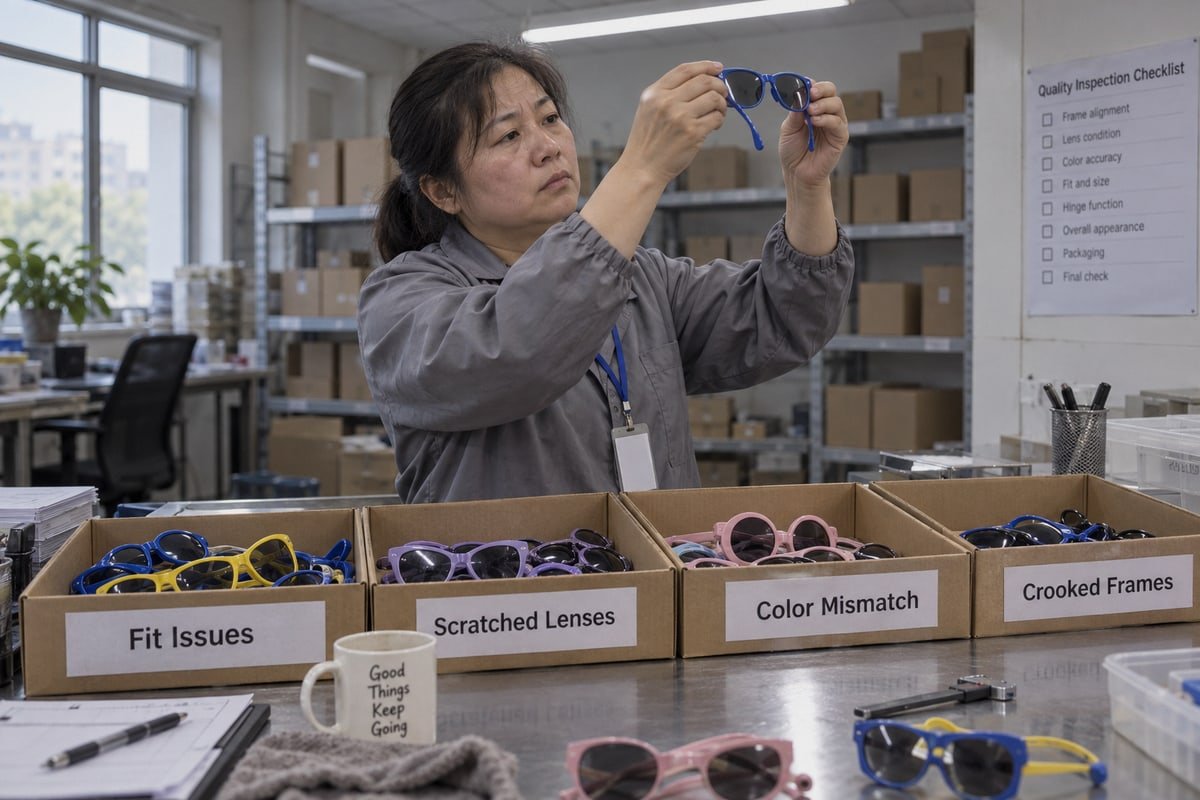
Common return reasons for TPEE kids sunglasses 1 surprise buyers who expect a bendable frame to solve everything. Each return eats margin. Our production line traces most to four fixable causes.
Common return reasons for TPEE kids sunglasses are fit and sizing mismatch, lens quality complaints such as scratching or unclear polarization, color or logo mismatch, and quality-control defects like crooked frames. Avoid them with millimeter sizing charts, clear UV400 labeling, approved color samples, and inspected shipments.
Below I break each cause into a checklist you can use with any supplier. I will start with fit, because it drives more returns than breakage in this category.
A procurement manager in Australia once told me her best-selling style from our line had the highest return rate. The frames never broke. They simply slid off toddlers' noses.
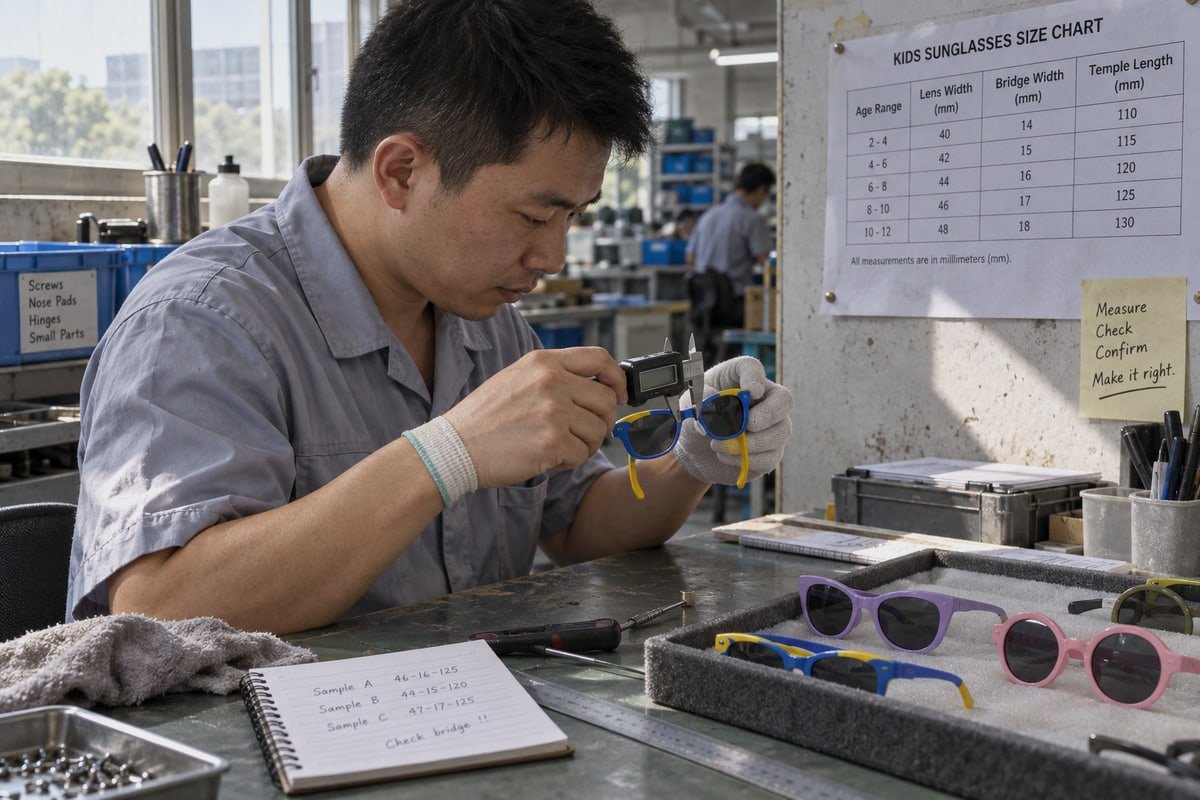
Select frame sizes by measuring lens width, bridge width, and temple length in millimeters, then match them to narrow age bands such as 1–4, 4–10, and 10+. Treat age ranges as guidance only, offer at least two sizes, and add an adjustable silicone strap for active toddlers.
Which common return reasons for TPEE kids sunglasses trace back to fit?
Fit sits at the top of the list. A TPEE temple can bend almost flat and spring back, but bending does nothing for a bridge that is too wide. The child pushes the frame up, it slides down again, and the parent files a return. Too tight is just as bad. Pressure at the temples and the nose leads to a child who simply refuses to wear the glasses.
Here is a fair objection we hear from buyers: "Returns are the parent's fault. They bought online without trying anything on." That is partly true. It is also the reality of ecommerce, so the listing has to do the trying-on for them. Major retailers offer 30-day returns on kids' sunglasses, and flexible-frame specialists often advertise 60-day exchanges for sizing. Those policies exist because fit uncertainty is normal in this category. Our job is to shrink it.
Build a toddler sizing guide on measurements, not age
"Ages 3–10" covers a huge spread of head sizes. Retail listings that perform well split kids into narrower bands, such as 1–4, 4–10, and 10+. Even better, they give millimeters. Our spec sheets list five numbers for every one of our roughly 800 existing styles.
| قياس | ما يتحكم فيه | Return risk when wrong |
|---|---|---|
| عرض العدسة | Coverage and how large the frame looks | "Looks bigger or smaller than the photo" |
| عرض جسر الأنف | Whether the frame rests on the nose or slides | Slipping, red marks on the nose |
| Lens height | Sun coverage below the brow | Glare complaints, toy-like look |
| طول الذراع الجانبي | Grip behind the ear | Sliding during play, pressure headaches |
| Total width | Match to head width | Pinching at the temples |
Keep the frame secure over time
Two design details protect fit after the first month. First, we use a high-density TPEE formulation with strong shape memory, so temples return to their original position after a child stretches them. A floppy frame feels safe in the hand but loosens on the face. Second, we recommend packing an adjustable silicone strap with toddler styles. It solves the sliding problem for the most active children, especially at the beach or in hot weather when sweat reduces grip. Tell parents how to measure a child's face, or how to compare a known pair that fits. That one line in a listing prevents many exchanges.
What defects should I inspect for when I receive my shipment?
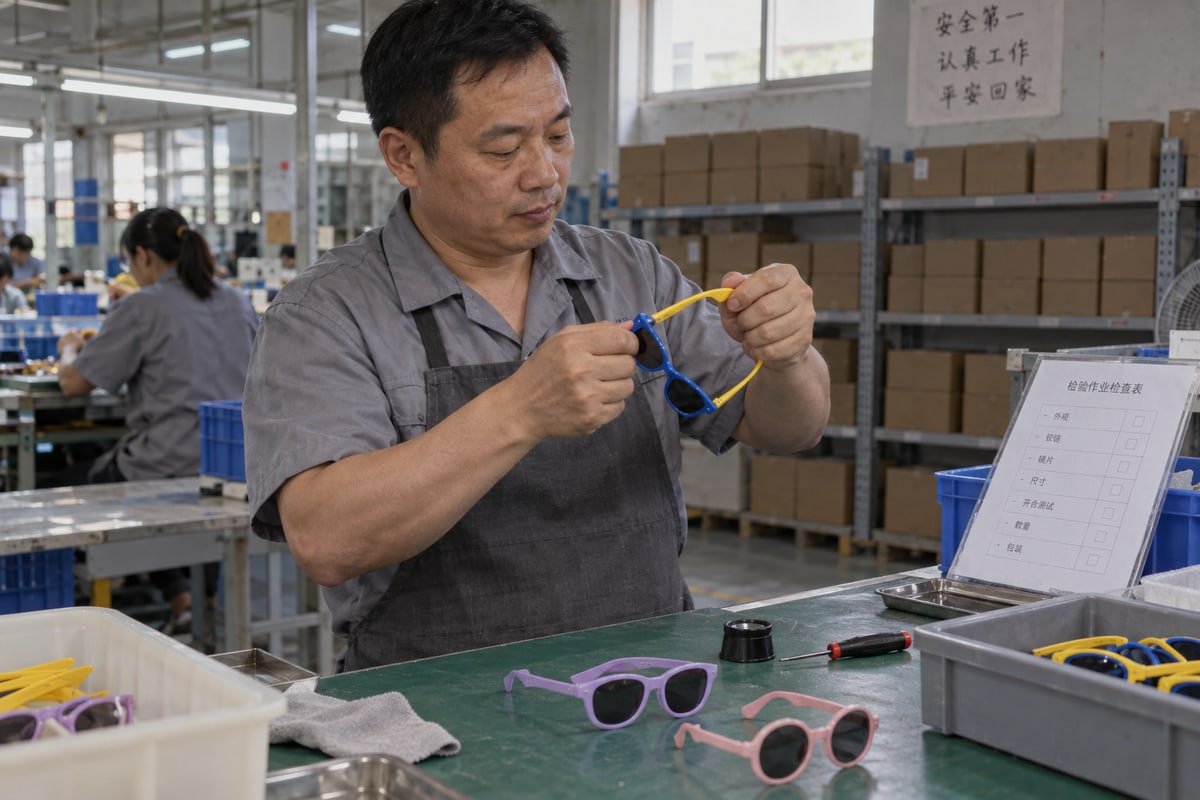
Every carton that leaves our 5S-managed workshop gets a random pull for inspection. Even so, we tell buyers to check the shipment on arrival. Transit can undo good work.
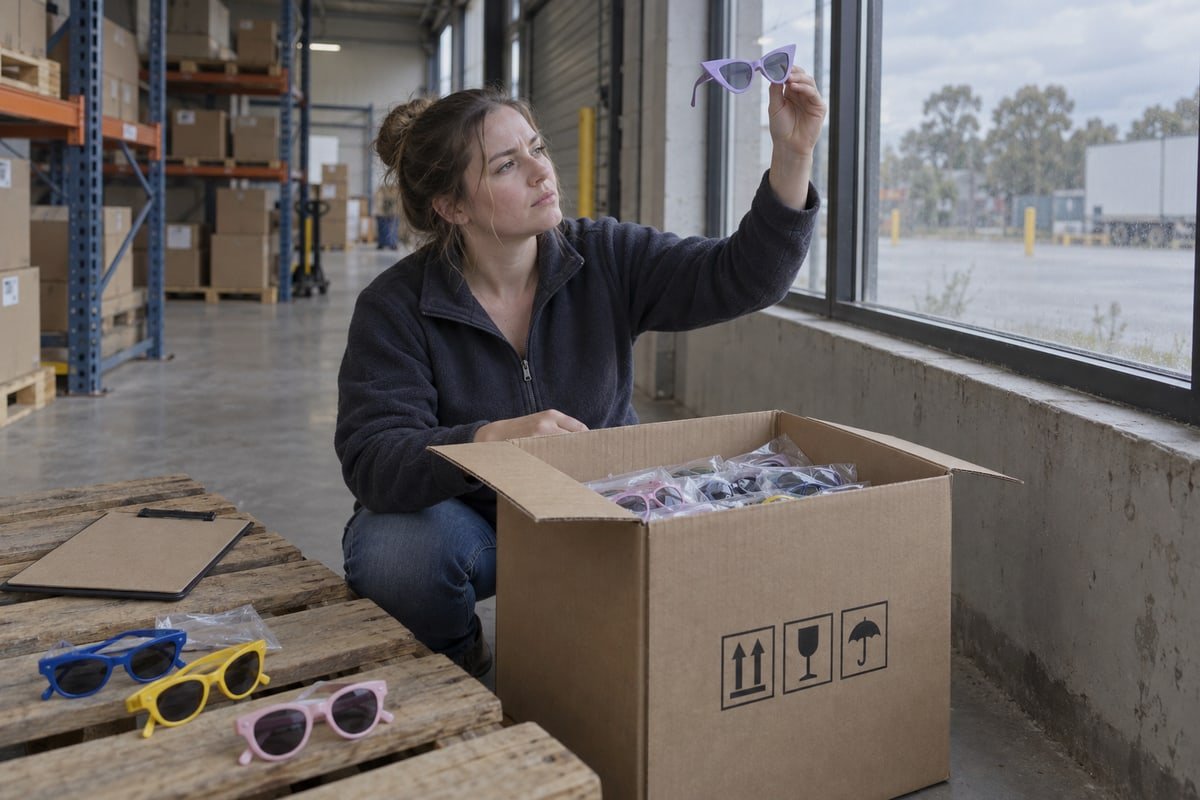
Inspect incoming TPEE kids sunglasses for crooked or warped frames, uneven lens alignment, loose lens seating at the frame junction, loose hinge screws, rough flash lines, chemical odor, missing accessories, and poor finish. Check a random sample from several cartons, because multi-pack budget items show weaker consistency across units.
A five-step arrival inspection
Flexible frame durability is real. TPEE deforms instead of breaking, and that is a genuine advantage over rigid plastic. But the same flexibility stresses the lens seat over time, and it does nothing for a crooked hinge or a rough mold line. "Unbreakable" marketing can set expectations that no frame meets. So we ask buyers to run a simple check before the goods reach a warehouse shelf.
- Pull units from at least three different cartons, not just the top box.
- Lay each frame on a flat table. Both temples and both lens rims should touch the surface evenly. A rocking frame is warped.
- Bend each temple outward and release it. It should spring back to position. Repeat five times and confirm the lens has not lifted from its seat.
- Look through each lens toward a window edge. The line should stay straight.
- Open the polybag and smell the frame. Medical-grade, food-safe TPEE has no sharp chemical odor. A strong smell often signals a cheaper elastomer, undermines the hypoallergenic properties parents expect, and triggers returns from health-conscious buyers.
Common defects and what they mean
| عيب | How to detect it | السبب المحتمل | إجراء |
|---|---|---|---|
| Crooked frame | Flat-table test | Cooling stress or rough packing | Reject unit, flag batch |
| Uneven lens alignment | Compare lens height left vs right | Poor lens insertion | Re-seat or reject |
| Loose lens at frame junction | Bend test | Undersized lens groove | Reject, report to factory |
| برغي مفصلة فضفاض | Open and close temple | Missed torque check | Tighten, note frequency |
| Flash or rough edges | Run a finger along rims | Worn mold | مرفوض |
| Missing case or cloth | Count accessories | Packing error | Claim shortage |
One more note on the lens seat. A popped-out lens is not a broken product on a flexible frame. It can usually be pressed back in. Many parents do not know this and return the pair. A short how-to video or a card in the box showing how to pop the lens back saves a return and a one-star review. We can include that card as part of retail-ready packaging.
Multi-pack budget items deserve extra sampling. Consistency across units drops when a supplier chases the lowest price, and defect complaints cluster there. Our workshop runs in-line checks at molding, lens insertion, and final packing, but we still welcome a buyer's own inspection. Two sets of eyes catch more of the common return reasons for TPEE kids sunglasses before a parent ever does.
How do I ensure my custom colors and logos are produced correctly?
Matching a Pantone reference on soft TPEE means weighing gloss against color depth. We now lock this decision at the sample stage, before any bulk resin is mixed.
Ensure custom colors and logos are produced correctly by approving a physical pre-production sample, referencing a Pantone code rather than a screen image, confirming logo method and placement in a signed spec sheet, and photographing approved samples in natural sunlight for listing images that match the delivered product.
Color: why the sample must be physical
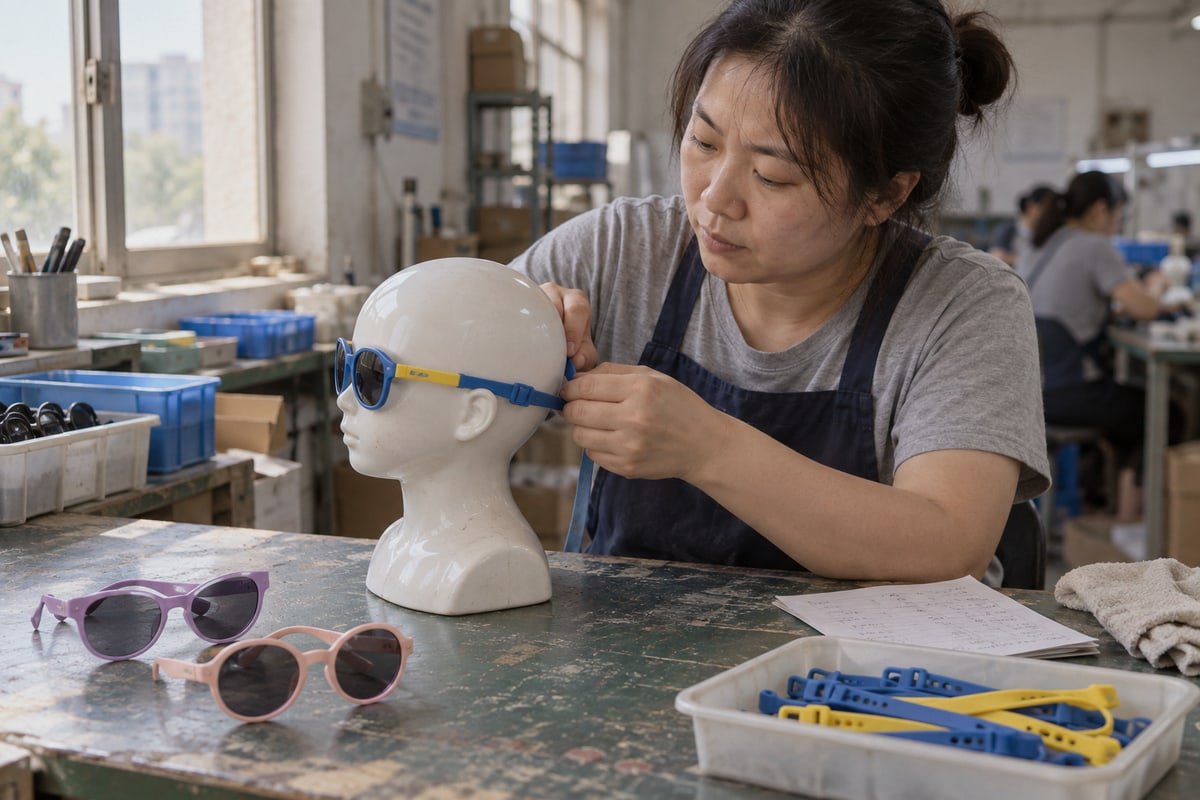
Screens lie. A royal blue front with bright yellow temples looks one way on a monitor and another under sunlight. Translucent pastels are trickier still. A blush-pink round frame changes tone depending on the smoke lens behind it, and a lavender cat-eye shifts with the gloss level. So we mix a small batch of resin, mold a real sample, and ship it. The buyer approves the physical sample. Only then do we mix bulk material.
Matte or glossy is a real trade-off. Gloss makes colors look deeper and more premium, but it shows fingerprints and light scratches. Matte hides marks and feels softer, but it can make the same Pantone look a shade lighter. We show both finishes on the same style so the decision is informed, not guessed.
Logo methods that survive a flexible frame
Logos on TPEE face a challenge that hard plastic does not. The surface stretches. A print that works on TR90 can crack on a TPEE temple after a few hundred bends. The table below sums up the options we run.
| الطريقة | Best position | Durability on flexing TPEE | ملاحظات |
|---|---|---|---|
| Pad print | Outer temple, front corner | Good with proper curing | Most economical, needs an adhesion test |
| طباعة حريرية | Temple tips, cases | جيد | Best for multi-color marks |
| نقش بالليزر | Inner temple | ممتازة | Same method used for CE and size marking |
| Molded-in logo | Temple or front | ممتازة | Requires a mold change, longer lead time |
| Metal plaque | Front corner or temple | Good if bonded well | Premium look, check for edges near skin |
Lock everything in a spec sheet
Every custom order carries one signed spec sheet. It lists the رمز بانتون 2, finish, logo file, method, size, exact position in millimeters, lens spec, and packaging. We photograph the approved sample and attach it. Bulk production is checked against that photo and that sheet. When the buyer then shoots listing images in natural sunlight from the same approved sample, the parent sees the product they will actually receive. That single habit removes most "not as expected" returns.
New brands can start with any of our roughly 800 existing styles and change only colors, logos, and packaging. There is no mold investment, and the market test carries much lower risk. Once a color-blocked style or a pastel cat-eye proves itself, a molded-in logo can follow in the next order.
What lens quality issues should I check for before selling?
One lesson from our fifteen years of eyewear work: a lens complaint rarely says "lens" in the return note. It says "cheap", "not dark enough", or "not polarized".
Before selling, check that lenses carry verified UV400 protection, sit flat without peripheral distortion when the frame bends, show the Category 3 tint stated on the listing, resist scratching in a simple cloth test, and either pass a polarization screen test or are clearly labeled as non-polarized.
Polarized or not: settle the confusion before the sale
Polarization disputes are a recurring return reason. Some parents assume all dark lenses are polarized. Others buy a polarized pair and expect a dramatic change that a child never notices. Both end in a refund. Compare the two honestly on the listing.
| الميزة | Non-polarized UV400 lens | Polarized TAC lens |
|---|---|---|
| حماية UV400 | Yes, if the lens is rated | Yes, if the lens is rated |
| Glare reduction on water and roads | لا | نعم |
| Screen test (rotate against an LCD) | No darkening | Darkens at a quarter turn |
| Typical use case | Daily wear, playground | Beach, boating, car passengers |
| التكلفة | أقل | أعلى |
Run the screen test on samples. Hold the lens in front of a phone screen and rotate it. Polarized TAC lenses go dark at about a quarter turn. If they do not, the listing must say non-polarized. Clear labels beat refunds.
UV400, Category 3, and the safety questions
Lens complaints are among the most common return reasons for TPEE kids sunglasses because parents mix up darkness and protection. UV400 protection and lens tint are separate things. A pale lens can block UV fully, and a dark lens can block nothing. Ask for the UV transmission report. Then confirm the tint category. A Category 3 sun filter is the standard for bright daylight and is what most parents expect from a "dark" kids' lens. If a listing shows a Category 3 tint 3 and the delivered lens is lighter, expect "not dark enough" returns.
Certifications belong on the product page and the packaging, not buried in a PDF. Our frames carry the علامة CE 4 engraved on the inner temple, and UV400 is printed on the lens sticker. Parents increasingly ask about plastics too. We work with BPA-free material, and buyers can request third-party lab reports covering BPA, phthalates, and lead to answer safety anxiety before it becomes a return.
Optics, scratches, and care
Flexible frames bring one optical problem that rigid frames avoid. When a TPEE frame bends, a standard lens tilts and can cause peripheral distortion. Some children get headaches or dizziness. Decentered lens technology corrects the للمركز البصري 5 so the view stays straight even when the frame flexes. Ask whether your lenses are decentered.
Lenses still scratch. The frame is unbreakable; the lens is not scratch-proof. Impact resistance and shatterproof lens technology protect the eye, but a sandy pocket ruins the coating in a day. Add care tips to the packaging: no hot cars, no abrasive cloths, no twisting the frame for fun. The lens deserves the same care as any adult pair.
الخلاصة
Returns erode a kids' eyewear launch. Unbreakable frames alone will not stop them. Fit, inspection, approved samples, and honest lens claims will, and we build all four into every order.
Interested in sourcing the products mentioned in this article? See details and request a quote here:
ملاحظات ختامية
1. Technical overview of thermoplastic elastomers including TPEE properties. ↩︎
2. Authoritative Wikipedia entry for the Pantone Matching System, ensuring long-term link stability. ↩︎
3. Official ISO standard for sunglasses and related eyewear protection. ↩︎
4. Official European Commission requirements for CE marking on consumer products. ↩︎
5. Scientific definition and engineering context of the optical center in lenses. ↩︎
مقالات أخرى قد تعجبك

هل تبحث عن شريك موثوق به للنظارات للأطفال؟
استكشف أكثر من 800 نمط جاهز ودعم OEM/ODM كامل مصمم خصيصًا لعلامتك التجارية.
اتصل بنا English
  Español de México
  Deutsch
  Français
  日本語
日本語  العربية
  Português do Brasil