How to Verify Bio-Based or Recycled Material Claims in Kids’ Optical Frames?

Bio-based or recycled material claims in kids’ optical frames are everywhere now, and honestly, some of the “eco” language I see from other suppliers makes our team in Taizhou wince. A vague green label can sink a brand’s reputation overnight. When we develop TR90 and TPEE frames for children’s brands, buyers increasingly ask us one hard question: can you prove it? The good news is that proof exists — if you know exactly which documents, tests, and questions to demand.
To verify bio-based or recycled material claims in kids’ optical frames, request third-party certificates like GRS or ISCC Plus, chain-of-custody records, and technical datasheets stating the exact percentage and component covered. For bio-based content, demand an ASTM D6866 radiocarbon test report rather than a self-declaration.
That is the short answer. Below, I will walk you through each part of the verification process, step by step, the same way I explain it to buyers who visit our factory.
What documents or certificates should I request to prove bio-based or recycled content claims?
A procurement manager from Australia once emailed me a competitor's "100% eco frame" flyer and asked if it was real. I asked her one question back: where is the certificate number? Silence. That exchange taught me how few buyers know what paperwork to request, so let me lay it out clearly.
Request the certificate itself with its number and scope, a recent ASTM D6866 test report for bio-based claims, a Global Recycled Standard (GRS) or RCS transaction certificate for recycled claims, the material's technical datasheet, and a signed supplier declaration naming the component and exact percentage covered.

Documents are the foundation of any credible claim. But not all documents carry the same weight. In our fifteen years of eyewear production, we have seen the full range — from serious third-party audits to a one-line email that says "material is green." So you need an evidence hierarchy in your head before you start collecting paper.
The evidence hierarchy, from strongest to weakest
Independent certification sits at the top. A GRS certificate 1 verifies both recycled input and chain of custody. ISCC Plus certification 2 does similar work for bio-based feedstock, often under mass-balance rules. Lab test reports come next. Then come manufacturer datasheets and supplier declarations. At the bottom sits marketing copy, which proves nothing on its own.
| وثيقة | ما تثبته | Strength |
|---|---|---|
| GRS / RCS certificate | Verified recycled plastic content plus chain of custody | Very strong |
| ISCC Plus certificate | Bio-based or circular feedstock with traceability rules | Very strong |
| ASTM D6866 test report | Actual bio-based carbon percentage in the material | Very strong |
| Technical datasheet | Resin type, percentage, mechanical properties | معتدل |
| ISO 14021 self-declaration 3 | Supplier's own stated claim, structured but unaudited | Weak to moderate |
| Marketing brochure | Nothing verifiable | Weak |
One buyer objection I hear often: "Isn't a self-declaration under ISO 14021 good enough?" It can be legitimate, and the CSE technical framework for eyewear does accept it as one evidence route. But it is unaudited. If your brand faces a regulator or a journalist, a self-declaration alone leaves you exposed. Pair it with a test report or a certificate whenever the claim matters commercially. Also check the certificate scope carefully. A GRS certificate covering a resin supplier's pellets does not automatically cover the finished frame from a different factory. The paperwork must connect, link by link, to the actual product model you are buying.
How can I verify a supplier's sustainability claims are accurate and not just greenwashing?
There is a trade-off we weigh constantly in our workshop: honest, specific claims are less flashy than bold green slogans, but they survive scrutiny. When we tell a European kids' brand "this TPEE temple uses X% bio-based content, verified by test report," it sounds modest next to a rival's "planet-friendly frames." Modest wins audits.
Cross-check every claim against independent evidence: confirm the certificate number with the issuing body, verify the certification covers the exact factory and product, request supply chain traceability records, and reject any claim that lacks a stated percentage, a named component, and a defined material.

Greenwashing in children's eyewear 4 rarely involves outright lies. More often it involves technically true statements framed to mislead. A frame might contain recycled material only in the temple tips, yet the listing says "made with recycled plastic." Or a brand uses mass-balance accounting 5 — allocating recycled input across total production volume — while the buyer assumes every physical frame contains that share. Neither is fraud. Both can mislead a parent.
A five-step verification routine
- Pin down the exact claim wording. Is it bio-based, recycled, partly recycled, or "bio-based acetate"? Each term means something different, and vague hybrids like "eco-material" mean nothing.
- Check the percentage basis. Ask whether the figure is by total frame weight, by component weight, or by mass-balance allocation. The CSE eyewear framework calculates content by component weight relative to the front and temples combined — which means a frame-front claim may not apply to the temples at all.
- Verify the certificate independently. Most certification bodies maintain public databases. Look up the number. Confirm it is current, and confirm the scope names the right site and material.
- Trace the supply chain. Ask for transaction certificates linking the resin lot to the production batch. Genuine supply chain traceability leaves a paper trail; greenwashing does not.
- Watch the language. "Recyclable" is not "recycled." "Bio-based" is not "biodegradable." "Natural," "green," and "circular" without numbers are decoration, not data.
Some buyers push back: "Mass balance is accepted by ISCC Plus, so isn't it fine?" It is an accepted system, yes. But you must disclose it accurately. If your marketing implies physical recycled content in every frame while your evidence only supports an allocation, you have created greenwashing risk even with valid certificates behind you. We advise our brand customers to state the accounting method plainly. Emerging tools like Digital Product Passports will eventually make this transparency automatic, but until then, the burden sits with you and your paperwork.
What testing methods confirm the actual bio-based or recycled percentage in TR90 or TPEE frames?
Early in my career at our factory, I assumed a resin supplier's datasheet was the final word. Then a customer's third-party lab retested a batch and found the numbers did not match the sales pitch. Lesson learned: for TR90 and TPEE, the material itself can be interrogated, and serious buyers do exactly that.
ASTM D6866 radiocarbon testing measures the actual bio-based carbon percentage in TR90 or TPEE by detecting renewable versus fossil carbon. Recycled content cannot be measured by a single lab test, so it is verified through GRS-style chain-of-custody documentation combined with batch-level production records.
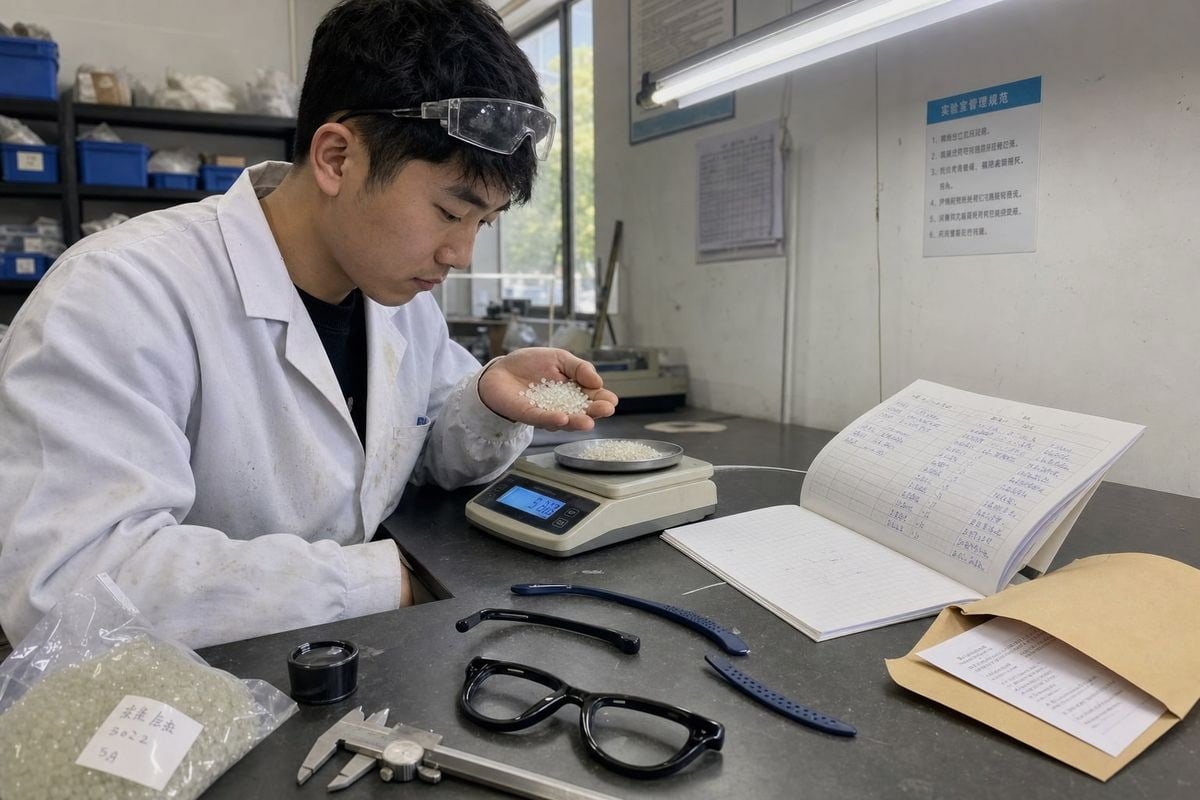
This distinction confuses many buyers, so let me break it down. Bio-based content is physically detectable. Renewable feedstock contains carbon-14; fossil feedstock does not. ASTM D6866 radiocarbon analysis 6 exploits that difference and reports a defensible bio-based percentage. UL uses exactly this test for its biobased content validation, and it asks for a recent report — an old test on a reformulated resin proves nothing about today's production.
Recycled content is different. A recycled polyamide molecule looks chemically identical to a virgin one. No instrument can tell them apart in the finished frame. That is why recycled plastic content verification depends on documentation: certified inputs, transaction certificates, and production records showing what went into which batch. Third-party verification here means auditing paper and process, not running a spectrometer.
What each test can and cannot tell you
| الطريقة | Applies to | What it confirms | Limitation |
|---|---|---|---|
| ASTM D6866 radiocarbon | Bio-based TR90, TPEE, bio-based acetate | Actual renewable carbon percentage | Says nothing about recycled content or biodegradability |
| FTIR / material identification | Any polymer | The resin family matches the datasheet | Cannot distinguish recycled from virgin resin |
| Chain-of-custody audit (GRS/RCS) | Recycled content | Certified recycled input and batch traceability | Depends on record quality, not physical measurement |
| Migration and heavy-metal testing | Finished kids' frames | Compliance with kids' eyewear safety standards like EN 71 or CPSIA | A safety test, not a content test |
Notice the last row. For children's products, content verification and safety verification must run in parallel. A frame can be genuinely bio-based and still fail restricted-substance limits. When we run new bio-based acetate or TPEE colorways, we test for both — including checks on plant-based plasticizers, since substituting one plasticizer for another changes the chemistry a child's skin touches every day. Also remember that bio-based does not mean biodegradable. If a supplier claims real biodegradation, ask under which conditions — industrial composting is not a backyard, and unverified biodegradability claims can hide microplastic risk rather than solve it.
Which questions should I ask my manufacturer before trusting their eco-friendly material claims?
Buyers who visit us in Taizhou sometimes apologize before asking tough questions about our materials. I always tell them the opposite: interrogate us. A factory that flinches at a certificate request is telling you something important, and after supplying kids' brands in more than twenty countries, we have learned that the best partnerships start with hard questions.
Ask for the exact material name and grade, the claimed percentage and its calculation basis, which frame components the claim covers, the certificate numbers and issuing bodies, a recent test report, chain-of-custody proof, and confirmation of compliance with kids' eyewear safety standards.

A structured question list does two jobs. It gets you the evidence, and it reveals how your manufacturer thinks. Confident factories answer with documents. Evasive ones answer with adjectives. Here is the checklist I recommend, based on the questions our most professional customers ask us.
The pre-order question checklist
| سؤال | لماذا هو مهم | A good answer looks like |
|---|---|---|
| What exact resin and grade is used? | "Eco TR90" is not a material name | A named grade with a technical datasheet |
| What percentage is bio-based or recycled, and how is it calculated? | Percentages can hide behind mass balance or component math | A number, a basis (weight or allocation), and honesty about method |
| Which components does the claim cover? | Fronts, temples, tips, and nose pads often differ | Component-by-component breakdown |
| Can you share certificate numbers for GRS, RCS, or ISCC Plus? | Environmental product certifications must be verifiable | Numbers you can check in public databases |
| Is there a recent ASTM D6866 report for bio-based claims? | Self-declared bio-content is weak evidence | A dated lab report matching the current formulation |
| Does the frame meet children's safety regulations? | Kids have unique exposure risks | Test reports for EN 71, CPSIA, and restricted substances |
| How do you handle traceability from resin lot to shipment? | Claims collapse without batch records | Documented lot tracking through production |
| What is the frame's expected lifespan and repairability? | Durability is a sustainability metric too | Hinge, flex, and drop-test evidence |
That last question deserves emphasis. A full life cycle assessment view often shows that durability beats material novelty. A flexible TPEE temple that survives two years of playground abuse can have a smaller real footprint than a fragile "green" frame replaced twice. When we design TR90 fronts with TPEE temples, flexibility and longevity are the point — the material story only adds value if the frame itself lasts. And one final nuance worth raising with any supplier: bio-based feedstock reduces fossil input, but it does not automatically guarantee a lower total environmental impact. Production energy, processing chemistry, and product lifespan all count. A manufacturer who acknowledges that nuance is one you can probably trust with your brand.
الخلاصة
Unverified eco claims put children's brands at real risk. Demand percentages, named components, valid certificates, and test reports — because credible sustainability is proven with documents, never with adjectives.
ملاحظات ختامية
1. Official information on the Global Recycled Standard, its scope, and requirements. ↩︎
2. Official details about ISCC Plus certification for bio-based and circular materials. ↩︎
3. Replaced with a comprehensive and current explanation of ISO 14021 self-declared environmental claims from an accessible source. ↩︎
4. Provides guidelines from the FTC to prevent misleading environmental marketing claims. ↩︎
5. Original URL is now working and is the authoritative source for mass-balance accounting explained by ISCC. ↩︎
6. Official standard for determining bio-based carbon content via radiocarbon analysis. ↩︎
مقالات أخرى قد تعجبك
أغسطس 5, 2026
Bio-Based vs Regular Cellulose Acetate: What's the Difference for Kids' Frames?
أغسطس 5, 2026
How Recyclable Are Kids' Optical Frame Materials, and What Eco-Friendly Alternatives Exist?
أغسطس 5, 2026
Do Kids Optical Frames Whiten or Age in Storage, and How to Control Warehouse Conditions?
هل تبحث عن شريك موثوق به للنظارات للأطفال؟
استكشف أكثر من 800 نمط جاهز ودعم OEM/ODM كامل مصمم خصيصًا لعلامتك التجارية.
اتصل بنا English
  Español de México
  Deutsch
  Français
  日本語
日本語  العربية
  Português do Brasil