How Do TR90 Kids Sunglasses Size & Structure Differ by Age?
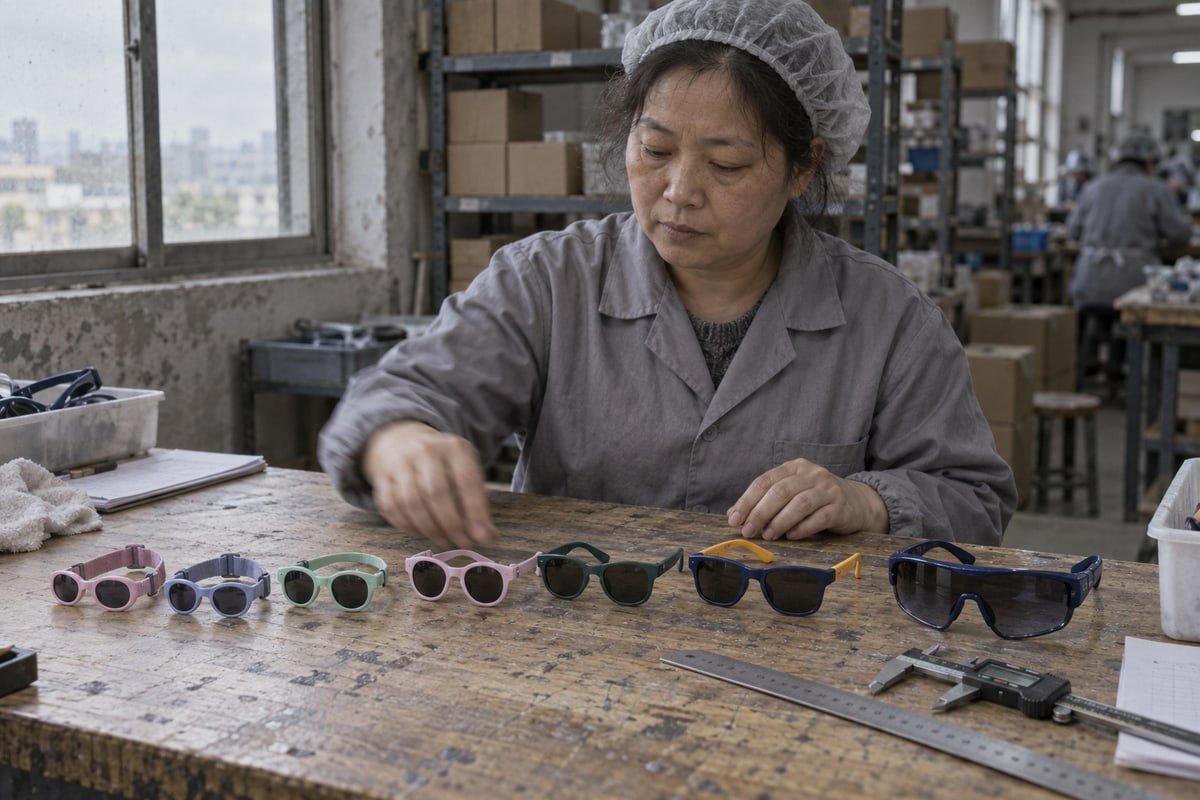
TR90 kids sunglasses size and structure shift sharply from toddler to pre-teen. Buyers who order one size face returns and lost sales. Our Taizhou line solved this with graded sizing.
TR90 kids sunglasses grow from about 36–40 mm lens width and 10–12 mm bridges for babies to 52–56 mm lenses, 16–18 mm bridges, and 130–140 mm temples for ages 10–12. Structure shifts from strap-based, flat-bridge frames to keyhole bridges, longer temples, and adult-lite styling.
Age is a useful shortcut. It is not the final answer. Below, I break down the numbers, the structural changes, the collection plan, and the flexibility engineering behind each size bracket.
What size differences should I expect when I'm sourcing TR90 sunglasses for toddlers versus older children?
A procurement manager from Australia once asked us why her ages 3–8 order returned so often. We pulled the frames and measured them against our size chart.
Expect toddler TR90 sunglasses at 40–44 mm lens width, 12–14 mm bridge width, and 105–115 mm temples, while older children move to 48–56 mm lenses, 15–18 mm bridges, and 125–140 mm temples. Head circumference, not age, should decide the final size.
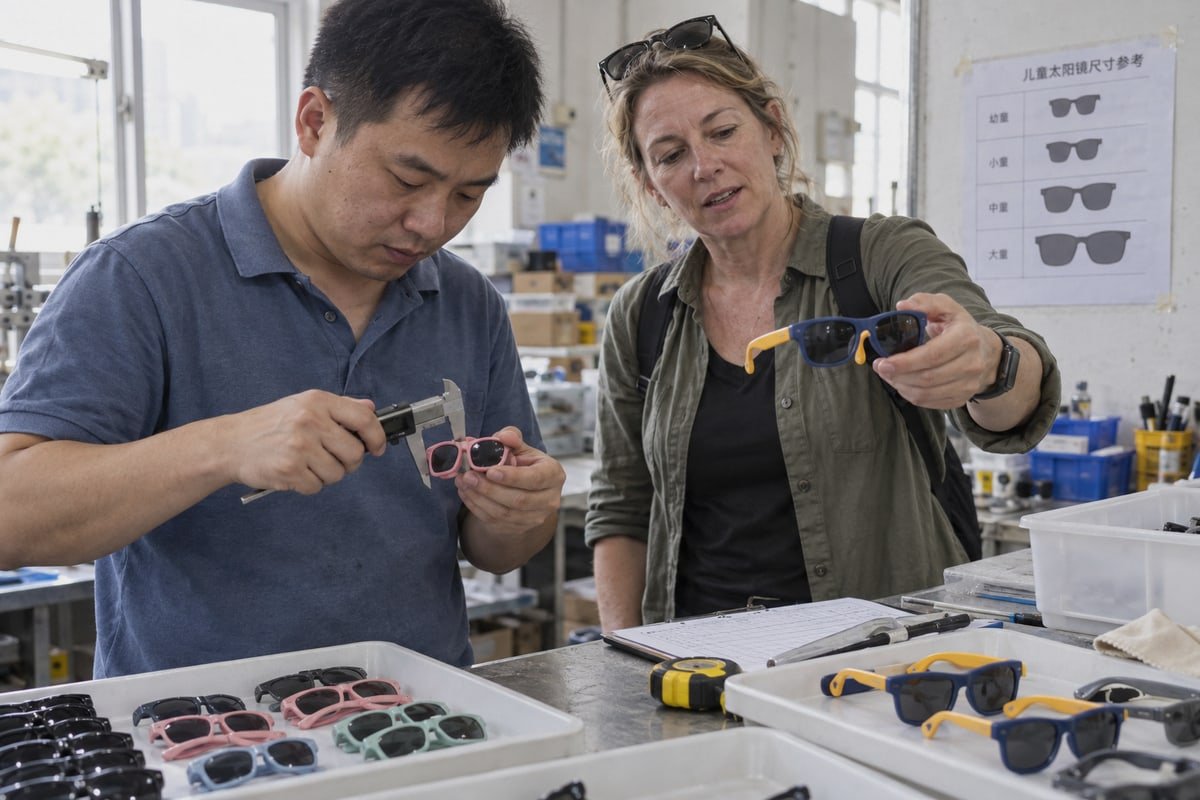
Her problem was simple. One frame cannot cover a five-year span in a child's face. A three-year-old and an eight-year-old differ by roughly 8 mm in lens width and 20 mm in temple arm length. That gap shows up as frames sliding off small faces or pinching larger ones.
The measurements that matter
I ask every buyer to read three numbers before they look at color. Lens width sets the front width. Bridge width sets where the frame sits on the nose. Temple arm length decides whether the frame reaches the ear without pressure. Here is the chart we use on our production line when we scale a style down or up.
| الفئة العمرية | عرض العدسة | عرض جسر الأنف | طول الذراع الجانبي | Typical material |
|---|---|---|---|---|
| Baby 0–2 | 36–40 mm | 10–12 mm | Strap (100–110 mm if temples) | سيليكون بدرجة غذائية |
| Toddler 2–4 | 40-44 ملم | 12–14 mm | 105-115 ملم | Silicone / TPE / TPEE |
| Kids 4–7 | 44-48 ملم | 14–16 ملم | 115-125 مم | TPEE / TR90 |
| Junior 7–10 | 48-52 ملم | 15–17 ملم | 125-135 مم | TR90 / PC |
| Youth 10–12 | 52–56 mm | 16–18 ملم | 130-140 ملم | TR90 / acetate |
Sport styles run larger. One youth sport frame for ages 8–16 measures 64 mm lens width, 17 mm bridge, 135 mm frame width, and 120 mm temples. The wider front and shorter temple work together for a wraparound grip. So a sport frame and a casual frame with the same age label can feel very different on the child.
Why age labels alone fail
Some suppliers organize sizes strictly by age. Others, including us, push buyers to use محيط الرأس 1 as the primary check. Editorial reviews back this up. They note that fit varies widely even among products with the same stated age range. Their advice is to measure the head, or size up when the child sits near the top of a range.
| Head circumference | Approximate age | Suggested bracket |
|---|---|---|
| Under 48 cm | 0–3 | Baby / Toddler |
| 48–52 cm | 3–6 | أطفال |
| 52–55 cm | 6–9 | ناشئ |
| Above 55 cm | 9–12 | Youth |
My recommendation to buyers is to print both age and محيط الرأس on the packaging. Parents then have a real number to check. Returns drop, and the brand looks more careful than competitors who print only a broad age range.
How does frame structure need to adapt for younger children's comfort and safety?
During a drop-and-flex check on a toddler batch last season, one bridge design kept sliding on our fit dummies. That test changed how we think about structure.
Younger children need flat or saddle bridges, shorter temple arms, wider lens coverage, strap-compatible retention, and 0-degree pantoscopic tilt. As faces lengthen, frames move to keyhole bridges, 5–10 degree tilt, standard temples, and slimmer profiles, while TR90 keeps impact resistance and flexibility throughout.
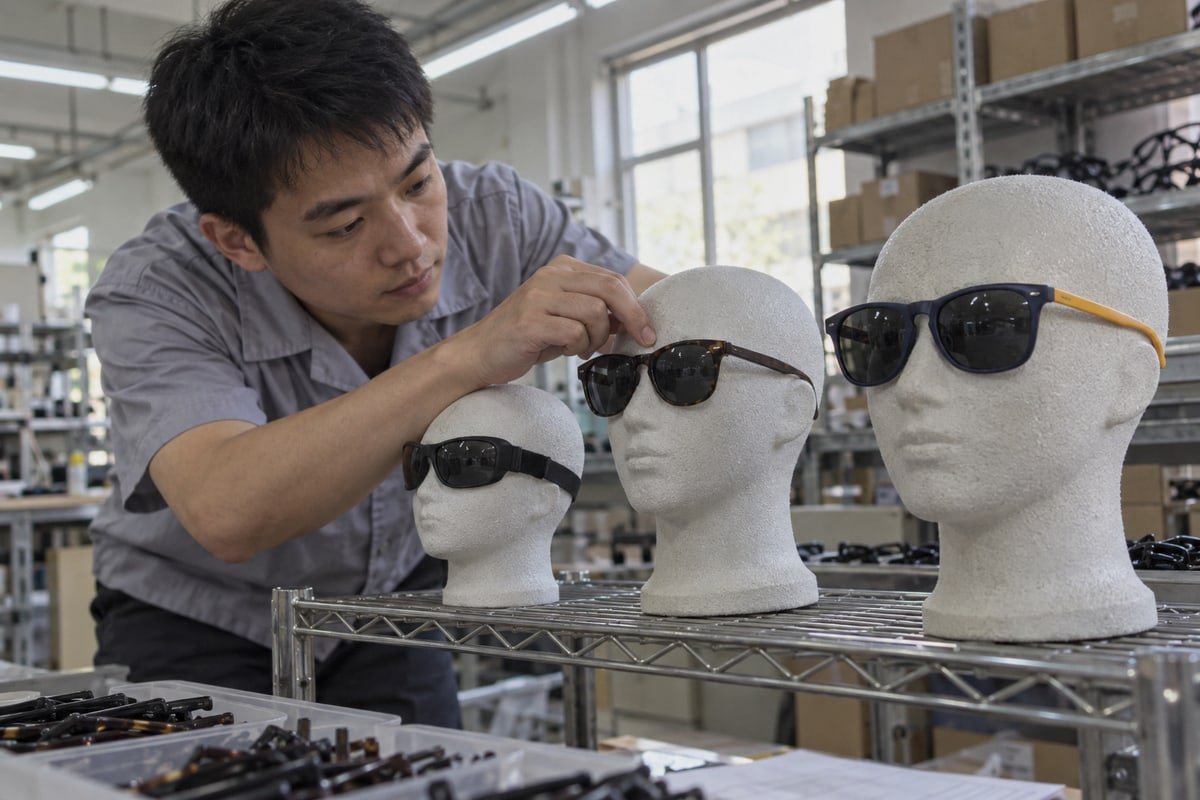
Size tells you how big the frame is. Structure tells you how the frame stays on and how safe it is. For young children, structure matters more than style. I want to walk through the four structural shifts we engineer into every age bracket.
The bridge evolves with the nose
Babies have almost no nasal bridge. A frame with a raised bridge 2 simply sits on the cheeks. So baby frames use a flat bridge design. Toddlers begin to develop a nose, but it is still shallow. A saddle bridge spreads weight across a wider surface and stops the frame sliding as the face lengthens. By the junior years, a keyhole bridge mirrors adult facial growth and gives a cleaner look.
The frame front also tilts differently. Toddler frames sit at a flat 0-degree pantoscopic tilt. Teen frames tilt 5–10 degrees downward. The tilt improves optical clarity and keeps the lower lens edge off the cheeks.
| Structural feature | Baby / Toddler | Kids 4–7 | Junior / Youth |
|---|---|---|---|
| Bridge type | Flat or saddle | Saddle | Keyhole |
| الميل البانتوسكوبي | 0 degrees | Slight | 5–10 degrees |
| الثبات | Strap-compatible | Curved temples, optional strap | Standard temples |
| Lens coverage | Proportionally largest, wraparound | Wide, slight wrap | Style-driven, flatter |
| المفصل | Screwless or flex hinge | Flex hinge | Spring or flex hinge |
Retention and the cranial-to-facial ratio
Young children have a large head relative to a small face. This cranial-to-facial ratio means the frame front must be wide, but the temples must be short. If we simply shrink an adult frame, the temples end up too long and the front too narrow. Ears on infants also sit higher and closer, so temple arms must be very short, around 100–110 mm, or replaced by a strap.
Lens coverage is a safety issue
Children's pupils are larger and their lenses clearer than adults. More UV reaches the retina. So younger frames need proportionally larger lens coverage to block leakage from the top and sides. We pair that coverage with حماية UV400 3 on every lens, and offer polarized TAC lenses where buyers want glare control for beach or snow.
Small details that protect small faces
Screwless hinges remove a loose-part hazard for toddlers. Rounded edges reduce pressure points. Hypoallergenic frames matter because young skin is sensitive and contact is constant. TR90 gives the impact resistance active kids demand, and it stays light enough that a two-year-old will tolerate wearing it.
Which age groups and sizes should I include in my initial collection when I'm sourcing TR90 eyewear?
Every launch forces the same trade-off: fewer SKUs mean simpler inventory, but too few sizes mean lost fits. We help new brands pick from our 800 existing styles.
Start with three core brackets: toddler (2–4, 40–44 mm lenses), kids (4–7, 44–48 mm), and junior (7–10, 48–52 mm). Add youth 10–12 and a strapped baby size if your brand serves those groups. Cover everyday and sport shapes.
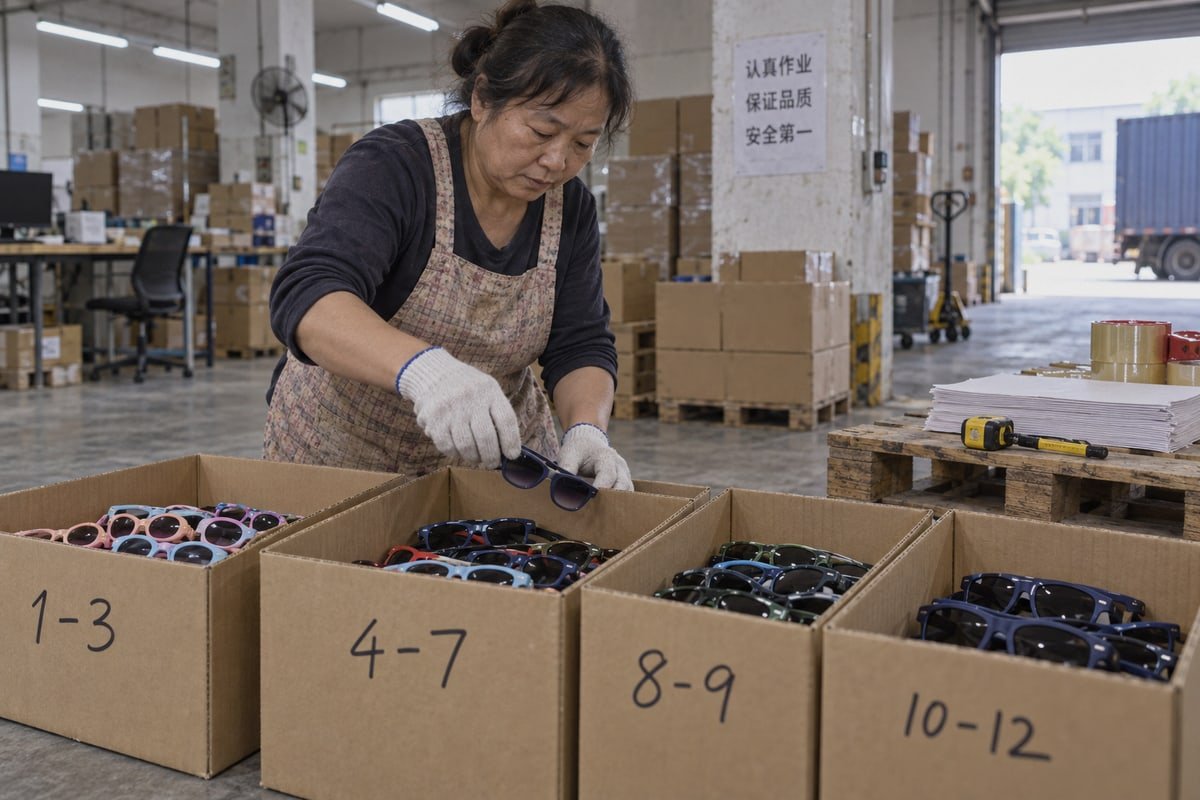
A first collection should test the market, not carry it. Most of the brands we work with launch with three to five sizes and two or three silhouettes. Then they add depth where sales prove demand. Here is the planning process I walk buyers through.
- Define your customer's age window. A baby brand needs 0–2 and 2–4. A kids' outdoor brand needs 4–7 through 10–12. Do not stretch into brackets your retail channel never sees.
- Pick one silhouette per bracket first. For 4–7, a classic wayfarer shape works well. Our navy blue front with yellow-orange temples is a good example. It is glossy, rounded, and playful, and it sells across genders.
- Add a sport option for 7 and up. Our matte navy wraparound style has gradient gray lenses, a rubberized finish, and curved temples for an athletic fit. It runs wider than casual frames, so treat it as its own size, not a color variant.
- Offer one fashion piece for older kids. The glossy black oval frame with a low-profile bridge and 90s look appeals to pre-teens who want a more adult style at a compact size.
- Decide the lens spec per bracket. UV400 protection is the baseline everywhere. Polarized TAC lenses 4 add value in the junior and youth brackets, where parents pay more for outdoor performance.
A sample first collection
| Bracket | Silhouette | الثبات | عدسة | مادة الإطار |
|---|---|---|---|---|
| Toddler 2–4 | Rounded wayfarer, saddle bridge | Strap-compatible | يو في 400 | TPEE or TR90 with TPEE temples |
| Kids 4–7 | Two-tone wayfarer | Curved temples | يو في 400 | TR90 مع معابد TPEE |
| Junior 7–10 | Wraparound sport | Dynamic-tension temples | Polarized TAC, UV400 | TR90 |
| Youth 10–12 | Oval retro or slim rectangular | Standard temples | Polarized TAC, UV400 | TR90 or TR90 / acetate |
Why the material mix shifts
Toddlers get the softest, lightest compounds. Silicone and TPE tolerate chewing and bending. From about age four, TR90 becomes dominant because it balances flexibility with a firmer, more grown-up feel. Some buyers ask why we do not put TR90 on everything. My answer is that a pure TR90 toddler frame can feel too stiff on a very small face. Our TR90 front with TPEE temples solves that. The front holds the lens securely. The temples bend freely behind the ear.
Because these styles already exist in our catalog, a brand can launch without paying for new molds. Custom colors, logos, lens tints, and packaging turn a stock frame into a retail-ready product. That is the lower-risk path we recommend for a first season.
How can I ensure my smaller TR90 frames maintain the right flexibility for young children?
Fifteen years of molding flexible eyewear material taught us one thing: a small frame does not scale down automatically. Wall thickness and temple design must be re-engineered.
Keep small TR90 frames flexible by specifying thermoplastic memory polymer grades, thinner temple walls with dual-density molding, TPEE or soft-tip temples, screwless or flex hinges, and dynamic-tension curves. Then verify with repeated flex and twist tests on toddler frame dimensions before mass production.
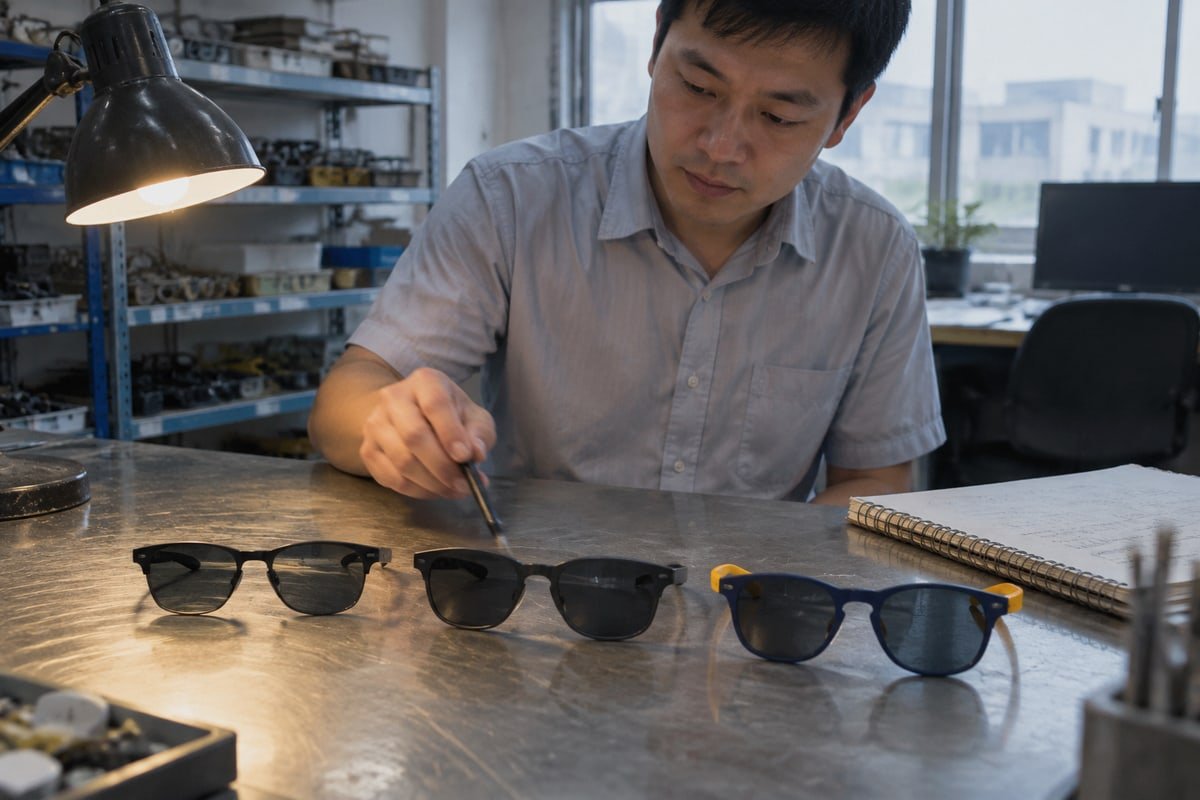
Here is the trap. When a mold is shrunk from a junior size to a toddler size, the wall thickness often stays the same. The frame gets shorter but not thinner. A short, thick temple is stiff. It presses hard behind the ear and snaps back too slowly. The child pulls it off, and the parent stops using it. Flexibility must be designed in, not assumed.
Why memory matters most at ages 3–7
TR90 هو thermoplastic memory polymer. It returns to its original shape after bending. This memory property 5 is most critical in the 3–7 range. Children this age remove sunglasses with one hand. They grab a single temple and yank. A frame without good memory warps permanently within weeks. A well-molded TR90 frame springs back every time.
Engineering choices we specify
- Dual-density molding. The bridge area is reinforced for structural integrity. The temple tips stay ultra-pliant. This suits the mastoid process behind the ear, which grows quickly in young children.
- Dynamic-tension temples. We mold a slight inward curve into the temple arms. The frame grips gently during running and jumping. The navy wraparound sport style in our range uses this curve for a secure fit.
- TPEE temples on a TR90 front. For toddler frame dimensions, this combination gives the softest feel behind the ear while the front keeps the lenses stable.
- Screwless hinges. These flex without a metal pin that can loosen or corrode, and they remove a small-part hazard.
Our checks before we ship
| فحص | What we look for |
|---|---|
| Temple flex | Temple opens well past 90 degrees and returns flat with no whitening |
| Front twist | Frame twists corner to corner and recovers without lens pop-out |
| Repeat bend | Multiple bend cycles at the hinge with no cracking or memory loss |
| Fit on head form | Correct bracket sits level with no temple pressure marks |
| Surface and edge | Smooth, rounded, no flash or sharp points near skin |
We run these checks in our 5S-managed workshop on every new size before mass production. I also encourage buyers to request pre-production samples in each bracket, not just one. A flexible junior frame does not prove a flexible toddler frame.
الخلاصة
Age labels start the sizing conversation, but measurements finish it. Bracket sizes, adapt structure, and engineer flexibility per size. We are ready to build that collection with you.
Interested in sourcing the products mentioned in this article? See details and request a quote here:
ملاحظات ختامية
1. Official CDC growth charts used to determine standard head circumference measurements for different age groups. ↩︎
2. NIH peer-reviewed research regarding facial growth and the development of the nasal bridge in children. ↩︎
3. Authoritative medical guidance from the American Academy of Ophthalmology on UV protection standards for children. ↩︎
4. General technical overview of sunglass lens technologies, including polarization and material types. ↩︎
5. Scientific explanation of thermoplastic polymer characteristics and memory properties relevant to TR90 material. ↩︎
مقالات أخرى قد تعجبك



هل تبحث عن شريك موثوق به للنظارات للأطفال؟
استكشف أكثر من 800 نمط جاهز ودعم OEM/ODM كامل مصمم خصيصًا لعلامتك التجارية.
اتصل بنا English
  Español de México
  Deutsch
  Français
  日本語
日本語  العربية
  Português do Brasil