How to Store TR90 & TPEE Kids Sunglasses: Hard Case or Soft Pouch?
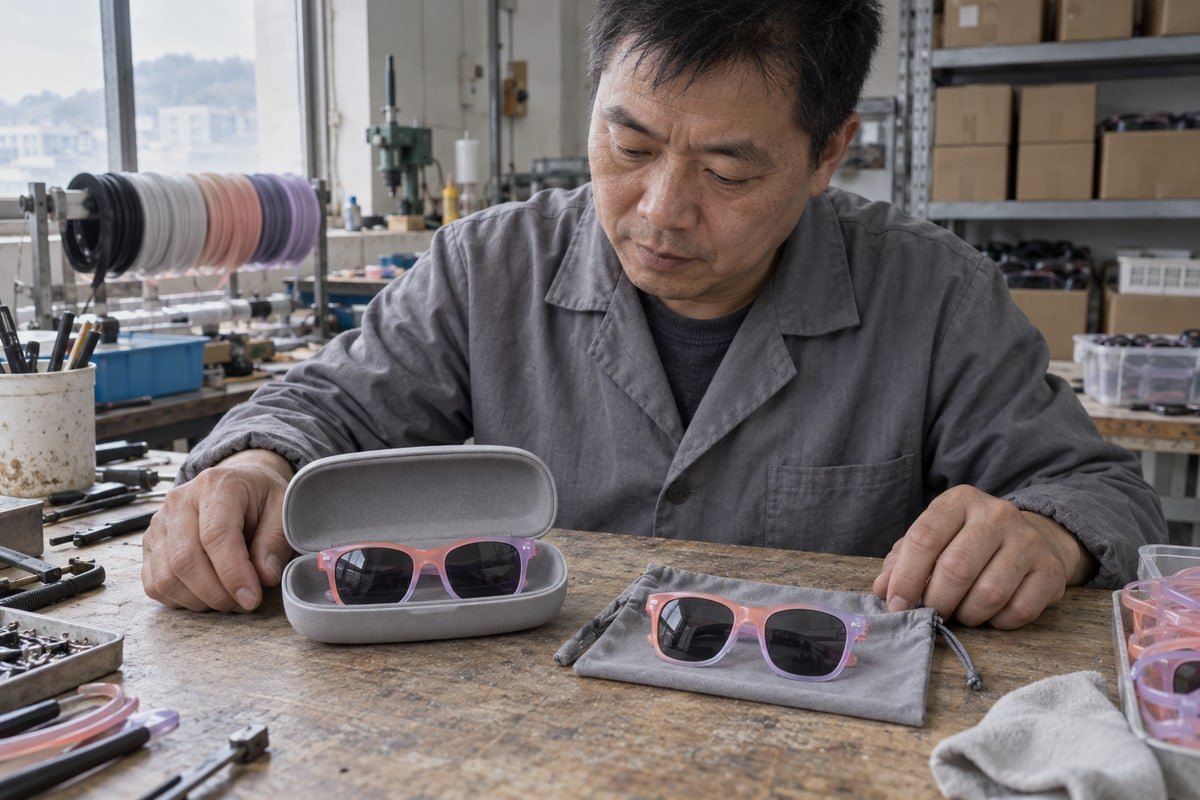
Every season, buyers ask our Taizhou production line about storing TR90 and TPEE kids sunglasses: hard case 1 or soft pouch? Choose wrong, and scratched lenses mean returns. Our answer follows.
For TR90 and TPEE kids sunglasses, a hard case is the safest storage choice. It prevents crushing, lens pop-out, and scratches in school bags, travel, and cars. A soft microfiber pouch works only for light, short-term, low-pressure storage at home. Choose a hard case for the main pair.
That is the short answer. The longer answer depends on the child, the use case, and the packaging budget. I will break each part down below. I will also show you where a soft pouch 2 genuinely makes sense, and where it quietly damages the frame.
What packaging should I choose to keep TR90 and TPEE sunglasses safe during shipping and retail display?
A few years back, our QC team opened a returned carton and found a translucent pink wayfarer with a popped lens. The pouch had done nothing against stacked boxes.
For shipping and retail display, use a hard case as the primary packaging for TR90 and TPEE sunglasses, with a microfiber pouch inside. This double-bagging stops dust vibration, compression, and lens pop-out in transit, and the case doubles as a retail-ready display piece.
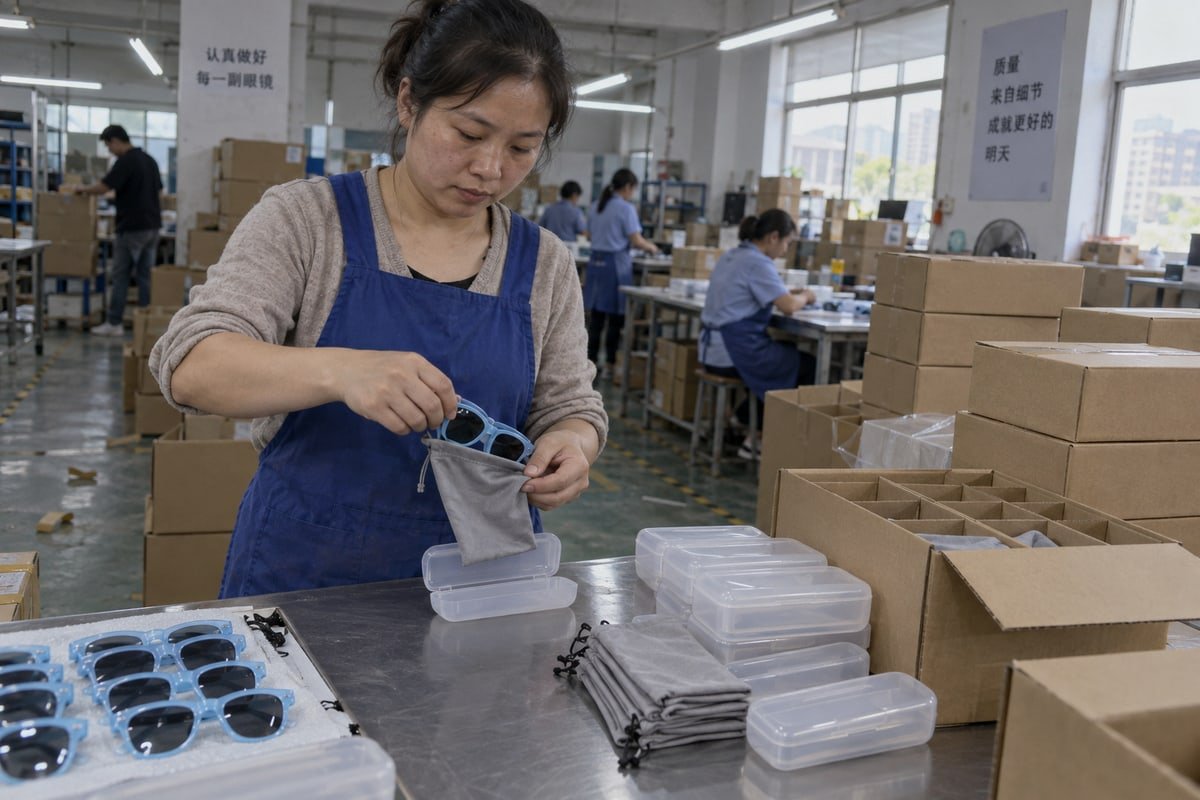
That returned carton taught us something simple. The frame survived. The lens did not. Flexible frames bend under load, and when they bend, the lens groove opens. That is how a lens pops out inside a pouch. So let me explain the materials first, then the packaging.
What TR90 and TPEE actually are
TR90 is a thermoplastic nylon. It is lightweight, flexible, and known for impact resistance. We use it for older, active kids because it bends and springs back instead of snapping. TPEE is softer and more rubber-like. We use it for toddlers and very young children, often as معابد TPEE 3 on a TR90 front. Both are BPA-free materials in our workshop. Both cut the risk of a broken frame. But neither material makes a lens scratch-proof. And neither makes a frame crush-proof under a pallet of cartons.
Hard case vs soft pouch at a glance
| العامل | علبة صلبة | Soft pouch |
|---|---|---|
| Protection from crushing | مرتفع | منخفض |
| Protection from lens pop-out | مرتفع | منخفض |
| حماية من الخدوش | High (with pouch inside) | متوسط |
| Weight and bulk | Heavier, bulkier | Very light, flat |
| Retail display | Stands on shelf, premium look | Peg-hook or drawer, budget look |
| تكلفة الوحدة | أعلى | أقل |
| Doubles as cleaning cloth | لا | Yes, if microfiber |
Why we double-bag for export
Here is the routine we follow on our line for buyers in 20+ countries:
- Wipe every pair with a قطعة قماش تنظيف من الألياف الدقيقة 4 before packing. Grit left on a lens becomes sandpaper during shipping.
- Slide the sunglasses into a microfiber pouch. This stops fine dust from vibrating against the scratch-resistant coating during weeks at sea.
- Place the pouch inside a hard case. The case takes the compression, not the frame.
- Pack cases into a carton with dividers, so cases do not rub each other.
For retail display, the hard case also matters. A clamshell case stands upright next to a coral-pink gradient wayfarer or a sky-blue translucent frame. It looks like a product, not an afterthought. Shoppers open and close it many times before purchase. The pouch alone cannot survive that handling and still look new. A pouch works for peg-hook promotional pairs. It does not work for a premium kids' line with polarized lenses and UV400 protection.
How do I decide between a hard case or soft pouch for my children's eyewear line?
Last spring, a baby-product buyer from Australia asked us to quote both options for the same TPEE toddler frame. We walked her through the trade-offs before quoting.
Decide by how and where the child will use the sunglasses, not by frame material alone. Choose a hard case for school bags, sports, travel, and car storage. Choose a soft pouch for toddler lines, home use, or promotional pairs where crushing risk is low and convenience matters.
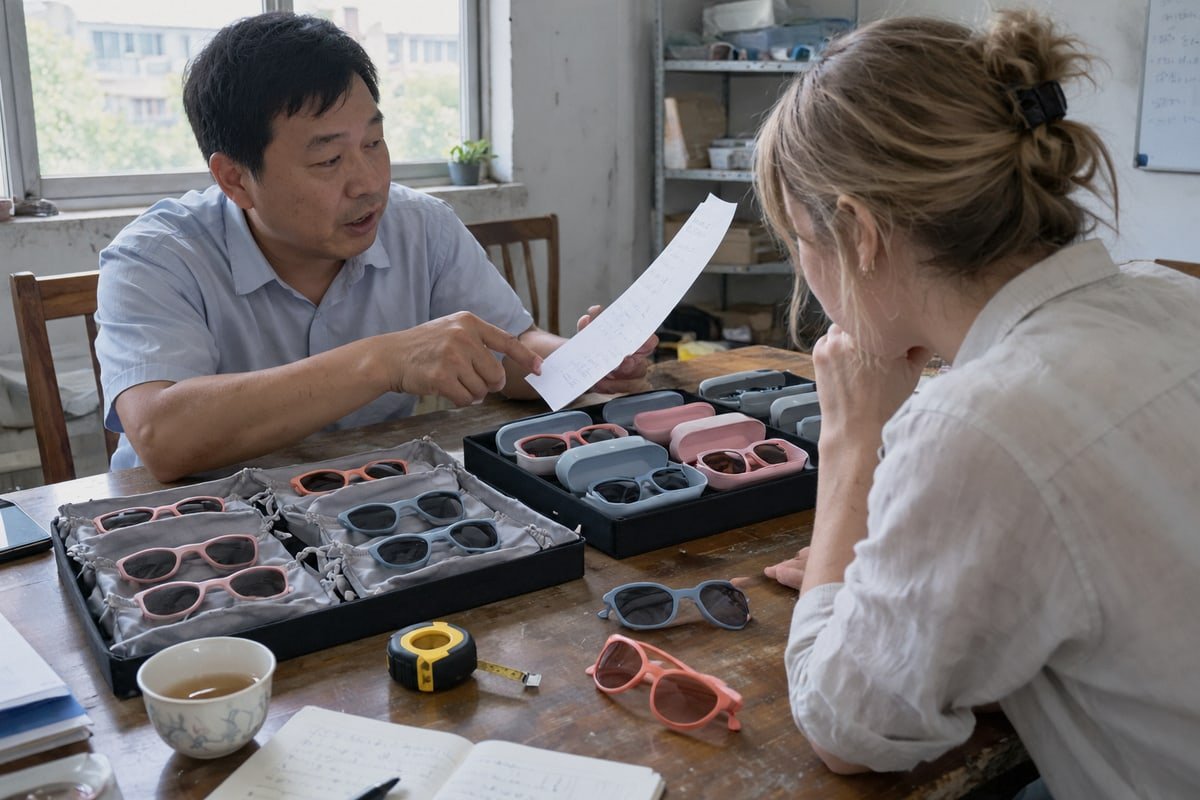
That buyer ended up choosing a hard case for her main line and a soft pouch for a lower-priced gift set. That split is common. It works because the two products are used in different ways. Below is the framework we shared with her.
Match the accessory to the child and the setting
| Child and use case | Typical frame | Recommended accessory | لماذا |
|---|---|---|---|
| Toddler, parent-managed, home and stroller | TPEE or TR90 with TPEE temples | Soft microfiber pouch | Parent controls storage; low crush risk; pouch doubles as cleaning cloth |
| Preschool or daycare bag | TPEE أو TR90 | علبة صلبة | Bags get tossed; toys and cups crush contents |
| School-age, backpack daily | TR90 | علبة صلبة | Books and water bottles compress; lens pop-out risk |
| Sports, beach, camp | TR90 | Hard case, pouch inside | Sand and grit scratch; case blocks pressure |
| Car glove box | Any | علبة صلبة | Compression from other items; never on the dashboard |
| Promotional or gift-with-purchase | TR90 أو TPEE | Soft pouch | Cost control; short-term protection is enough |
Answering the convenience objection
Buyers often tell me a soft pouch is lighter, cheaper, and "good enough." Many product pages promote pouches for exactly that reason. I understand the appeal. A pouch is flat, it ships cheaply, and it doubles as a microfiber cleaning cloth for smudges and sunscreen residue. But convenience is not protection. Eye-care and parenting sources consistently recommend a hard case for scratch and structural protection. A pouch protects against surface scratches better than nothing. It does not protect against a backpack full of books. So I resolve the objection this way: offer the pouch where risk is low, and the case where the child carries the glasses out of the house.
Our three-question test
- Will the child carry the sunglasses in a bag without adult supervision? If yes, hard case.
- Will the sunglasses see sand, chlorine, or a hot car? If yes, hard case.
- Is the pair a backup or a gift item sold on price? If yes, a soft pouch is acceptable.
Many brands run two pairs per child: a main pair in a hard case, and a backup pair in a pouch for the car or daycare. Our ~800 existing styles make that pairing easy to build without new molds.
Will the wrong storage accessory affect the flexibility and lifespan of TR90 or TPEE frames?
One lesson cost us a batch of samples: a cheap PVC pouch turned a set of TPEE temples sticky within weeks. We never sourced that pouch again.
Yes. The wrong accessory can shorten frame lifespan. PVC pouches can migrate plasticizers into TPEE and make it sticky, cramped soft pouches can bend TR90 into frame memory misalignment, and sealed damp cases can grow mold. A dry, PVC-free hard case avoids all three.
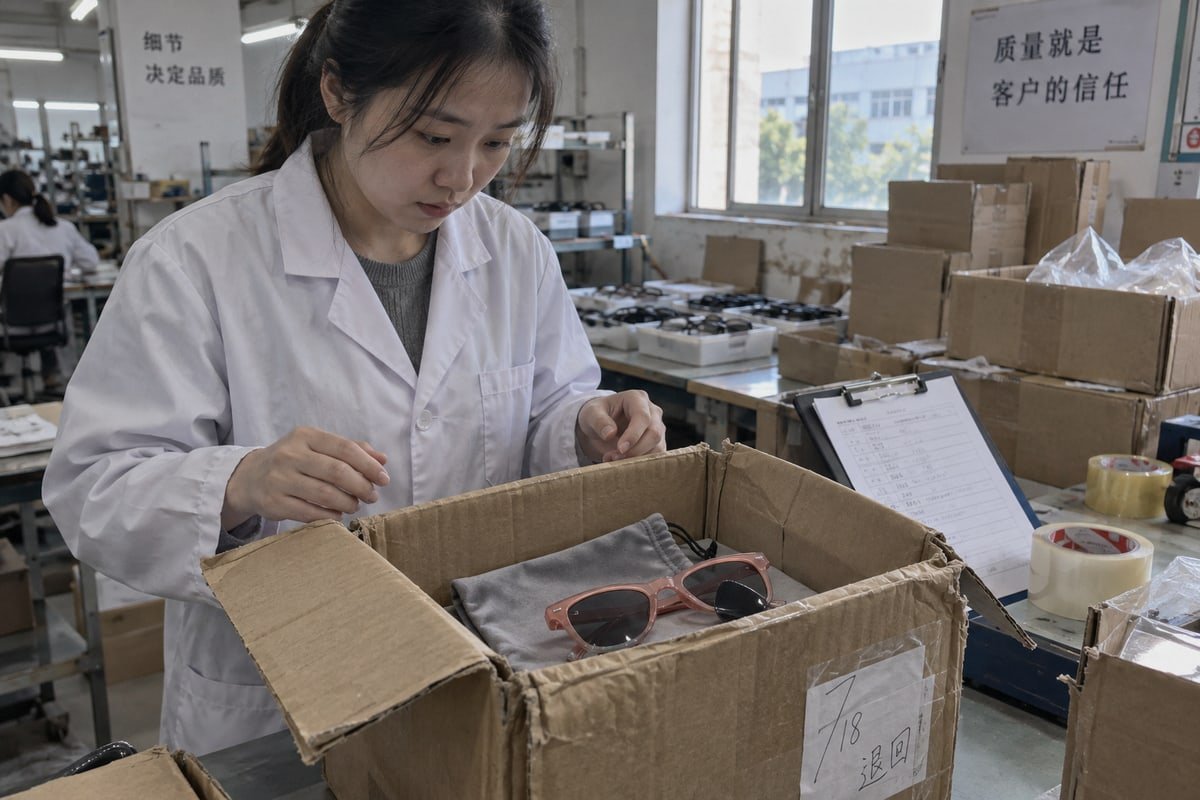
That sticky-temple lesson changed how we spec accessories. The frame material was fine. The pouch was the problem. So when buyers ask whether storage affects lifespan, I say it affects lifespan more than most people expect. Here is what actually goes wrong.
The four accessory risks we screen for
| خطر | Which frame it hits | ماذا يحدث | How to avoid it |
|---|---|---|---|
| PVC plasticizer migration | TPEE | Surface turns permanently tacky | Specify PVC-free pouch and case lining |
| Frame memory | TR90 | Temples stored bent or twisted in a tight pouch stay misaligned; needs heat reshaping | Use a case shaped for the frame, temples folded flat |
| Trapped grit | كلاهما | Sand, salt, or chlorine inside a pouch scratches lenses | Rinse and dry before storage |
| Mold and bacteria | TPEE, chewed by toddlers | Sealed, damp case grows growth in the dark | Choose breathable or antimicrobial-treated pouch; dry fully first |
Heat is a separate enemy
Storage accessories do not stop heat. A hard case on a car dashboard still bakes. Thermoplastics like TR90 and TPEE have thermal limits, and a closed car in summer can push past them. The frame warps, the fit changes, and the lens groove loosens. Tell your customers to keep sunglasses out of direct dashboard sun, case or no case. This protects both the frame and the lens longevity.
Clean before you store
Eyewear maintenance and storage go together. Grit trapped inside any accessory does the damage. Our recommended routine is short:
- Rinse the lenses under lukewarm water. Never hot water.
- Add a drop of mild soap if there is sunscreen or salt residue.
- Dry with a microfiber cleaning cloth. Never paper towels or a T-shirt; both scratch the scratch-resistant coating.
- Fold the temples flat and place the pair in the case.
Shatterproof lenses still scratch. Polarized lenses still lose their film if rubbed with a shirt sleeve. Proper cleaning before storage protects the coating as much as the case does. Do this well, and the same pair can last several seasons instead of one.
Can I customize cases or pouches with my brand logo when I order from a manufacturer?
Every custom packaging quote we prepare balances three things: unit cost, minimum quantity, and how the case looks on a retail shelf next to the frame.
Yes. Most OEM/ODM eyewear factories, including ours, can print, emboss, or deboss your logo on hard cases, microfiber pouches, and cleaning cloths. You can also match case colors to frame colors, choose materials, and add inserts, so the packaging arrives retail-ready under your brand.
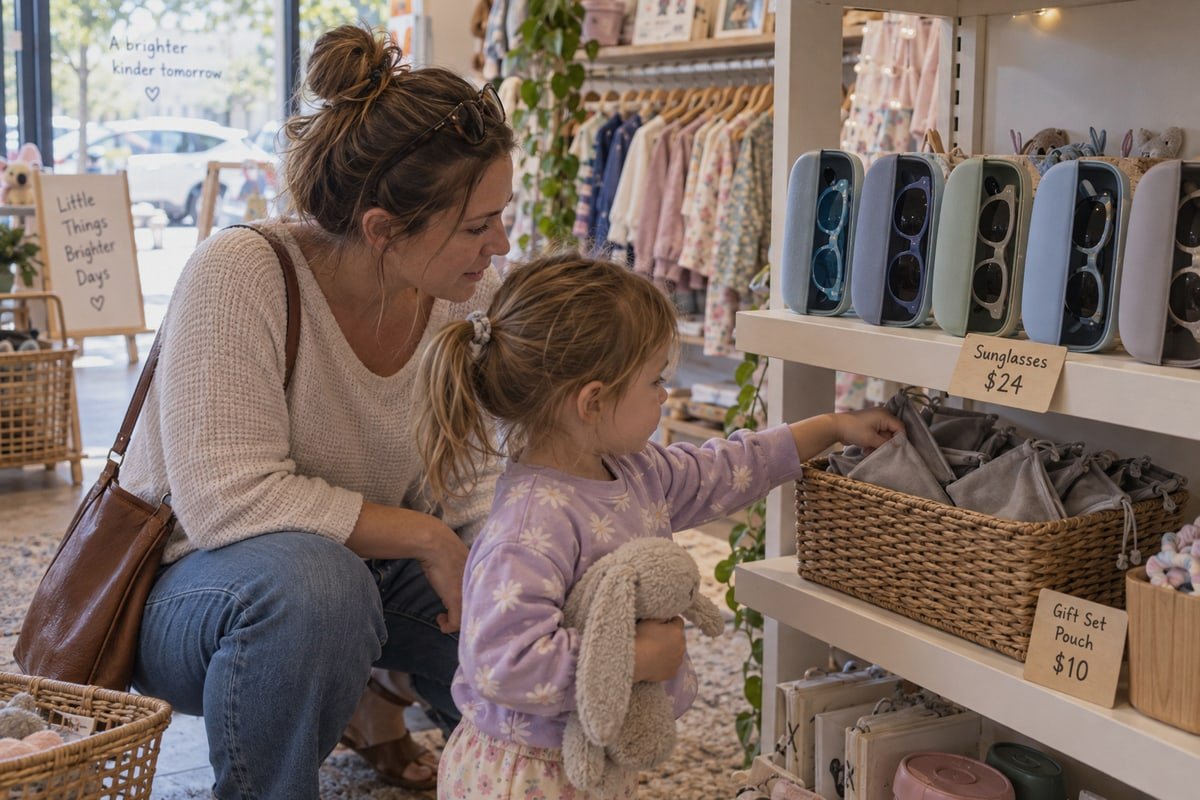
Branded packaging is where a kids' eyewear line stops looking like a commodity. Our OEM/ODM service covers frames, lenses, and accessories together, because buyers want one supplier and one quality standard. Here is what is typically possible, and what I weigh with each buyer.
What you can customize
| العنصر | Hard case options | Soft pouch options |
|---|---|---|
| Logo method | Silk-screen print, hot stamp, emboss, deboss, metal plate | Silk-screen print, heat transfer, woven label |
| المواد | EVA clamshell, PU-covered, rigid plastic | Microfiber, cotton, breathable mesh, antimicrobial-treated fabric |
| اللون | Pantone-matched shell, contrast lining | Dyed to match frame or brand palette |
| Extras | Inserts, hang tags, care cards, UV400 and polarized labels | Drawstring, elastic closure, doubles as cleaning cloth |
How the process works with us
- Pick a frame from our ~800 existing styles, or brief us on a new design. Existing styles need no mold investment, so a new brand can test the market with lower risk.
- Choose the accessory type based on the use-case framework above.
- Send your logo file and color references. We return artwork proofs for approval.
- We produce a pre-production sample of the case or pouch with the frame inside. This is when we check that the temples fold flat and the frame does not sit bent.
- Approve the sample, then we move to bulk in our 5S-managed workshop.
Matching packaging to the frame
Color matching sells. A coral-pink gradient wayfarer with matte pink temples looks stronger in a blush case than in a generic black one. A translucent sky-blue frame with pastel blue temples pairs well with a pale blue microfiber pouch. A chunky slate-blue frame suits a darker EVA clamshell. We talk through these choices with buyers because the accessory is part of the product, not a giveaway.
One trade-off I always raise: a premium printed hard case adds cost per unit and takes more carton space. A pouch is cheaper and flatter. The right answer depends on your retail price, your channel, and your customers' priorities. For brands focused on child safety, consistent quality, and professional presentation, the hard case usually earns its cost back in fewer returns.
الخلاصة
Loose storage scratches lenses and pops frames. That costs you returns and trust. Choose a hard case for daily wear, a soft pouch for low-risk use, and clean before storing.
Interested in sourcing the products mentioned in this article? See details and request a quote here:
ملاحظات ختامية
1. Professional optometric guidance recommending hard cases to protect eyewear from structural damage. ↩︎
2. General overview of microfiber material properties used in protective eyewear pouches. ↩︎
3. Scientific definition and engineering properties of thermoplastic polyester elastomers (TPEE) used in frames. ↩︎
4. Authoritative eye care advice on using microfiber cloths to clean lenses without scratching. ↩︎
مقالات أخرى قد تعجبك
هل تبحث عن شريك موثوق به للنظارات للأطفال؟
استكشف أكثر من 800 نمط جاهز ودعم OEM/ODM كامل مصمم خصيصًا لعلامتك التجارية.
اتصل بنا English
  Español de México
  Deutsch
  Français
  日本語
日本語  العربية
  Português do Brasil