How to Prepare Optometrist Training on Kids’ Optical Frame Fitting When Procuring Frames?
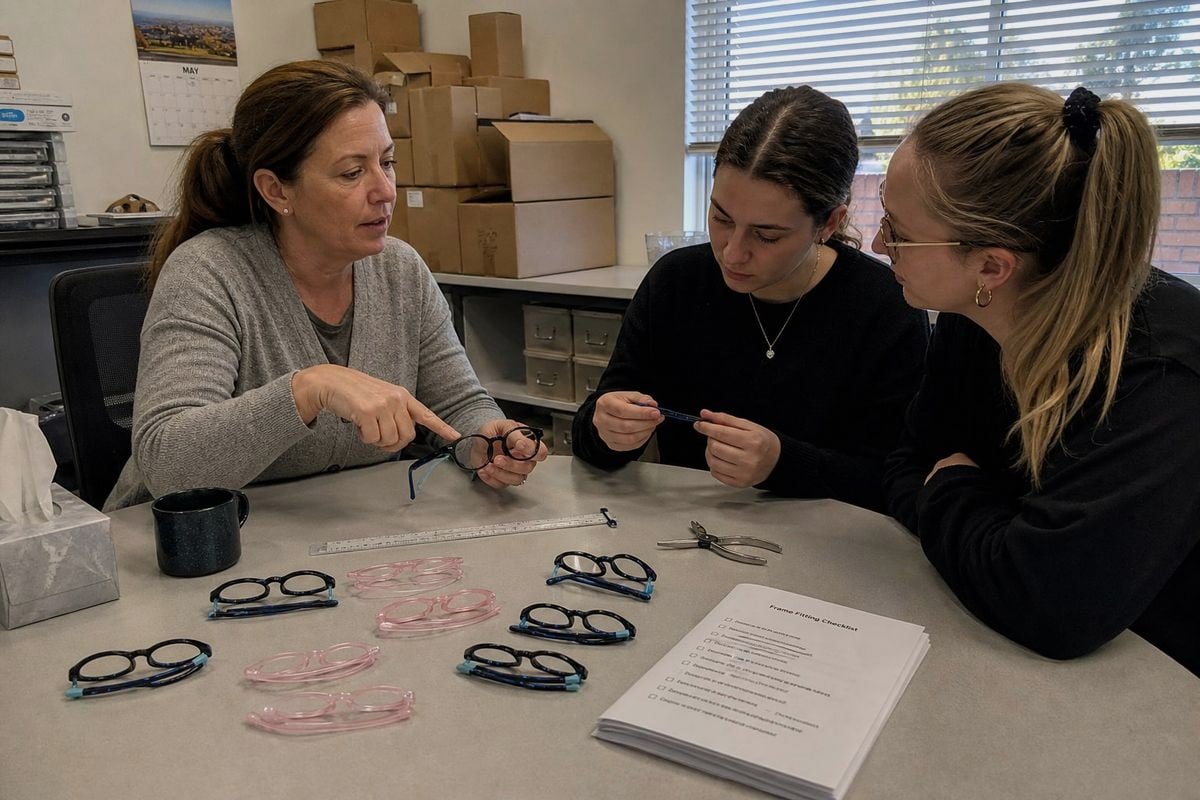
Optometrist training on kids’ optical frame fitting is the step most buyers skip pantoscopic tilt 1. In our Taizhou factory, we see the result: perfect frames returned because nobody fitted them properly.
To prepare optometrist training on kids’ optical frame fitting when procuring frames, build a training kit with sample frames and measurement tools, teach pediatric-specific fitting for flexible TR90 materials, provide written measurement guidelines, and partner with your manufacturer for technical documentation, fitting videos, and adjustment workshops.
Below, I break this into four practical steps. Each one comes from real projects with optical buyers across 20+ countries. Let’s start with the training kit itself.
What should I include in an optometrist training kit when I procure kids' optical frames?
A distributor in Australia once asked us to ship five extra sample sets with her order. She wanted her opticians to practice before the real inventory arrived. Smart move — we now recommend it to every buyer.
A complete optometrist training kit should include physical sample frames in every size you procure, a pupillary distance ruler or pupilometer, adjustment pliers suited to flexible materials, a pediatric fitting checklist, warning-sign reference cards, and manufacturer spec sheets covering frame dimensions and material behavior.
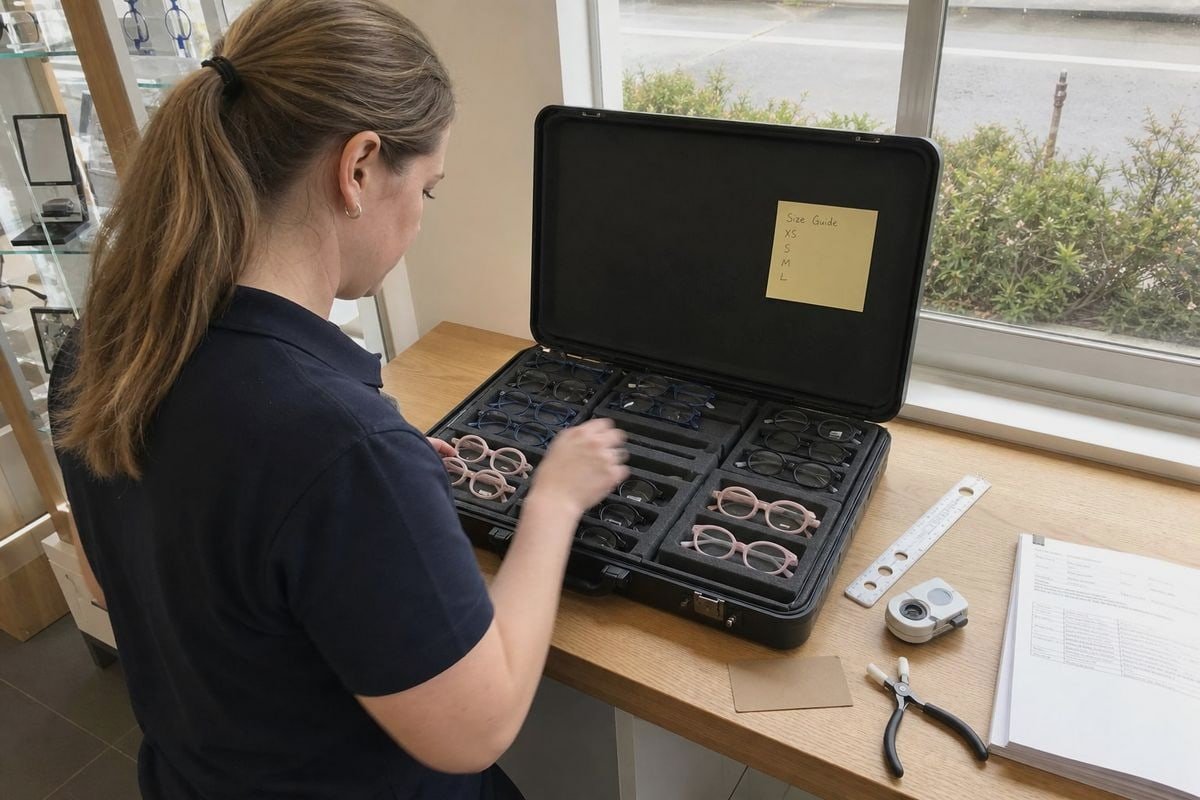
A training kit turns abstract theory into hands-on skill. In our experience, opticians learn pediatric optical dispensing 2 much faster when they can bend, adjust, and even break sample frames without fear. That is why we always suggest ordering dedicated training samples, separate from sellable stock.
Core components of the kit
Think of the kit in three layers: tools, references, and practice materials. Each layer supports a different part of the learning process.
| Kit Component | الغرض | Notes |
|---|---|---|
| Sample frames (all sizes) | Hands-on adjustment practice | Include TR90, TPEE-temple, and acetate styles |
| PD ruler / pupilometer | Pupillary distance measurement 3 | Monocular PD capability for higher prescriptions |
| Adjustment pliers set | Eyewear adjustment techniques | Nylon-jaw pliers protect flexible frames |
| Frame warmer | Softening temple tips | Low heat only for TR90 and TPEE |
| Fitting checklist card | Standardized workflow | Bridge, temples, centration, cheek clearance |
| Warning-sign reference | Troubleshooting glasses fit | Slipping, red marks, looking over lenses |
| Manufacturer spec sheets | Dimension and material data | Ask your supplier to provide these |
Why sacrificial samples matter
Children's eyewear materials behave differently from adult acetate. TR90 has memory flex. TPEE temples bend far past the point where standard plastic would snap. Opticians who have never handled these materials tend to under-adjust because they fear breakage. Give them samples they are allowed to stress-test. One of our clients runs a "break it on purpose" exercise — opticians discover how much force flexible frame technology actually tolerates, and their confidence during real fittings improves immediately.
Also include at least one frame with cable-style ear hooks, like our sporty black-and-blue model with silicone temple tips. Cable temples require a different fitting motion, and staff should practice it before facing a wiggling four-year-old.
How do I train optometrists to fit flexible TR90 frames correctly on children's faces?
There is a trade-off we weigh in every design review: the more flexible we make a temple, the more a poorly trained optician can misjudge its fit. Flexibility forgives rough handling, but it does not forgive wrong sizing.
Train optometrists to fit TR90 frames by teaching material behavior first: TR90 flexes and returns to shape, so adjustments require gentle, gradual pressure and low heat. Then drill bridge seating, temple contouring around the ear, and verification that flexibility never substitutes for correct frame size.
The biggest misconception we hear from buyers is that flexible frames "fit themselves." They do not. Flexibility protects the frame from damage when a child sits on it. It does not center the lenses over the pupils. Your training must make this distinction crystal clear from day one.
Teach the material before the technique
TR90 is a thermoplastic with shape memory. When an optician heats it too much, it can deform permanently. When they adjust it cold with sudden force, it springs back. So the correct technique is warm gently, adjust in small increments, hold, and cool. Our engineers demonstrate this in every factory visit, and buyers are always surprised how different it feels from acetate work.
For frames like ours that pair a rigid TR90 front with soft TPEE or silicone temple ends, opticians need to know which zones to adjust and which to leave alone. The flexible temple absorbs movement during play. The bridge and front do the optical work.
A four-step fitting drill for flexible frames
- Seat the bridge first. The frame's weight should rest on the nose bridge, not the cheeks. Children have low, developing nasal bridges, so check for cheek contact when the child smiles.
- Contour the temples. Bend the temple drop to follow the ear's curve. With cable-style hooks, wrap them snugly behind the ear without pulling it forward.
- Check centration under movement. Ask the child to look down, shake their head, and jump. The pupils must stay centered in the lens area. This matters because visual development in children 4 depends on lenses staying in the correct optical position.
- Verify comfort verbally. Ask the child directly, in simple words, whether anything pinches or presses. Include sensory-sensitivity awareness here — some children, especially those with special needs, react strongly to pressure points that adults would ignore.
Repeat this drill in role-play sessions before real appointments. One session is not enough. Treat it as a recurring optician training module, refreshed whenever new frame styles arrive.
What fitting guidelines should I provide so my optometrists can measure kids' frames accurately?
A lesson we learned early in our 15 years of eyewear work: buyers who give their opticians written measurement standards get far fewer complaints than buyers who rely on "experience." Children are not scaled-down adults, and guidelines must say so explicitly.
Provide written guidelines covering binocular and monocular pupillary distance measurement, bridge fit for children, temple length and drop, pantoscopic tilt, vertex distance, and vertical lens centration. Add explicit rules against oversizing, plus a warning-sign checklist for follow-up visits every three to six months.
Good guidelines do two jobs. They standardize the fitting workflow across staff, and they give newer opticians a reference when a fitting feels wrong. I recommend a one-page laminated card for daily use, backed by a longer manual for training sessions.
The measurements that matter most in pediatric fitting
| Measurement | لماذا هو مهم للأطفال | Common Error |
|---|---|---|
| Monocular PD | Facial asymmetry is common; critical for higher prescriptions | Using only binocular PD |
| Bridge fit | Children's low nasal bridges cause slipping | Choosing frames with adult bridge geometry |
| Temple length | Too long pushes frames forward; too short pulls ears | Assuming one length fits an age group |
| Vertical centration | Pupils must sit centered or slightly above lens center | Frames too deep, pupils sitting high |
| Pantoscopic angle | Affects lens performance for growing eyes | Copying adult tilt values |
| Vertex distance | Prescription accuracy, especially in stronger Rx | Ignoring it because "kids' Rx is simple" |
| Cheek/brow clearance | Frames must not touch cheeks or lashes | Missing contact that appears when smiling |
Address the "they'll grow into it" objection head-on
Parents will push for larger frames to save money. Your guidelines must arm opticians with a clear, polite refusal script. An oversized frame decenters the lenses, slides down the nose, and quietly undermines the prescription. The child ends up looking over the top of the lenses — the exact outcome the parents paid to avoid. Train staff to explain that a correct fit today, plus a re-check in three to six months, protects both the child's vision and the family's investment.
Build follow-up into the guidelines
Children's faces change fast. Include a troubleshooting glasses fit section listing early warning signs: red marks on the nose or ears, frames slipping during class, temples pulling ears forward, and eyes no longer centered in the lenses. Instruct staff to book re-adjustment visits proactively rather than waiting for complaints.
How can I work with my manufacturer to create training materials for proper frame fitting?
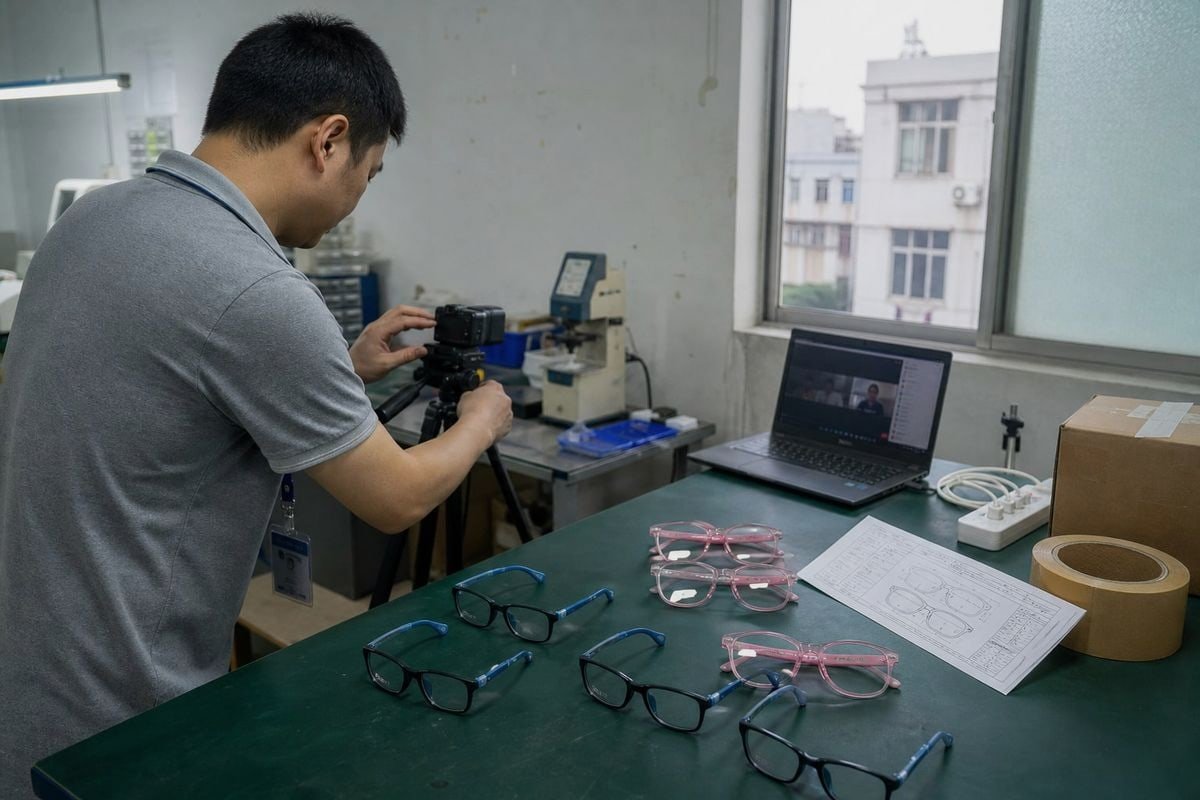
When a Japanese kids' brand asked us for fitting documentation last year, we did more than send spec sheets. We filmed adjustment demonstrations on our actual frames, in our 5S-managed workshop, and their opticians used the clips as onboarding material. That collaboration changed how we support buyers.
Work with your manufacturer by requesting technical spec sheets for every frame, material-specific adjustment guides, short fitting demonstration videos, extra training samples, and size-range charts by age. A capable OEM partner can also co-develop checklists and answer optician questions directly during onboarding.
Your supplier knows the frames better than anyone. They know how much heat a temple tolerates, where the flex zones sit, and which sizes suit which age bands. Tapping that knowledge costs little and prevents expensive fitting mistakes. When we co-develop children's eyewear with a client — custom colors, logos, lenses, packaging — training documentation is a natural extension of the same OEM/ODM process.
What to request, and what a good manufacturer provides
| Training Material | What to Ask For | How We Typically Deliver It |
|---|---|---|
| Frame spec sheets | Eye size, bridge width, temple length, weight per SKU | PDF datasheets with every sample set |
| Material guides | Heating limits, flex zones, adjustment do's and don'ts | Material cards for TR90 and TPEE styles |
| Fitting videos | 2–3 minute clips per frame family | Filmed on production samples in our workshop |
| Size-by-age charts | Recommended frame dimensions per age band | Based on our catalog of ~800 existing styles |
| Extra samples | Sacrificial frames for adjustment practice | Added to sample orders on request |
| Lens guidance | Impact-resistant lenses and compatibility notes | Polycarbonate and Trivex compatibility per frame |
| Q&A access | Direct line to engineering for fitting questions | Named contact during onboarding period |
Make it a two-way collaboration
The best training materials come from feedback loops. Ask your opticians to log recurring fit problems — say, a bridge style that slips on very young children — and send that data back to your supplier. We have adjusted temple curves and bridge profiles based on exactly this kind of field feedback. Because we hold roughly 800 existing styles, buyers can often solve a fitting problem by switching to a better-suited existing model instead of paying for new tooling.
Also consider pairing manufacturer materials with internal mentoring. Have your most experienced pediatric optician review the supplier's documentation, adapt it to your clinic's workflow, and mentor newer staff through it. Manufacturer knowledge plus in-house experience beats either one alone.
الخلاصة
Poorly fitted kids' frames waste good inventory. Pair your procurement with a training kit, TR90-specific drills, written measurement guidelines, and manufacturer-made materials — and every frame you buy performs.
ملاحظات ختامية
1. This article from Lens.com directly defines pantoscopic tilt, its frame angle, and how it affects vision, serving as a clear replacement. ↩︎
2. The American Association for Pediatric Ophthalmology and Strabismus (AAPOS) offers authoritative guidelines on glasses fitting for children, which aligns with pediatric optical dispensing. ↩︎
3. Details various methods for accurately measuring pupillary distance in young children. ↩︎
4. The American Academy of Ophthalmology offers a comprehensive article on vision development in children, covering various age ranges and milestones. ↩︎
مقالات أخرى قد تعجبك

أغسطس 5, 2026
Bio-Based vs Regular Cellulose Acetate: What's the Difference for Kids' Frames?

أغسطس 5, 2026
How Recyclable Are Kids' Optical Frame Materials, and What Eco-Friendly Alternatives Exist?
أغسطس 5, 2026
Do Kids Optical Frames Whiten or Age in Storage, and How to Control Warehouse Conditions?
هل تبحث عن شريك موثوق به للنظارات للأطفال؟
استكشف أكثر من 800 نمط جاهز ودعم OEM/ODM كامل مصمم خصيصًا لعلامتك التجارية.
اتصل بنا English
  Español de México
  Deutsch
  Français
  日本語
日本語  العربية
  Português do Brasil