How to Meet Australia’s Sunglass Safety Standards for Kids’ Eyewear D2C Brands?
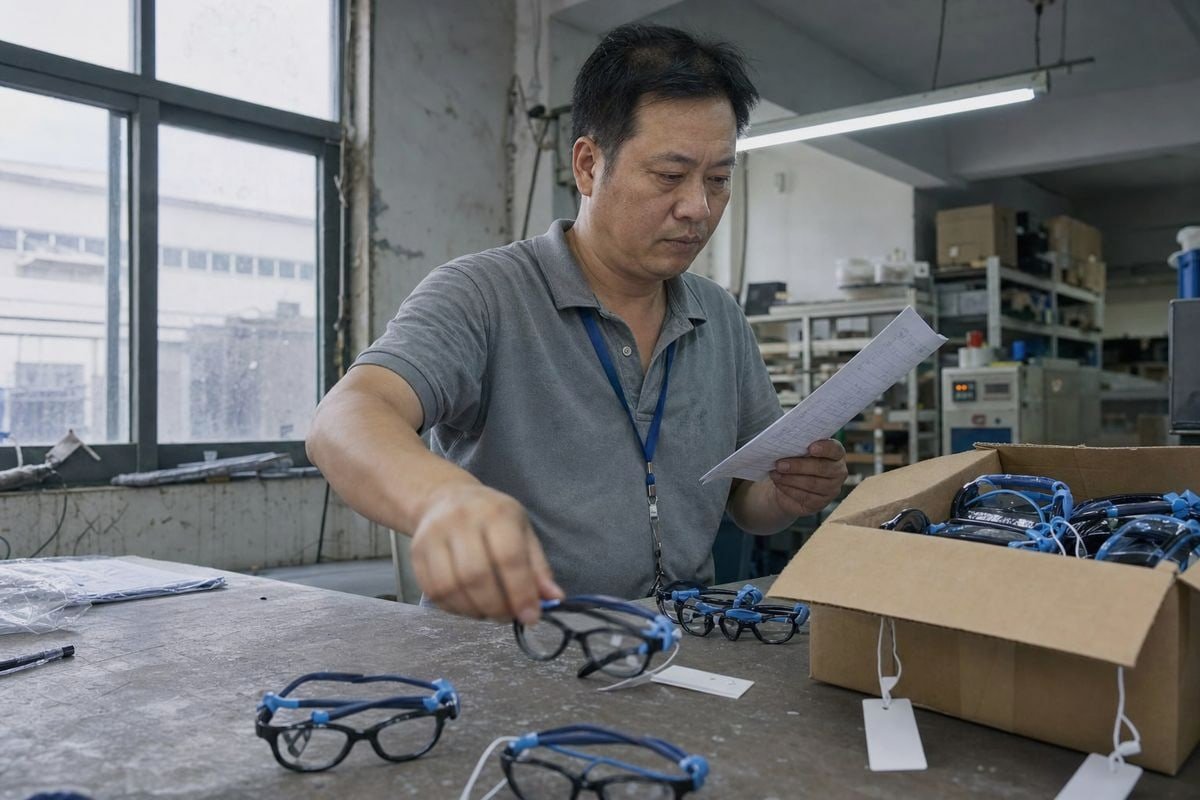
Australia’s sunglass safety standards for kids’ eyewear are strict, and I have watched promising D2C brands stumble on them during our export projects from Taizhou.
To meet Australia’s sunglass safety standards, kids’ eyewear D2C brands must comply with the mandatory AS/NZS 1067.1:2016 standard, which covers UV transmittance, lens category labelling, and frame construction. Brands need accredited lab test reports, correct swing-tag labelling, and marketing claims that match the tested protection level.
The standard is not complicated once you break it down AS/NZS 1067.1:2016 standard 1. But the details matter. One wrong label or one overclaimed product page can trigger a recall. Let me walk you through the full picture, from certification to long-term compliance.
What certification does kids' sunglasses need to meet AS/NZS 1067.1 for the Australian market?
A few years back, an Australian buyer sent our factory a rejected shipment report from a previous supplier. The lenses passed UV tests, but the swing tags said "fashion spectacles." That single wording error cost them the whole batch.
Kids' sunglasses sold in Australia must be tested and labelled to AS/NZS 1067.1:2016, mandatory since 1 July 2019. Australia has no certification mark like the CE mark; instead, brands need accredited lab test reports proving UV transmittance, lens category, and construction compliance, plus correct product labelling.
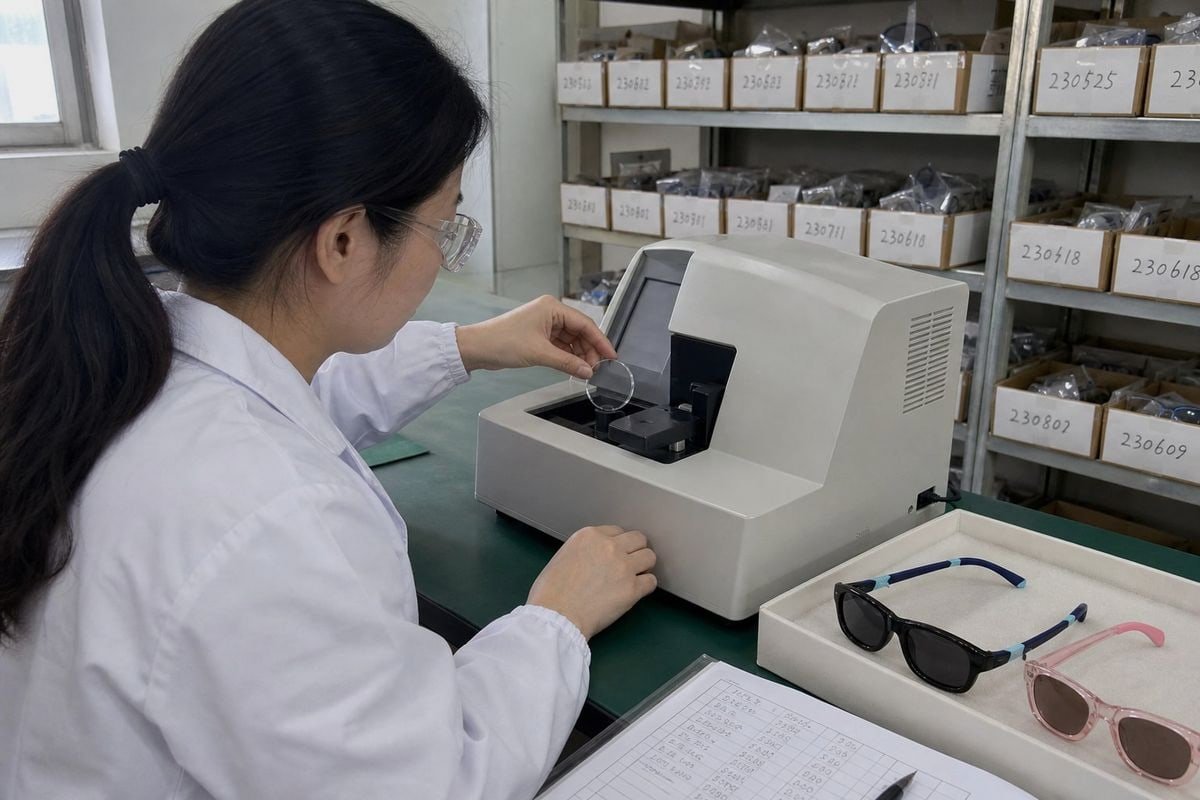
The first thing to understand is scope. The ACCC product safety framework 2 makes AS/NZS 1067.1:2016 a mandatory standard, not a voluntary one. It explicitly covers children's sunglasses, along with uniformly tinted, polarising, photochromic, and gradient lenses. If your D2C product is meant to protect a child's eyes from the sun, it is in scope. There is no exemption for small brands or online-only sellers.
What the standard actually controls
AS/NZS 1067.1:2016 sets limits for visible light transmittance and ultraviolet radiation blocking across the 280–400 nm range. It also includes frame construction durability and design requirements, so lenses cannot shatter into hazardous fragments. Finally, it defines the lens category classification system, from category 0 to category 4.
Lens categories at a glance
| فئة العدسة | Light Reduction | الاستخدام النموذجي | Suitable for Kids' Sun Protection? |
|---|---|---|---|
| 0 | منخفض جدًا | Fashion spectacles | لا |
| 1 | منخفض | Mild glare, fashion use | محدودة |
| 2 | متوسط | General daytime wear | نعم |
| 3 | مرتفع | Strong Australian sunlight | Yes — most recommended |
| 4 | عالي جداً | Extreme glare, not for driving | Yes, special purpose |
Cancer Council guidance points parents toward category 2, 3, or 4 for real sun protection, and category 3 is the sweet spot for most Australian children. Your product must be labelled with its tested category, the standard reference, and the identity of the manufacturer or supplier. In our experience, buyers who define the target category before lens sourcing avoid almost all downstream labelling problems.
How do I choose a manufacturer that understands Australia's UV400 and lens safety requirements?
The trade-off I discuss most often with new brand founders is this: a cheap supplier who says "yes" to everything, or a factory partner who asks hard questions before quoting. For the Australian market, the second option protects your business.
Choose a manufacturer with documented experience in AS/NZS 1067.1:2016 projects, in-house knowledge of UV400 protection and lens category classification, safe flexible frame materials like TR90 and TPEE, and full OEM/ODM support covering labelling, swing tags, and retail-ready packaging for the Australian market.
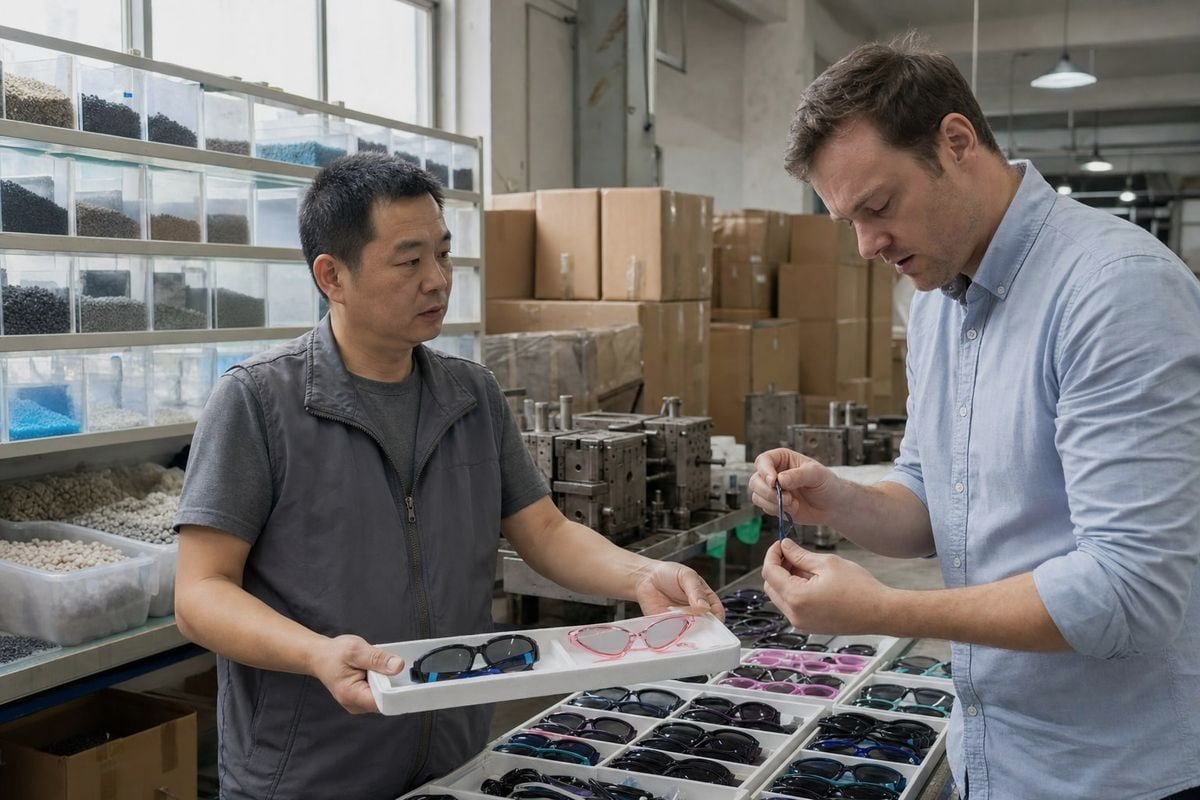
A claim of "UV400" on a quotation sheet means very little on its own. حماية UV400 3 means the lens blocks ultraviolet radiation up to 400 nanometres, which aligns with what AS/NZS 1067.1:2016 measures. But the standard also tests construction, labelling, and category accuracy. At our Taizhou workshop, we treat UV performance as one input among several, not the finish line. Over fifteen years of exporting children's eyewear to more than twenty countries, we have learned that Australian buyers ask the most detailed compliance questions of any market, and rightly so.
Questions that separate real partners from resellers
Ask any prospective factory these five questions:
- Can you show recent test reports to AS/NZS 1067.1:2016 for a comparable kids' style?
- What frame materials do you use, and why are they safe for children?
- How do you control lens category consistency across production batches?
- Can you produce compliant swing tags and packaging, not just the frames?
- Are you a factory or a trading company?
That last question matters. As a direct importer, a D2C brand carries full legal responsibility under ACCC product safety rules. A trading company adds a layer between you and the actual production line, which weakens your supply chain transparency.
Why frame material expertise matters for kids
Children drop, bend, sit on, and chew their eyewear. This is why we build most of our roughly 800 existing styles in TR90 and TPEE 4, often combining a rigid TR90 front with flexible TPEE temples. These materials resist snapping into sharp fragments, which supports the frame construction durability requirements of the standard. They are also lightweight and comfortable on small faces, which keeps the sunglasses actually on the child. A compliant lens does nothing in a backpack.
For new D2C brands, an existing-style catalogue also lowers launch risk. You can test the Australian market without heavy mold investment, then move to custom OEM/ODM designs once sales data supports it.
What testing and documentation should I request before importing kids' eyewear into Australia?
One lesson our QC team learned early: paperwork gaps surface at the worst possible time, usually when a marketplace or customs officer asks for evidence you assumed the factory kept. Now we prepare document packs before goods ship, not after.
Before importing, request an accredited lab test report to AS/NZS 1067.1:2016 covering UV and visible light transmittance, lens category verification, and frame construction testing, plus labelling artwork approval, a bill of materials, batch traceability records, and supplier identity documentation for ACCC product safety obligations.
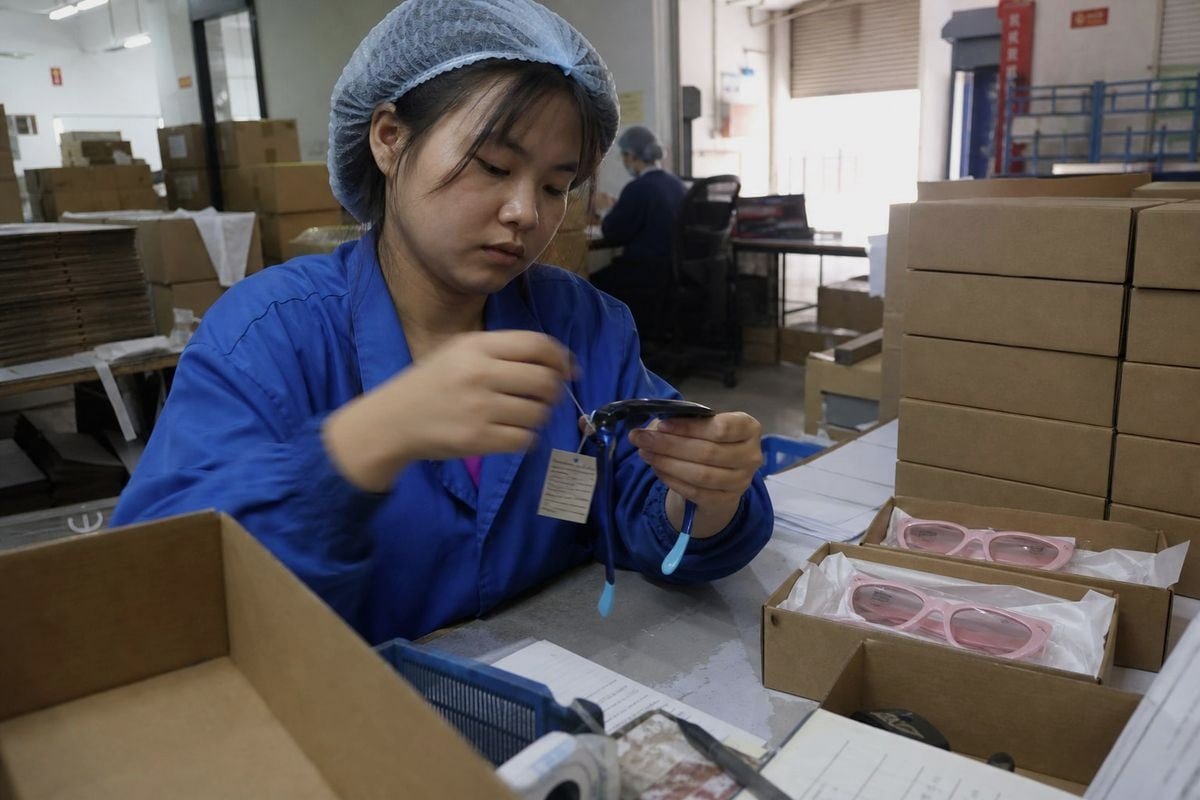
Import regulations Australia applies to sunglasses are enforced through the mandatory standard, so your documentation must map directly to its clauses. When we prepare shipments for Australian clients, we organise evidence into four groups. This structure has saved buyers real time during marketplace onboarding and distributor audits.
The core document pack
| وثيقة | ما يثبته | Who Provides It |
|---|---|---|
| تقرير اختبار معمل معتمد 5 | Compliance with AS/NZS 1067.1:2016 transmittance and construction clauses | Third-party lab, arranged by factory or brand |
| Lens category verification | The labelled category matches tested performance | Lab report plus factory QC records |
| Labelling artwork approval | Swing tag shows standard, category, description, driving suitability, supplier identity | Brand and factory jointly |
| Bill of materials | Frame and lens materials, coatings, and any child-safety-relevant substances | Factory |
| Batch traceability records | Which production run each shipment came from | Factory QC system |
Sunglass testing procedures worth understanding
You do not need to run the tests yourself, but you should know what the lab checks. Sunglass testing procedures under the standard measure luminous transmittance, UV transmittance across 280–400 nm, uniformity between left and right lenses, and mechanical robustness of the frame. For children's models, fit and construction receive extra scrutiny because small users cannot judge risk themselves.
One buyer objection I hear often: "Testing every batch is too expensive for a small brand." My honest answer is that you do not need to re-test identical products constantly, but you must test any new lens supplier, new tint, new coating, or new frame construction. Material changes invalidate old reports. We flag this to clients whenever a running change is proposed, because a five-hundred-dollar test is cheaper than a recalled container. Keep every report on file; regulators and marketplaces can ask for it years later.
How can I ensure my D2C sunglasses brand stays compliant as Australian safety standards update?
A returning client from Melbourne once told me their biggest fear was not launching — it was quietly drifting out of compliance two years later. That conversation changed how we structure long-term supply agreements at our factory.
Stay compliant by assigning clear internal ownership of compliance, monitoring ACCC and standards updates annually, re-testing production batches periodically, auditing product pages against swing tags, keeping documentation centralised and current, and requiring your manufacturer to notify you of any material or process change.
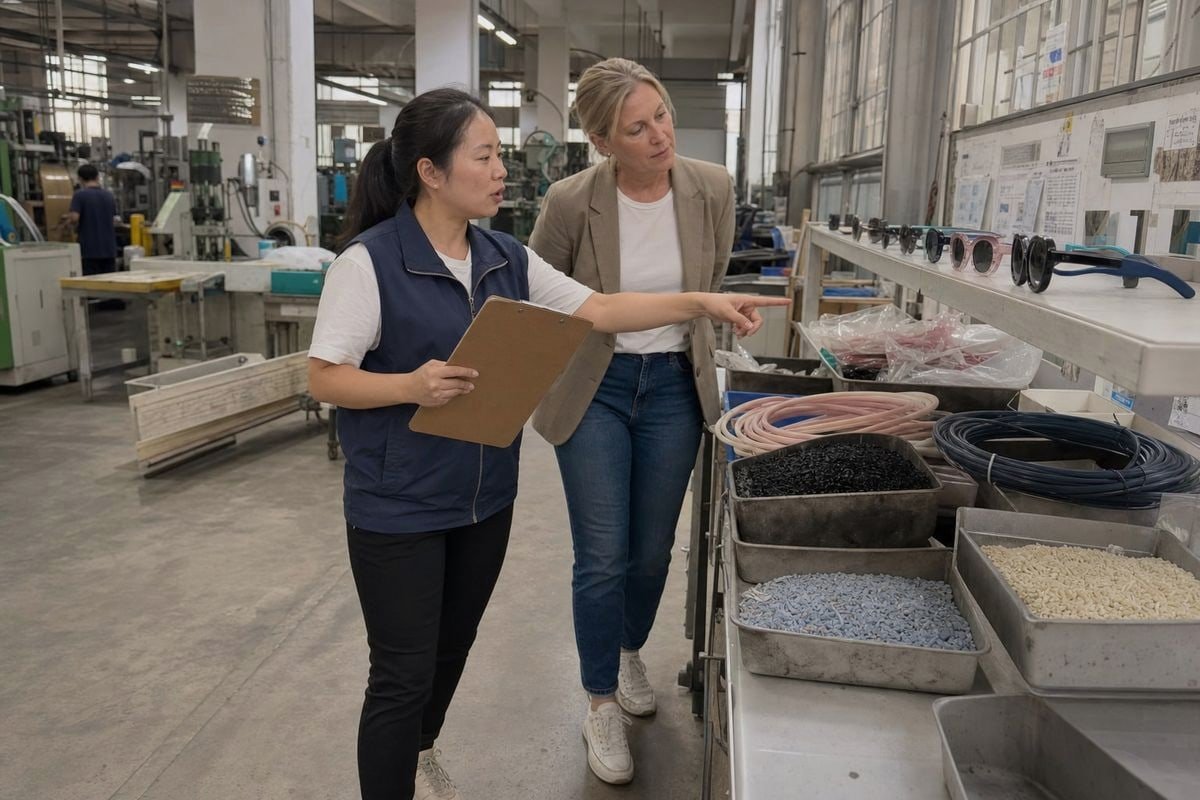
Compliance is not a launch event. Standards get revised, ACCC guidance evolves, and your own product line changes as you add colours, lens options, and new frame shapes. Each of those changes can silently break the link between your test report and the product actually shipping. The brands that stay safe treat compliance as a routine, split across teams, not a one-time certificate in a drawer.
Assign ownership across your team
| Team | Ongoing Responsibility |
|---|---|
| Product development | Flag any lens, coating, or frame change that needs re-testing |
| Compliance / vendor management | Track standard updates, hold test reports, schedule batch re-tests |
| Ecommerce / marketing | Keep product pages aligned with lens category and standard wording |
| Operations | Verify swing tags and packaging on every inbound shipment |
Watch your marketing claims as closely as your lenses
Here is a nuance many brands miss. Meeting AS/NZS 1067.1:2016 is mandatory, but it does not automatically justify claiming "100% UV protection" in your copy. Some industry commentary notes that certain compliant category 3 lenses may still transmit a small amount of UVA. So write claims you can substantiate with your own test data. Say "complies with AS/NZS 1067.1:2016, lens category 3" rather than absolute promises. Consistency also matters: your product page, swing tag, and packaging must all state the same category and the same product description. Calling a sun-protective product a "fashion accessory" undermines the classification, and calling a toy "sunglasses" invites regulatory trouble, since toy eyewear does not meet the standard and should never be marketed for children's eye health.
Build feedback and re-testing loops
We encourage clients to re-test at sensible intervals and after any supplier-side change. Pair that with post-purchase monitoring: customer feedback on durability, temple flexibility, and fit often reveals production drift before a lab does. Some of our larger clients now digitise their compliance files so every SKU links to its current report, which makes audits and marketplace reviews far faster. Finally, put change-notification duties into your manufacturing agreement. Our commitment to Australian clients is simple: no lens, material, or process changes without written notice, because your eyewear labelling standards are only as reliable as the factory behind them.
الخلاصة
Meeting Australia's sunglass safety standards means testing to AS/NZS 1067.1:2016, labelling correctly, choosing a factory with real kids' eyewear expertise, and maintaining compliance long after launch.
ملاحظات ختامية
1. Official government information on Australian/New Zealand sunglasses standard. ↩︎
2. Official Australian Competition and Consumer Commission information on product safety. ↩︎
3. Explains what UV400 protection means for sunglasses and eye health. ↩︎
4. Compares TR90 and TPEE materials specifically for children’s sunglasses frames. ↩︎
5. ACCC guidance on using accredited laboratories for product safety testing. ↩︎
مقالات أخرى قد تعجبك
أغسطس 5, 2026
Bio-Based vs Regular Cellulose Acetate: What's the Difference for Kids' Frames?
أغسطس 5, 2026
How Recyclable Are Kids' Optical Frame Materials, and What Eco-Friendly Alternatives Exist?
أغسطس 5, 2026
Do Kids Optical Frames Whiten or Age in Storage, and How to Control Warehouse Conditions?
هل تبحث عن شريك موثوق به للنظارات للأطفال؟
استكشف أكثر من 800 نمط جاهز ودعم OEM/ODM كامل مصمم خصيصًا لعلامتك التجارية.
اتصل بنا English
  Español de México
  Deutsch
  Français
  日本語
日本語  العربية
  Português do Brasil