How to Get Ball Drop Impact Test Certificates for Kids’ Sunglasses from China for US Customs/FDA?
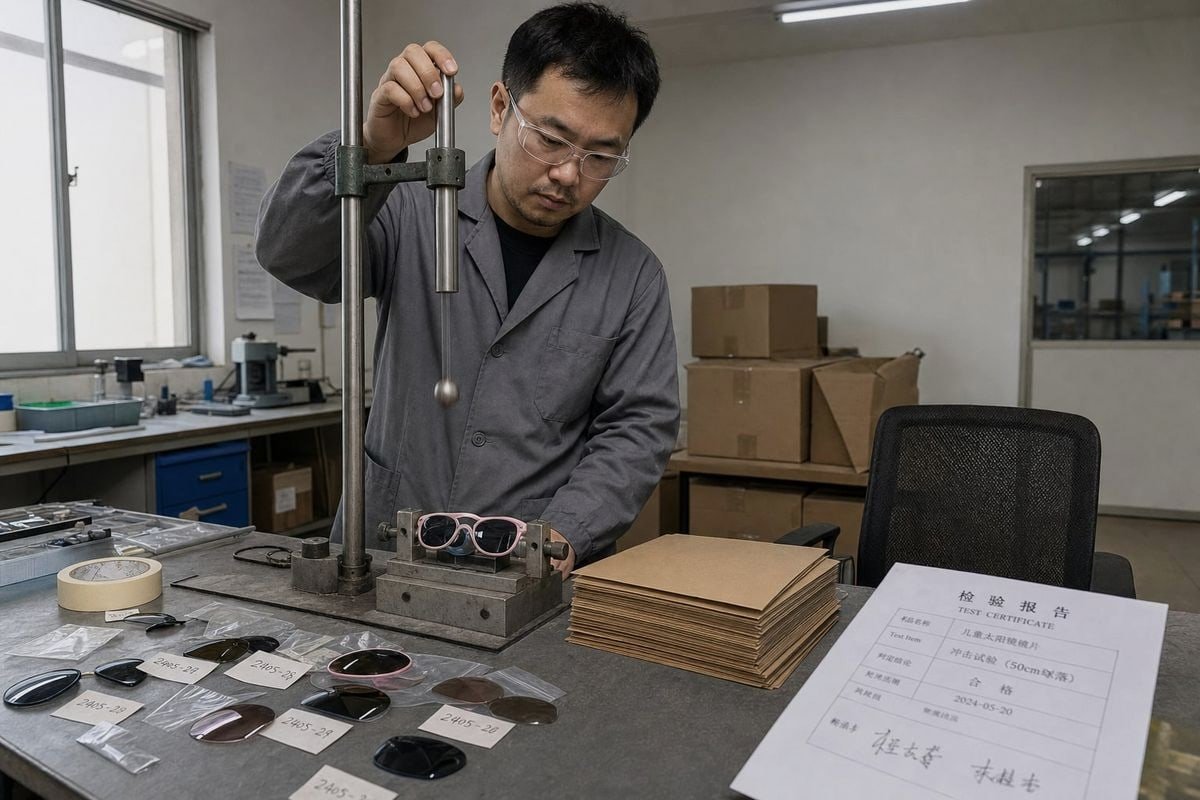
Getting a valid ball drop impact test certificate for kids’ sunglasses sounds simple — until your shipment sits frozen at a US port while our team faxes paperwork at midnight.
To get ball drop impact test certificates for kids’ sunglasses from China, your lens manufacturer must test each lot under 21 CFR 801.410, then issue a signed Certification Statement of Impact Resistance identifying the shipment, manufacturer, and test method — attached to every US-bound shipment.
That is the short answer. But there are traps hiding inside it. Let me walk you through what the test really requires, who should issue the paperwork, and how to avoid detention at the port.
What Does the Ball Drop Impact Test Actually Require for Kids' Sunglasses?
During a lens QC round in our Taizhou workshop last spring, a new hire asked me why we drop a small steel ball onto lenses all day. The answer sits inside a US federal regulation.
The ball drop test under 21 CFR 801.410 requires a 5/8-inch steel ball weighing about 0.56 ounces to be dropped from 50 inches onto the geometric center of the finished lens. The lens must not fracture, proving impact resistance before US import.
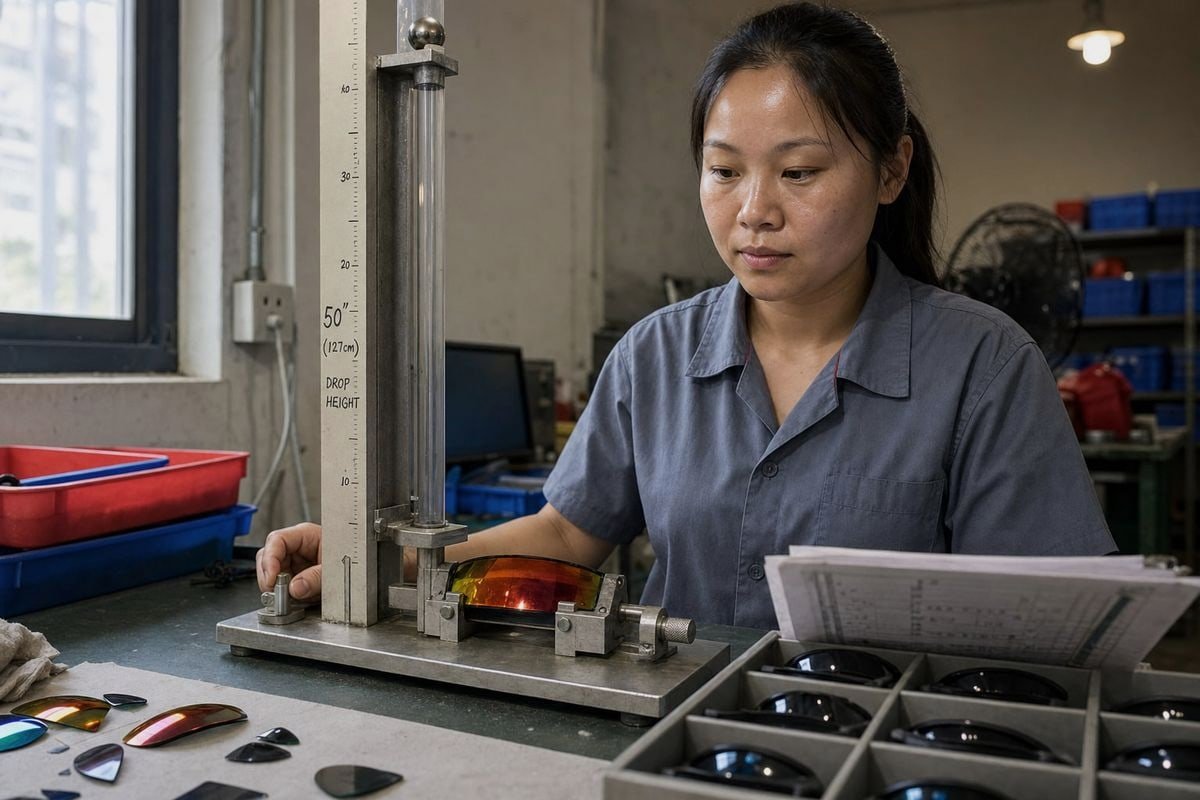
The first thing I tell buyers is this: the ball drop test is a lens-level test, not a whole-product certificate. It does not judge your frame, your hinges, or your packaging. It proves one thing only — that the lens resists impact. The FDA treats sunglasses as Class I medical devices, which is why this rule applies even to a playful pair of periwinkle-blue kids' round frames.
The Exact Test Parameters
The regulation is very specific, and our lab rig follows it precisely:
| Parameter | المتطلب |
|---|---|
| Ball size | 5/8-inch (approx. 15.9 mm) steel ball |
| Ball weight | Approximately 0.56 ounces (16 g) |
| Drop height | 50 inches (127 cm) |
| Impact point | Geometric center, within a 5/8-inch diameter circle |
| Drop method | Free fall; a guide tube may be used but must not restrict the fall |
| Pass condition | Lens must not fracture |
Sampling, Not Just One Lucky Lens
Here is a nuance many importers miss. For non-prescription sunglasses, the FDA permits batch testing using a statistically significant sampling method 1, generally aligned to an AQL of 6.5. The certificate must reflect that the lot was sampled and found impact resistant — not that one golden sample passed once, years ago.
One more point from our production floor: coatings matter. We always run the impact resistance test report 2 on the final finished lens, because mirror coatings — like the orange-to-yellow gradient shields we produce for sport styles — and anti-scratch layers can increase brittleness. A bare polycarbonate blank 3 that passes easily may behave differently after coating. Testing the finished lens is the only defensible approach, and it also aligns with ANSI Z80.3 standards thinking on finished-product performance.
Also note: "kids' sunglasses" is not a separate FDA category. Children's eyewear follows the same 21 CFR 801.410 4 pathway as adult eyewear. "Children's" never means "exempt."
How Do I Know If My Chinese Manufacturer Can Meet FDA and US Customs Standards?
A brand founder from Melbourne once asked me a blunt question on a video call: "Alan, how do I know your certificate isn't just a Word template?" I appreciated the honesty — because template certificates are exactly the risk.
Verify that your Chinese manufacturer performs or commissions real lot-level drop ball testing, holds traceable impact resistance test reports, understands 21 CFR 801.410 and FDA registration and listing requirements, and can show past US shipment records — not just a reusable certificate template.
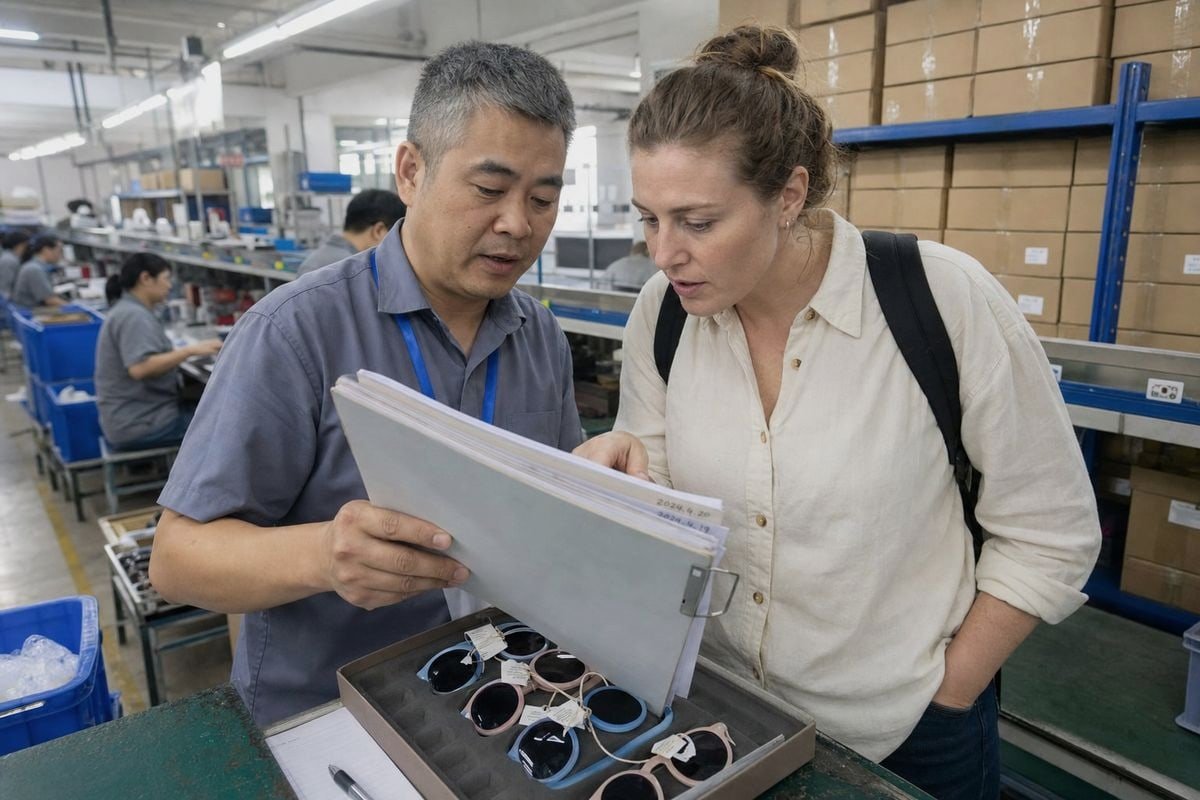
The hard truth is that some suppliers will happily email you a polished PDF certificate within an hour of your request. That speed should worry you, not comfort you. A genuine Certification Statement of Impact Resistance is tied to a specific lot. If the "certificate" arrives before your lot even exists, no testing happened.
Questions That Separate Real Compliance from Paper Compliance
In our fifteen years exporting children's eyewear, these are the questions serious buyers ask us — and the answers you should expect:
| سؤال لطرحه | Weak Answer (Red Flag) | Strong Answer |
|---|---|---|
| "Can you show a test report for my specific lot?" | "We have a certificate on file." | "Yes, each lot gets a sampled test with a dated report." |
| "Who performs the testing?" | "The lens supplier handles it." | "We test in-house per lot and can commission a third-party testing laboratory 5 for verification." |
| "Do you know the AQL for the drop ball test?" | Silence, or a guess. | "AQL 6.5 under statistically significant sampling." |
| "What about coated lenses?" | "Coatings don't matter." | "We test the finished coated lens." |
| "Have you shipped to the US before?" | Vague claims. | Entry documents or references from past US shipments. |
Trader vs. Factory: Why It Matters Here
The certificate should come from the lens manufacturer or the responsible party for the lot — not from a trading company producing paperwork after the fact. A trader who never touched the lenses cannot honestly certify shatterproof lens certification. This is one reason we invite buyers to audit our 5S-managed workshop: traceability from lens batch to test record to shipment is something you can physically see.
Also ask about medical device establishment registration 6 status. While the certificate itself is the critical shipment document, a supplier who understands FDA registration and listing is far more likely to handle the whole compliance chain correctly.
What Documents Do I Need to Clear US Customs Without Delays or Extra Inspections?
The most painful lesson in our export history came early on, when a customer's freight forwarder forgot to include the impact-resistance statement with an entry. The goods were fine. The paperwork gap still cost two weeks.
You need a signed Certification Statement of Impact Resistance under 21 CFR 801.410 accompanying each shipment lot, plus the underlying impact resistance test report on file, commercial documents, and — for children's sunglasses — a Children's Product Certificate covering CPSIA compliance.
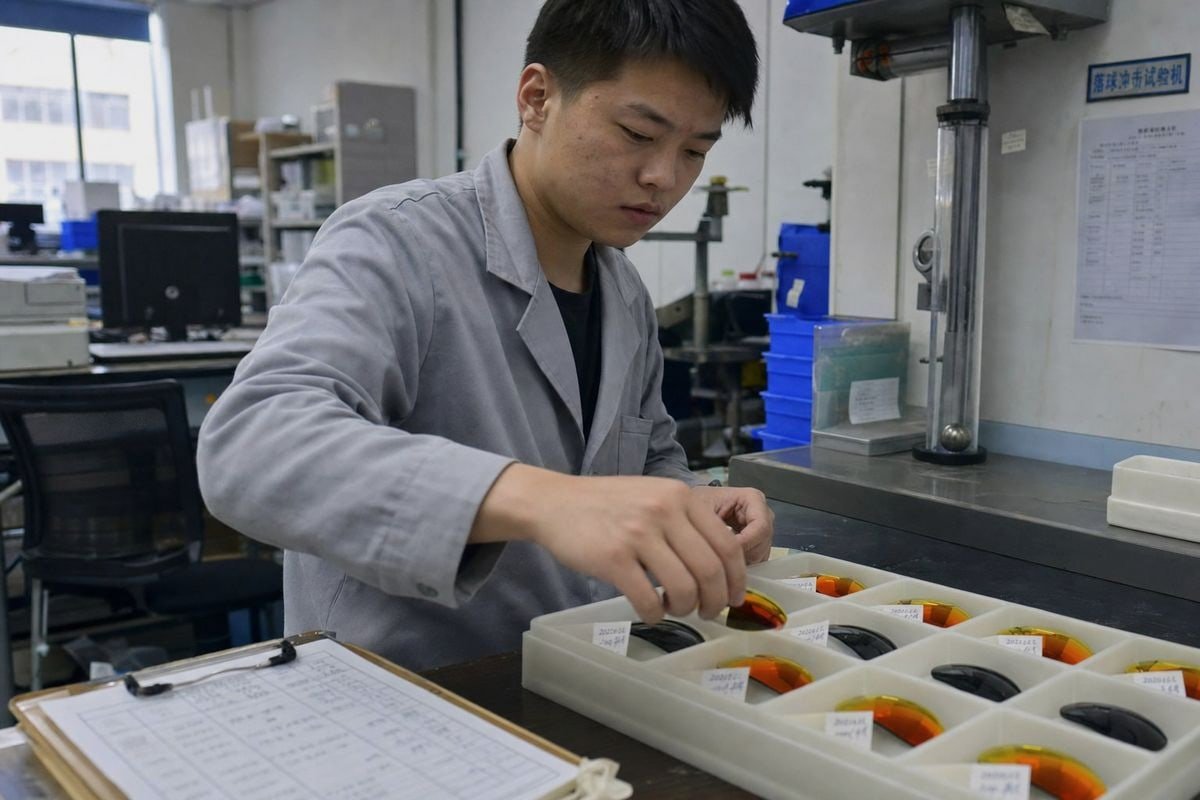
Let me break the customs clearance documentation stack into what travels with the shipment, and what you must keep on file.
The Core Document Checklist
- Certification Statement of Impact Resistance. This is the star document. It must state that the lenses comply with 21 CFR 801.410, identify the manufacturer's name and address, and reference the specific shipment or lot. It accompanies every entry.
- Impact resistance test report. This does not always travel with the entry, but the FDA may request it as supporting evidence. It should record the test method, sampling method, equipment used, and results. Keep it for at least three years.
- Children's Product Certificate (CPC). Because kids' sunglasses are a children's product under CPSC rules, you need a CPC covering الامتثال لـ CPSIA 7 — lead content, phthalates where applicable, and relevant safety rules. Referencing the impact testing within your broader compliance file keeps FDA and CPSC documentation aligned.
- Commercial invoice, packing list, and bill of lading. Standard entry documents your customs broker will file.
- FDA entry data. Your broker submits FDA-regulated product information at entry. Proactively uploading digital certificates through the Automated Commercial Environment (ACE) portal can support faster release and shorter port dwell time.
What Happens If Something Is Missing?
| Documentation Gap | Likely Consequence |
|---|---|
| No impact-resistance certificate with the entry | FDA hold or detention of the shipment |
| Certificate present, but lenses fail later verification | Detention and possible refusal of admission |
| Repeated inadequate documentation | Manufacturer placed on FDA تنبيه الاستيراد 86-07 8 — automatic detention of future shipments without physical inspection |
| Missing CPC for a children's product | CPSC enforcement exposure and retailer rejection |
That Import Alert row deserves emphasis. Once a manufacturer lands on Import Alert 86-07, every future shipment is detained by default. Digging out of that hole takes far more effort than doing the paperwork right the first time. Here is a buyer objection I hear often: "Isn't the signed declaration alone enough?" In practice, the declaration is what accompanies most entries — but authorities can and do request the test report. The safe position is to hold both. Paperwork alone is never enough either; the lenses themselves must actually pass, because the FDA has detained shipments even when a certificate existed but the product failed verification testing.
How Can I Choose a Factory That Provides Reliable Certification Support for My Brand?
Weighing tooling cost against compliance depth is a trade-off I discuss with almost every new brand. A cheap quote that ignores testing is not cheap — it just moves the cost to the port.
Choose a factory with in-house lot testing, willingness to use CNAS or CMA accredited third-party labs, documented 21 CFR 801.410 experience, child-safe material expertise, and full OEM/ODM support — then verify with an audit or sample test before your first order.
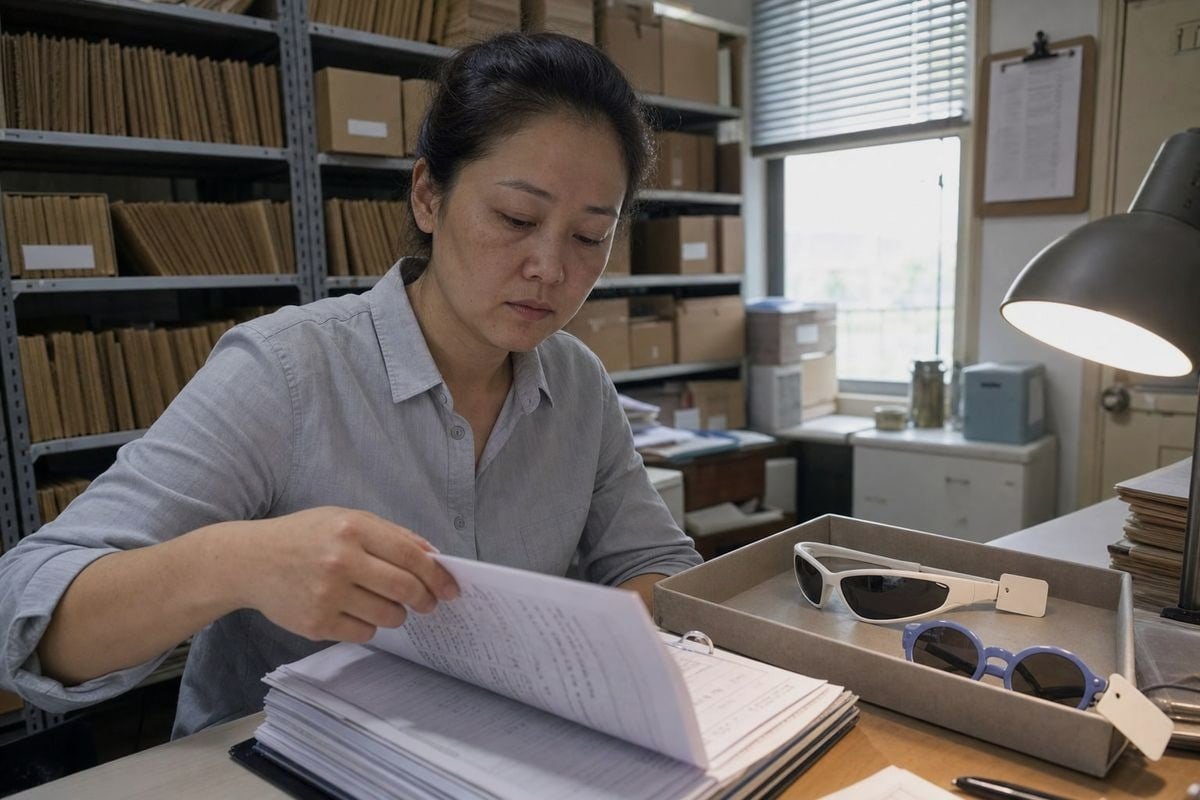
Reliable certification support is not a single document. It is a habit built into how a factory runs. Let me share how I would evaluate a partner if I were sitting on your side of the table.
Look at the Testing Infrastructure, Not the Promises
Ask to see the drop ball rig. Ask who operates it, how often lots are sampled, and where records are stored. At our facility, roughly 120 workers run production under 5S management, and lot testing is a scheduled step in the flow — not a favor we do when a customer asks. A factory that treats testing as an interruption will eventually skip it.
Then ask about third-party verification. Factory self-certification is legally workable, but reports from a third-party testing laboratory holding CNAS or CMA accreditation give you an extra "audit-proof" layer if the FDA or a retailer ever challenges your file. We support both routes, and for new brands entering the US market I usually recommend at least one accredited external report per style, alongside routine in-house lot testing.
Match the Factory to a Children's Product, Not Just a Sunglasses Order
Kids' eyewear carries obligations that generic sunglasses factories often ignore. Impact-resistant lenses are only part of child safety. Frame materials matter too — this is why we build most of our children's styles in flexible TPEE and TR90, which bend rather than snap on an active child's face. A factory fluent in CPSIA compliance, Children's Product Certificate preparation, and flexible-material engineering is solving your whole problem, not a slice of it.
Reduce Your Launch Risk
Finally, think about how you test the market. Custom molds are expensive, and compliance work multiplies per new tool. One practical path we offer buyers is selecting from around 800 existing styles — from soft-touch round kids' frames to wraparound sport shields with mirrored gradient lenses — then customizing colors, logos, UV400 or polarized lenses, and retail-ready packaging. You launch faster, with lower mold investment, on styles that already have a testing history behind them.
الخلاصة
Missing paperwork can strand your kids' sunglasses at a US port for weeks. The fix is straightforward: real lot testing under 21 CFR 801.410, a signed impact-resistance certificate with every shipment, and a factory partner who treats compliance as routine. If you want that partner, our team at OKAY EYEWEAR — Alan Kong, sales@okayeyewear.com — is ready to help you ship with confidence.
ملاحظات ختامية
1. Wikipedia definition and statistical context for sampling methods in testing. ↩︎
2. FDA overview of importing medical devices and required documentation. ↩︎
3. Wikipedia entry for polycarbonate, the standard material for impact-resistant lenses. ↩︎
4. Official FDA regulation detail for impact-resistant lenses in eyewear. ↩︎
5. Wikipedia explanation of laboratory roles and independent testing verification. ↩︎
6. FDA guide for medical device establishment registration and listing requirements. ↩︎
7. Official CPSC resource for the Consumer Product Safety Improvement Act. ↩︎
8. FDA import alert for manufacturers failing impact resistance standards. ↩︎
مقالات أخرى قد تعجبك
August 1, 2026
هل يجب على المصنع التعامل مع تغليف ووضع ملصقات نظارات الأطفال الشمسية، أم استخدام مورد مخصص؟
August 1, 2026
مستودع خاص مقابل الوفاء المباشر من المورد: أيهما يقلل تكاليف الإرجاع لعلامات نظارات الأطفال الشمسية؟
August 1, 2026
مباشر إلى ميناء المستودع أو التخزين الخارجي: أيهما يوفر أكثر على شحن نظارات الأطفال الشمسية؟
هل تبحث عن شريك موثوق به للنظارات للأطفال؟
استكشف أكثر من 800 نمط جاهز ودعم OEM/ODM كامل مصمم خصيصًا لعلامتك التجارية.
اتصل بنا English
  Español de México
  Deutsch
  Français
  日本語
日本語  العربية
  Português do Brasil