How to Ensure Giveaway Items with Kids Optical Frames Pose No Choking Risk?
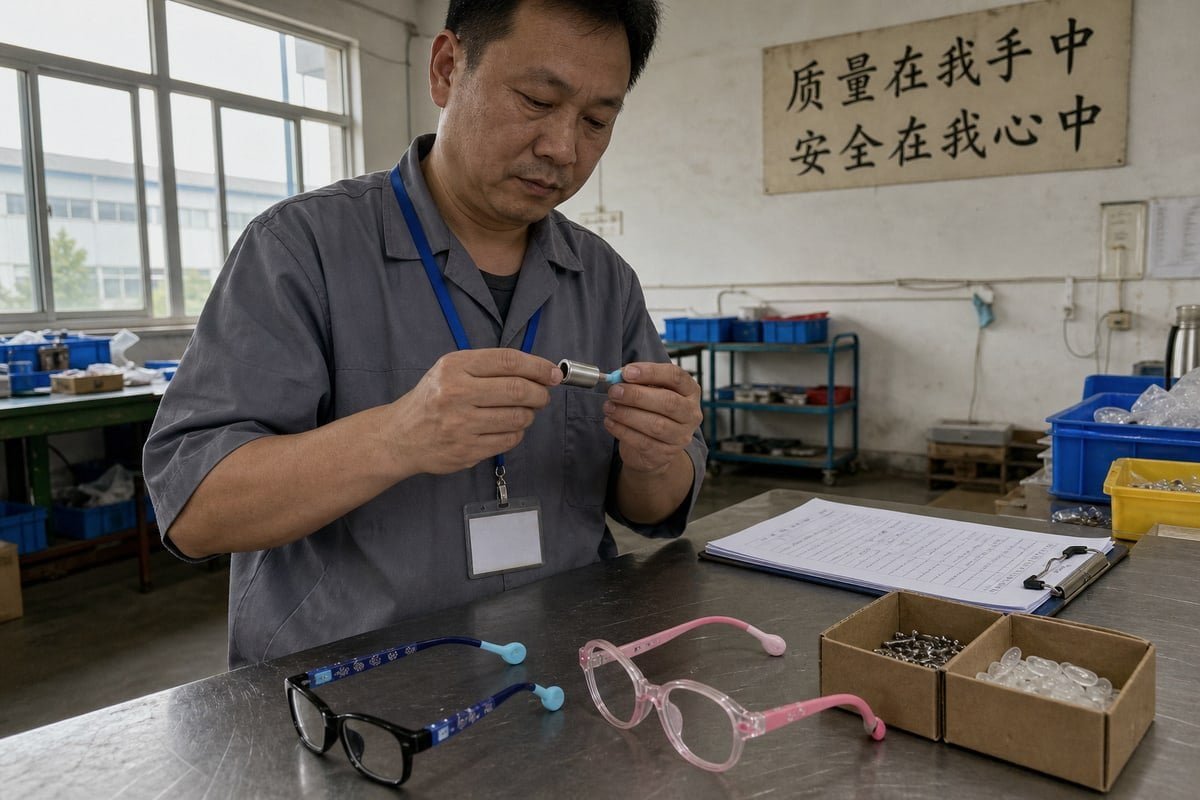
Last year, a promotional buyer asked our Taizhou factory a blunt question: could their giveaway kids optical frames choke a toddler? Honestly, many cheap promotional frames could.
To ensure giveaway kids optical frames pose no choking risk, choose one-piece flexible frames with no detachable components, verify no part fits the 31.7 mm CPSC small parts cylinder, run tension and drop tests, add age-appropriate labeling, and request test reports covering CPSC and ASTM F963 compliance.
That answer sounds simple, but each step hides real detail. Below, I will walk you through the standards, the tests, the materials, and the paperwork. This is the same process we use on our own production line every day.
What safety standards should I check before selecting kids optical frames for a giveaway campaign?
A procurement manager from Australia emailed us a single question before ordering: which standard actually governs choking risk for children's frames? Her caution saved her campaign from a costly mistake.
Before selecting kids optical frames for a giveaway, check 16 CFR Part 1501 for small parts, CPSIA limits on lead and phthalates, ASTM F963 mechanical requirements, and ISO 12870 for frame robustness. Frames aimed at children under three face the strictest small-parts prohibition in the United States.
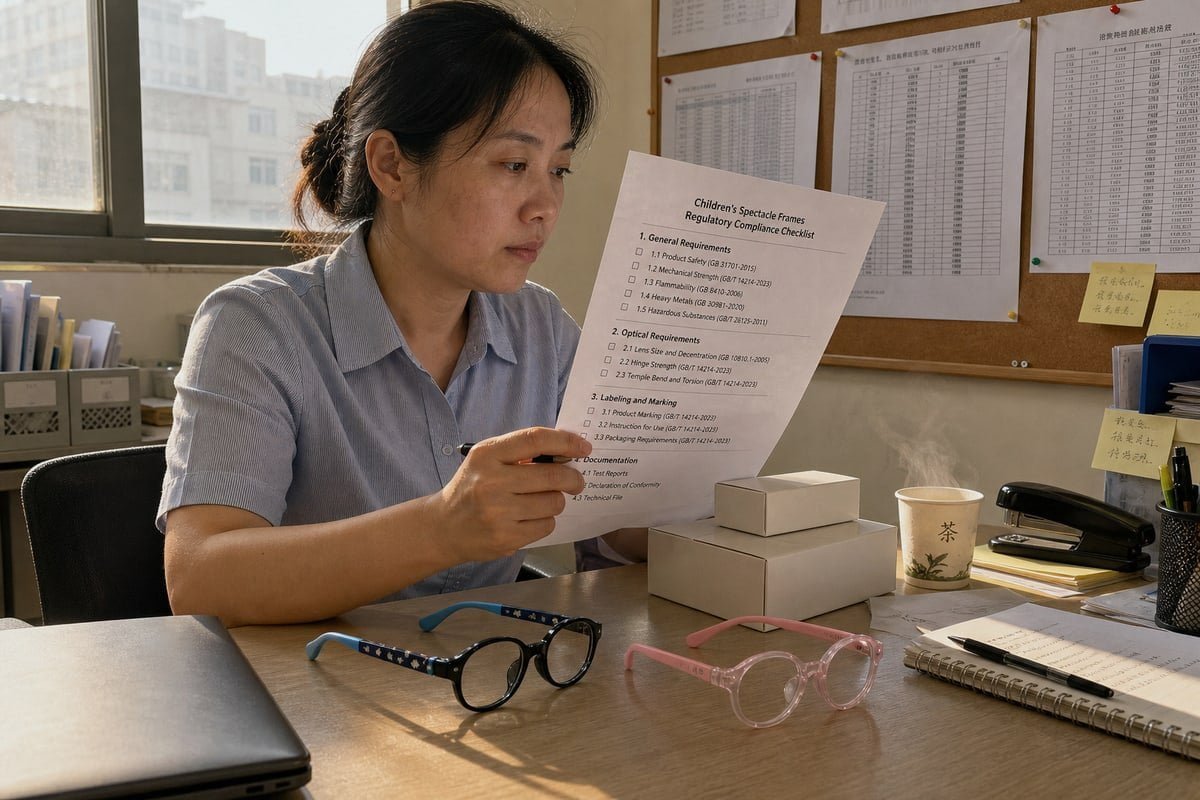
Most buyers assume eyewear sits outside toy rules. That assumption is dangerous. A giveaway frame handed to a child is a children's product. It gets treated like one by regulators, by customs, and by lawyers.
The Core Rules You Cannot Skip
The anchor rule in the US is the small parts ban at 16 CFR Part 1501. It applies to children's products intended for children under 3 that present a choking, aspiration, or ingestion hazard. CPSC small parts regulations define a small part by one physical test. If a piece fits fully into the small parts cylinder, without compression and in any orientation, it is a small part. On top of that, the CPSIA ecosystem requires testing for الرصاص والفثالات in children's products. ASTM F963 compliance adds mechanical requirements that many promotional buyers borrow for eyewear, because it covers exactly the abuse a child inflicts.
| Standard / Rule | المنطقة | ما يغطيه | Why It Matters for Giveaways |
|---|---|---|---|
| 16 CFR Part 1501 | الولايات المتحدة الأمريكية | Small parts ban for under-3 products | Defines the choking-hazard baseline |
| قانون تحسين سلامة المنتجات الاستهلاكية | الولايات المتحدة الأمريكية | Lead, phthalates, third-party testing | Mandatory for children's products |
| ASTM F963 | الولايات المتحدة الأمريكية | Toy mechanical safety, use-and-abuse | Best-practice reference for detachment |
| ISO 12870 | متانة الإطار، تشوه الجسر، تحمل الأذرع | Spectacle frame robustness | Durability and hardware security |
| Chinese draft children's frame standard | الصين | Smooth edges, secure hardware, under 19 g without lenses | Shows global expectations for lightweight, safe design |
Age Targeting Changes Everything
Under-3 products face the strictest prohibition. For older children, choking risk still matters, but your strategy shifts toward durability and fit. Either way, age-appropriate labeling on packaging is not optional. If your frames carry small parts and could reach toddlers at a family event, a clear choking-hazard warning must appear. In our experience exporting to 20+ countries, buyers who define the target age before sampling avoid almost every compliance headache later.
How can I test small parts and components to confirm my giveaway frames are truly choke-proof?
During one inline inspection, our QC team pulled a sample's temple tip with a force gauge until it slipped off. That failure sent the whole batch back for rework.
Test giveaway frames by placing every removable or breakable component into the 31.7 mm small parts cylinder, then apply tension, torque, and compression forces plus drop tests to simulate biting, pulling, and throwing. If any liberated part fits the cylinder fully, the frame is not choke-proof.
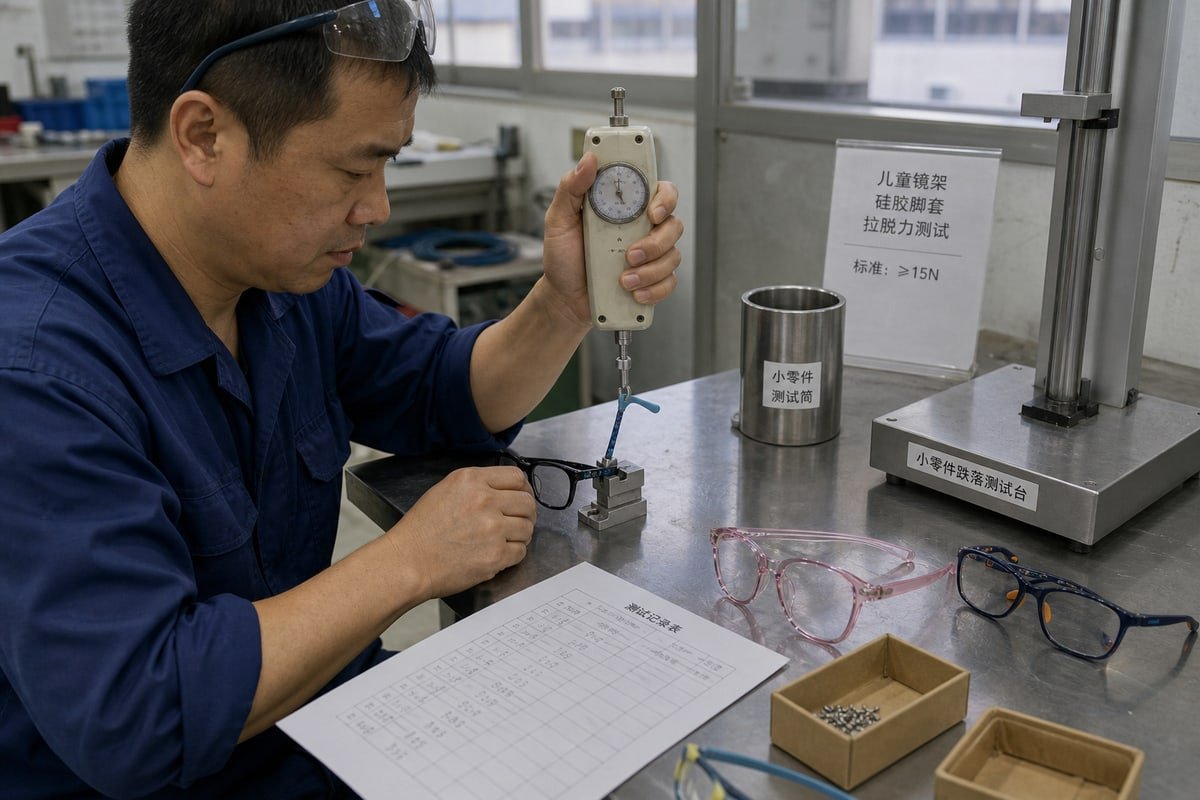
Testing a pristine sample tells you almost nothing. Children under 3 explore with their mouths, and every child bends, drops, and chews eyewear. So you must test the frame after abuse, not before it. Here is the sequence we follow in our 5S-managed workshop, and the one I recommend you demand from any supplier.
A Practical Five-Step Testing Sequence
- Map every component. List screws, nose pads, hinge parts, temple tips, ornaments, and any demo-lens accessories. Each one is a candidate hazard.
- Run the small parts cylinder test. The cylinder has an internal diameter of 31.7 mm. Any component that fits entirely, without external force, is classified as a small part.
- Apply use-and-abuse forces. Tension tests simulate a child pulling the temples apart. Torque tests simulate twisting. Compression simulates biting and sitting on the frame.
- Drop the frame repeatedly. Drop tests reveal whether hinges crack or decorations pop off on hard floors.
- Re-test the cylinder after abuse. Any piece liberated during steps 3 and 4 goes back into the cylinder. This is the step careless suppliers skip.
The Components That Fail Most Often
| المكون | Typical Failure Mode | مستوى المخاطر |
|---|---|---|
| Hinge screws | Loosen and unscrew over time | مرتفع |
| Push-in nose pads | Pull out under mouthing | مرتفع |
| Glued charms and appliqués | Peel or snap off | عالي جداً |
| أطراف الذراعين | Slide off under tension | مرتفع |
| Demo lenses | Pop out on impact | متوسط |
This mechanical safety testing approach mirrors ASTM F963 use-and-abuse logic. When we develop pediatric eyewear accessories for OEM clients, we run this loop on pre-production samples first, then again on random units from mass production.
Which frame materials and designs help me avoid detachable pieces that could pose a choking risk?
Every design review at our workshop weighs the same trade-off: buyers want eye-catching giveaway frames, yet every glued charm or snap-on ornament adds another potential detachment point.
Choose flexible one-piece or minimal-component designs in TR90 or TPEE, with co-molded silicone temple tips, integrated nose pads, captive screws or screwless hinges, and printed or molded-in decoration. These materials bend instead of snapping, so no small detachable pieces can break free during rough play.
Material choice does half the safety work before any test begins. A brittle frame shatters into fragments. A flexible frame absorbs the same abuse and springs back. That is why our engineers standardized on TR90 fronts with TPEE temples for most of our roughly 800 existing styles. Both are lightweight, environmentally friendly, non-toxic materials that survive bending, pulling, and dropping.
How the Main Options Compare
| Material / Design | المرونة | Detachment Risk | أفضل استخدام |
|---|---|---|---|
| TR90 + TPEE combination | ممتازة | Very low with co-molded parts | Active kids, giveaways |
| Monolithic silicone molding | ممتازة | Near zero, single piece | Toddler-focused campaigns |
| Standard acetate with metal hinges | معتدل | Medium, screws can loosen | Older children, supervised use |
| Cheap brittle plastic | ضعيف | High, cracks into fragments | Avoid entirely |
Design Rules We Apply on Every Kids Frame
One of our popular optical styles pairs a glossy black TR90 front with navy TPEE temples and light blue silicone temple tips that are bonded at the joint, not slipped on. Nothing peels off. For decoration, we print patterns directly onto the temple or mold color into the material itself. Molded-in graphics beat glued-on charms every time. Buyers sometimes push back that a plain frame looks boring. Our answer is translucent candy-tone frames, like our light pink rounded-rectangle style, that get their appeal from the material, not from add-ons. Two more hard rules: no magnets, no button batteries, ever. And for lenses, specify polycarbonate or Trivex 1, never glass, which matches WHO-aligned guidance for children. Keep the frame light too; one draft Chinese standard caps children's frames at 19 g without lenses, a useful benchmark for wearability.
What certifications or documents should I request from my manuf
ملاحظات ختامية
1. Authoritative health resource recommending impact-resistant lens materials for pediatric eye safety. ↩︎
مقالات أخرى قد تعجبك


هل تبحث عن شريك موثوق به للنظارات للأطفال؟
استكشف أكثر من 800 نمط جاهز ودعم OEM/ODM كامل مصمم خصيصًا لعلامتك التجارية.
اتصل بنا English
  Español de México
  Deutsch
  Français
  日本語
日本語  العربية
  Português do Brasil