How to Create a Size Guide for Kids’ Sunglasses for Retailers?
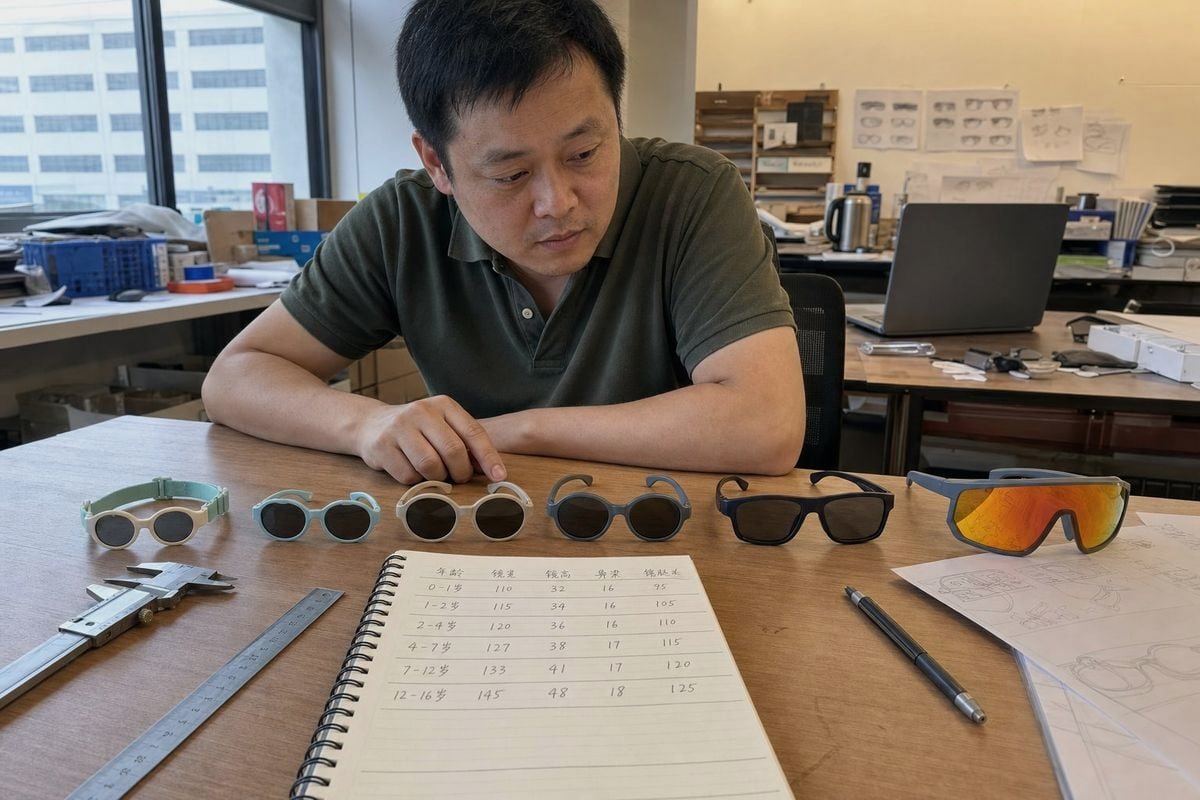
A size guide for kids’ sunglasses is the question our factory in Taizhou hears most from new retail buyers. Without one, parents guess, frames slip, and returns pile up fast.
To create a size guide for kids’ sunglasses, define age bands from 0–1 up to 10–16 years, list frame width, lens width, bridge width, and temple length in millimeters for each band, add simple at-home measuring steps, and include a fit checklist that reduces returns.
That is the short answer. Now let me walk you through each part, step by step, using what we have learned building children’s eyewear for brands in over 20 countries.
What age and head size ranges should I include in my kids' sunglasses size guide?
A buyer from Australia once told me her return rate doubled after she labeled everything simply "kids one-size." Our engineers reviewed her range and found three distinct head sizes hiding under one label.
Include six age bands: 0–1 years, 1–2.5 years, 2.5–4 years, 4–7 years, 7–10 years, and 10–16 years. Pair each band with a frame width range, from roughly 35 mm for babies up to 52 mm for teens, and state that age is a guide, not a rule.
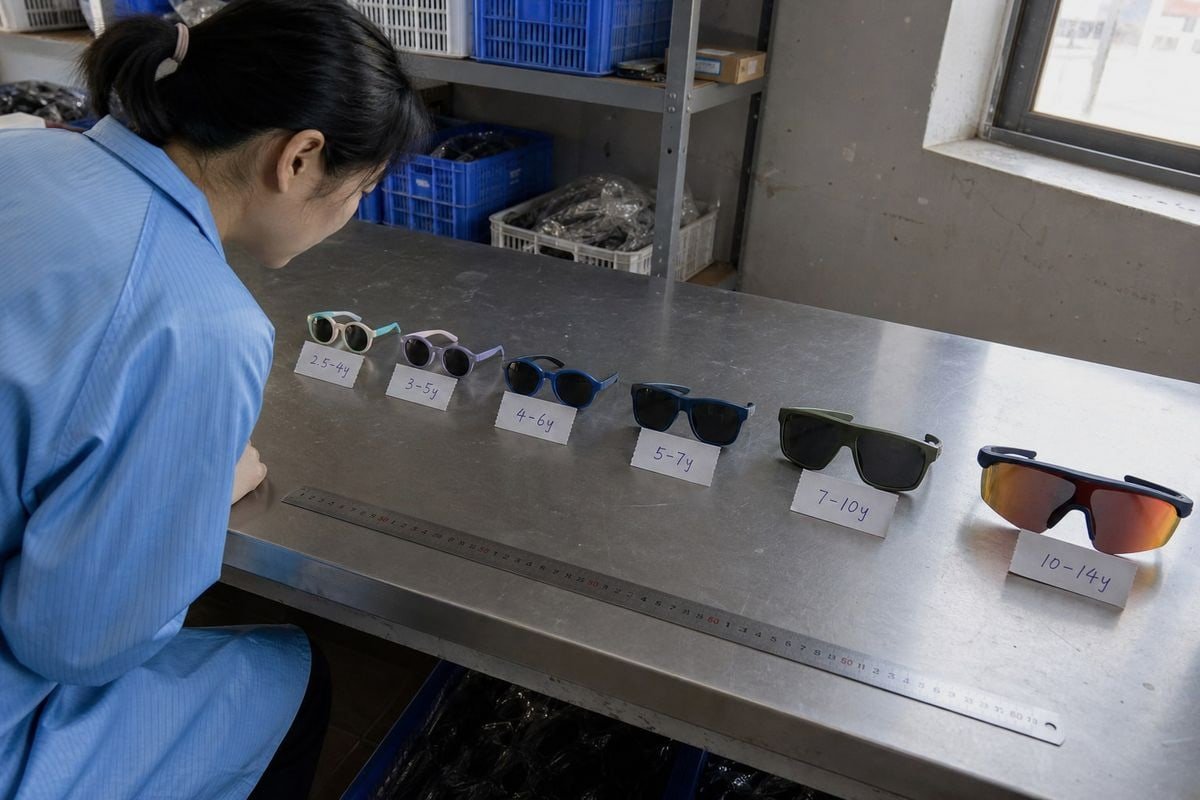
Children's faces do not grow in a straight line. Head width 1 grows fastest in the first three years, then slows. So your age-based sizing chart needs narrow bands for younger children and wider bands for older ones. In our experience developing around 800 existing styles for children's brands, the toddler vs youth dimensions gap is the single most misunderstood point. A 2-year-old and a 6-year-old may both be "kids," but their frames differ by 8–10 mm in total frame width. That is a huge difference on a small face.
A workable age-band framework
Here is a starting template we share with our B2B buyers. You should adjust it to match the actual dimensions of the frames you stock.
| Age Band | Approx. Frame Width | عرض العدسة النموذجي | طول الذراع النموذجي | ملاحظات |
|---|---|---|---|---|
| 0-1 سنوات | 35-37 ملم | 30–33 mm | 105-110 ملم | أحزمة رأس قابلة للتعديل 2 recommended |
| 1-2.5 سنوات | 37-38 مم | 33–36 mm | 110-115 ملم | مواد مرنة مثل TPEE يتم تركيبها في الحد الأدنى لأحجام الدفعات. تتطلب ألوان الإطارات المخصصة حجمًا كافيًا لتبرير دفعة مخصصة. المرنة 3 ideal |
| 5-4 سنوات | 2-5 سنوات (طفل صغير) | 36–40 mm | 115-120 ملم | First "walking around" size |
| 4-7 سنوات | 4-7 سنوات (ناشئ) | 40-44 ملم | 120-125 ملم | Most popular retail band |
| 7-10 سنوات | 7-10 سنوات (أطفال) | 44-48 ملم | 125–130 ملم | School-age active wear |
| 10-16 سنوات | 10-16 سنة (مراهق) | 48-52 ملم | 130-140 ملم | Overlaps with small adult |
Two important caveats. First, present these ranges as estimates based on average growth. Children of the same age vary widely in face width and bridge shape. Second, always show the exact frame measurements on every product page alongside the age band. Age gets the parent to the right shelf. Measurements get them to the right frame.
For babies under one year, we always recommend styles with adjustable head straps, because a rigid temple arm simply cannot hold on a baby's head. For toddlers, soft flexible TPEE frames matter more than exact millimeters, since the material forgives small sizing errors.
How do I measure frame width, temple length, and bridge fit for accurate sizing?
When we calibrate new molds in our workshop, we check four dimensions before anything else goes into production. Those same four numbers should anchor every retail size guide you publish.
Measure frame width across the entire front of the frame, lens width horizontally across one lens, bridge width as the gap between lenses, and temple length from hinge to temple tip. Record all four in millimeters and display them together on every product page.
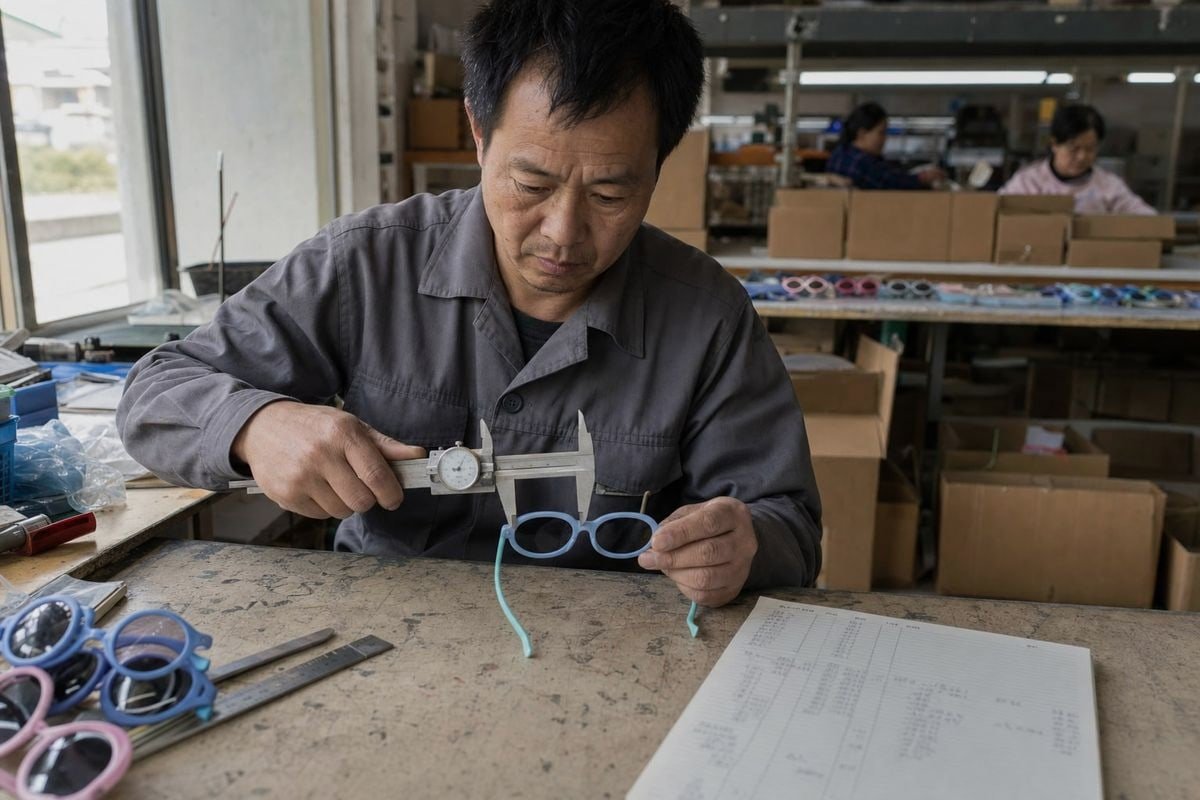
These four measurements work as a system. If you only publish one, parents cannot judge fit. Let me break down what each number actually controls on a child's face.
What each measurement does
عرض الإطار is the total width across the front. It decides whether the frame sits proportionally on the face. Too wide, and the sunglasses slide sideways and let ضوء الأشعة فوق البنفسجية 4 leak in around the edges. Too narrow, and the temples press against the head.
عرض العدسة helps ensure the child's eyes sit horizontally centered in each lens. This relates loosely to pupillary distance: if the lenses are far wider than the eye spacing, the child looks through the wrong optical zone and the frame looks oversized.
عرض جسر الأنف (sometimes labeled DBL) controls whether the frame slides down the nose or pinches it. Children have low, soft جسور أنوفهم 5, so this is the most failure-prone dimension in kids' eyewear. On our production line, we hold bridge tolerances tighter than any other spec for exactly this reason.
طول الذراع الجانبي determines whether the arms rest comfortably behind the ears. Too short, and the tips press painfully. Too long, and the frame slips during play.
A simple at-home measuring process for parents
Give parents a numbered process they can complete in two minutes:
- Use a soft tape measure, or a piece of string plus a ruler.
- Measure the child's face width temple to temple, just in front of the ears.
- Match that number against the frame width in your chart.
- If the child has existing glasses that fit well, read the three numbers printed inside the temple arm and compare directly.
Parents who already own well-fitting glasses can skip measuring entirely. That "compare to existing glasses" shortcut is the lowest-friction path, so put it first in your guide.
What tools or templates can help me create a retailer-friendly size guide?
One lesson we learned early: buyers do not need more data, they need better formats. A distributor in Japan once asked us to condense our full spec sheet into something a parent could act on in thirty seconds. That request shaped how we now package sizing content for every client.
Use a printable 1:1 scale fit template, a millimeter-based size chart, product-page spec tables showing lens, bridge, and temple numbers, and a simple fit checklist. Optional additions include string-and-ruler instructions and AR try-on tools for online stores.
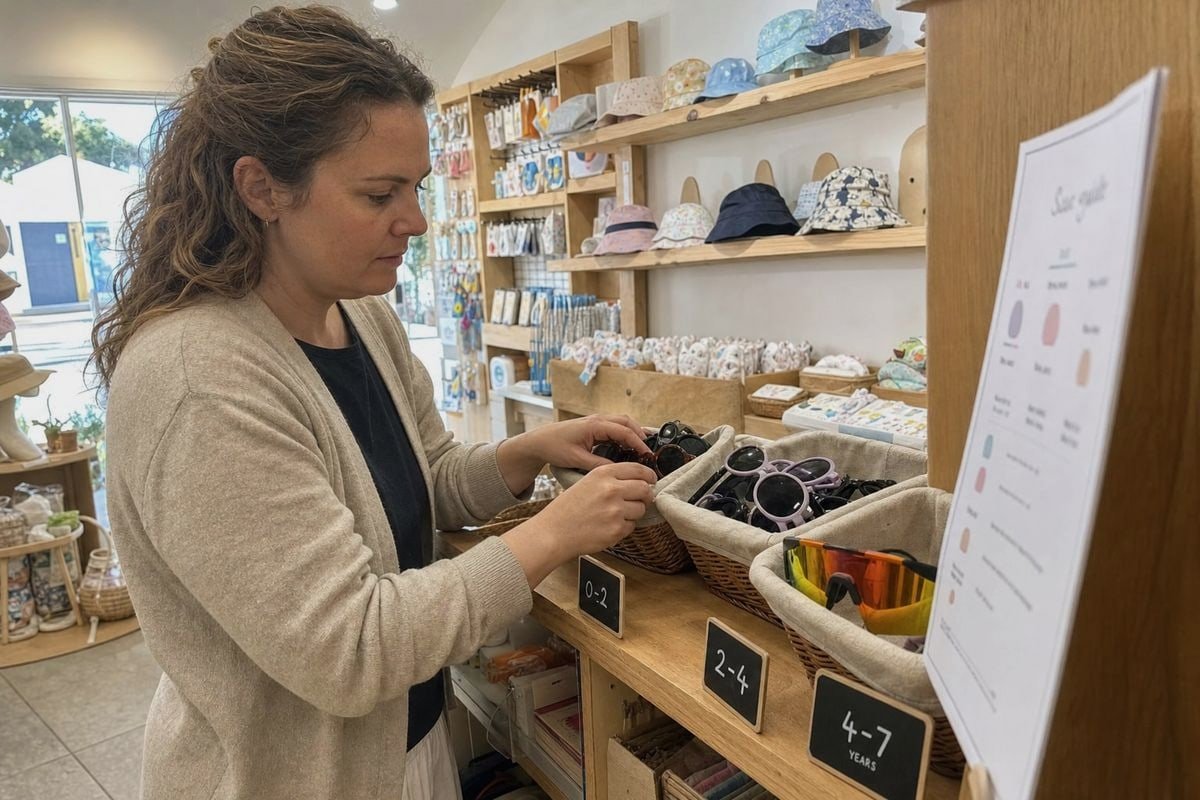
Different shoppers need different tools. Some parents will happily measure with a ruler. Others want a visual shortcut. Your size guide should offer both paths, so nobody hits a dead end and abandons the cart.
The core toolkit
| Tool | ما تفعله | Effort for Parents | الأفضل لـ |
|---|---|---|---|
| Printable measurement tool (1:1 scale PDF) | Parent prints, cuts, and holds it against the child's face or current glasses | منخفض | Online-only retailers |
| Millimeter size chart | Maps age bands to frame dimensions | منخفض | Category and landing pages |
| String-and-ruler tutorial | Guides measuring without special tools | متوسط | Detailed size-guide pages |
| Product-page spec table | Shows the "three numbers" per style | لا شيء | Every single PDP |
| AR fit-probability tools | Maps facial geometry against frame dimensions via smartphone | منخفض | Larger e-commerce retailers |
| Fit checklist graphic | Confirms fit after delivery | لا شيء | Packaging inserts and emails |
The printable measurement tool deserves special attention. A print-cut-test guide lets a parent physically place their child's current glasses on the paper, or hold the paper against the child's face, to verify dimensions before buying. Just remind users to print at 100% scale, not "fit to page," or every measurement will be wrong.
For product pages, adopt the "three numbers" format that adult eyewear uses: lens width, bridge width, temple length, printed in that order. Parents who own any pair of glasses recognize this format instantly, and it lets them compare against frames they already trust.
عندما نجهز OEM packages 6 for our brand clients, we often include retail-ready sizing inserts and hang tags with these dimensions printed on them. Sizing information that travels with the product supports the in-store experience too, not just online.
How can I ensure my size guide reduces returns and improves customer satisfaction?
The trade-off we weigh most often with buyers is precision versus simplicity. A guide packed with technical detail intimidates casual shoppers. A guide that is too simple sends the wrong sizes out the door. The answer sits in the middle, and it starts with the language you use.
Write plain-language fit rules, add a post-delivery fit checklist, advise sizing up only when a child is between sizes, display exact frame dimensions on every listing, and stock flexible frames that forgive small errors. Together these steps meaningfully cut sizing-related returns.
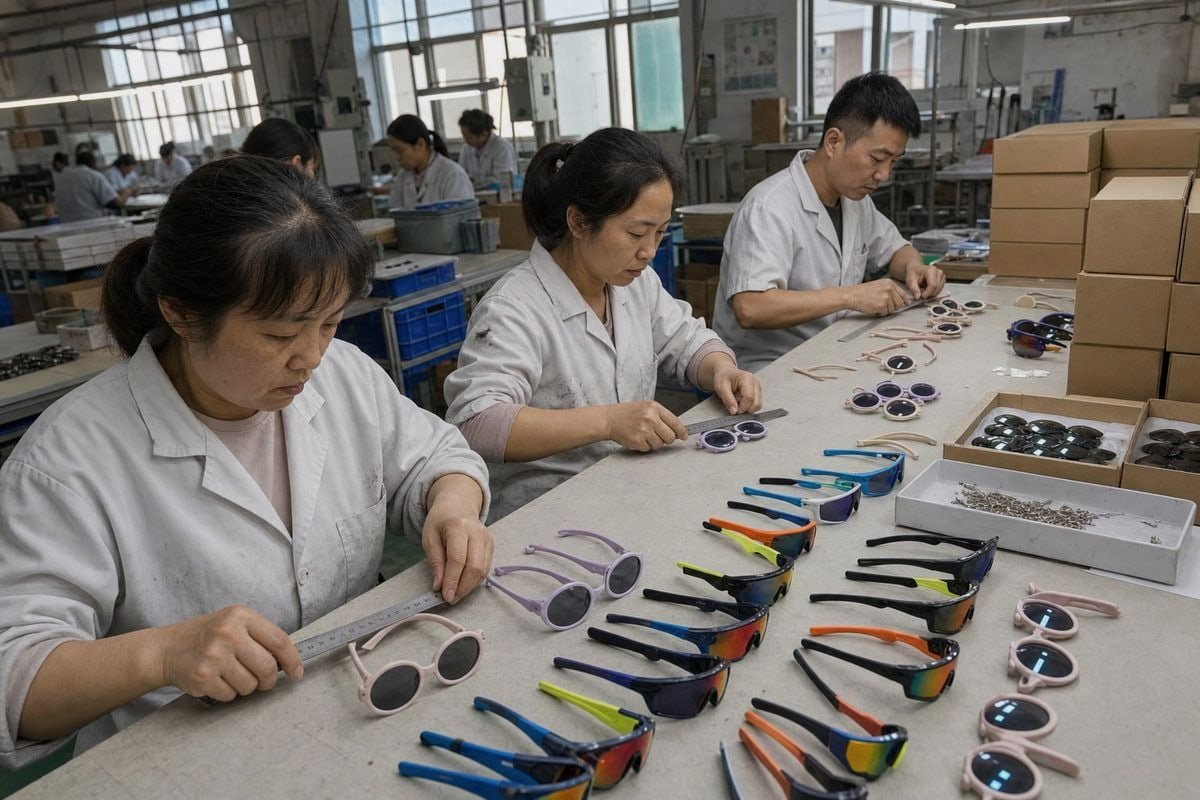
Reducing return rates is not one tactic. It is a chain of small decisions across your product pages, your copy, and your product selection. Let me break the chain into links.
Write copy that removes guesswork
Short, directive lines outperform long explanations. Use messaging like: "Measure first, then compare to the chart." "Age is a guide, not a rule." "If your child is between sizes, choose the larger size." "Check frame width, bridge width, and temple length together." Each line answers a question before the customer asks it.
Handle the size-up question carefully. Sizing up works when a child is between sizes or growing quickly. But too much growth room causes slipping and poor تغطية الأشعة فوق البنفسجية 7 around the eyes. Frame size-up as conditional advice, never a universal rule.
Give parents fit-success benchmarks
Parents cannot judge fit unless you define it. Publish a checklist they can run after delivery:
| Fit Check | Pass Looks Like | Fail Looks Like |
|---|---|---|
| Eye position | Eyes horizontally centered in the lenses | Eyes near lens edges |
| Nose comfort | No red marks after 15 minutes of wear | Pressure marks or sliding |
| Temple pressure | Arms rest lightly behind the ears | Squeezing at the temples |
| Movement test | Frame stays level when the child jumps and shakes | Slipping or bouncing |
| تغطية | Lenses shield the eyes with minimal side gaps | Light leaking around edges |
Choose products that forgive sizing errors
Materials matter as much as measurements. Flexible TPEE frames and TR90 constructions bend and adapt to varying head shapes within the same age band, so a frame that is one or two millimeters off still fits comfortably. This is the practical reason our factory has focused on flexible-material engineering for fifteen years: rigid frames punish small sizing mistakes, while flexible ones absorb them. For sensory-sensitive children 8, note the frame weight and gentle temple tension in your guide, since comfort details like these prevent the "my child refuses to wear them" return. For babies and toddlers, offer adjustable head straps as an accessory, which extends usable life across a growth spurt.
Finally, treat the size guide as living content. Track your return reasons monthly. If "too small" keeps appearing for one style, adjust that product's recommended age band, not just the chart.
الخلاصة
A clear size guide turns uncertain parents into confident buyers. Build it on real measurements, honest age bands, and forgiving materials, and returns fall while satisfaction climbs.
ملاحظات ختامية
1. WHO global standards for head circumference, the standard measure for child head growth. ↩︎
2. Background on eyewear frame components including strap-based fitting solutions for infants. ↩︎
3. Explains the flexible plastic material class used to make forgiving children’s eyewear frames. ↩︎
4. EPA guidance on UV radiation supports the point about eyewear blocking harmful UV exposure. ↩︎
5. Anatomical background on the nasal bridge explains why it is a common fit-failure point. ↩︎
6. Alibaba is a major marketplace for OEM manufacturing services referenced in eyewear sourcing. ↩︎
7. WHO fact sheet explains why adequate UV coverage from eyewear protects children’s eyes. ↩︎
8. CDC resource on sensory processing considerations relevant to comfort in children’s products. ↩︎
مقالات أخرى قد تعجبك



هل تبحث عن شريك موثوق به للنظارات للأطفال؟
استكشف أكثر من 800 نمط جاهز ودعم OEM/ODM كامل مصمم خصيصًا لعلامتك التجارية.
اتصل بنا English
  Español de México
  Deutsch
  Français
  日本語
日本語  العربية
  Português do Brasil