How to Choose Kids Optical Frame Materials From China That Resist Disinfectant Whitening?
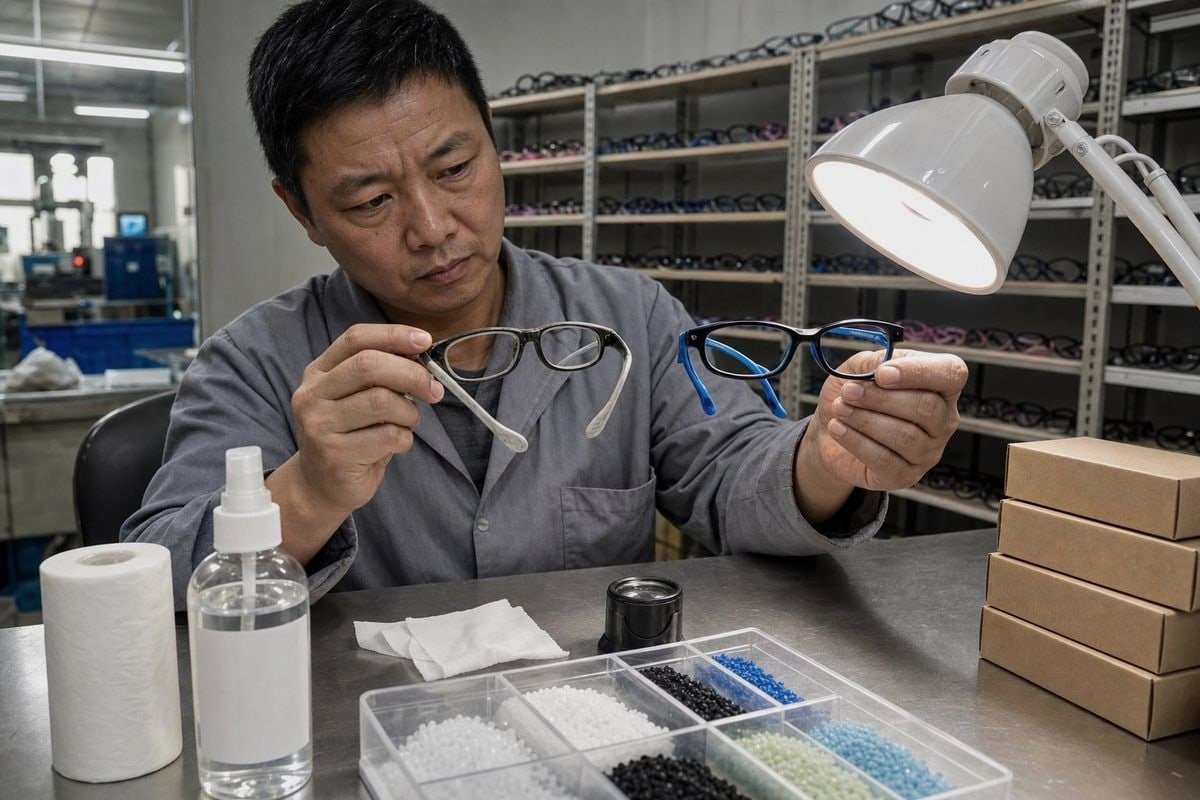
Choosing kids optical frame materials from China gets tricky when disinfectant wipes turn frames chalky. I have seen buyers lose whole seasons of stock this way — and it is preventable.
To resist disinfectant whitening, choose kids optical frame materials from China with proven chemical resistance: TR90 for the best balance of flexibility and cost, ULTEM/PEI for heavy sanitization, TPEE for soft temples, and always validate with disinfectant soak testing on samples before mass production.
Let me break this down step by step. First, I will explain which materials work best. Then I will show you how to test them, and what to demand from your supplier.
What material should I choose for my kids' optical frames to best resist disinfectant whitening?
A few years back, a European client sent us photos of frames from another factory. The temples had turned hazy white after weeks of alcohol wiping in a school program. That failure shaped how our team specifies materials today.
TR90 offers the best overall resistance to disinfectant whitening for kids' frames, combining chemical resistance with flexibility and safety. ULTEM/PEI is the premium upgrade for heavy sanitization environments, while polyamide/nylon works as a mid-tier option. Treat acetate and basic PC with caution.
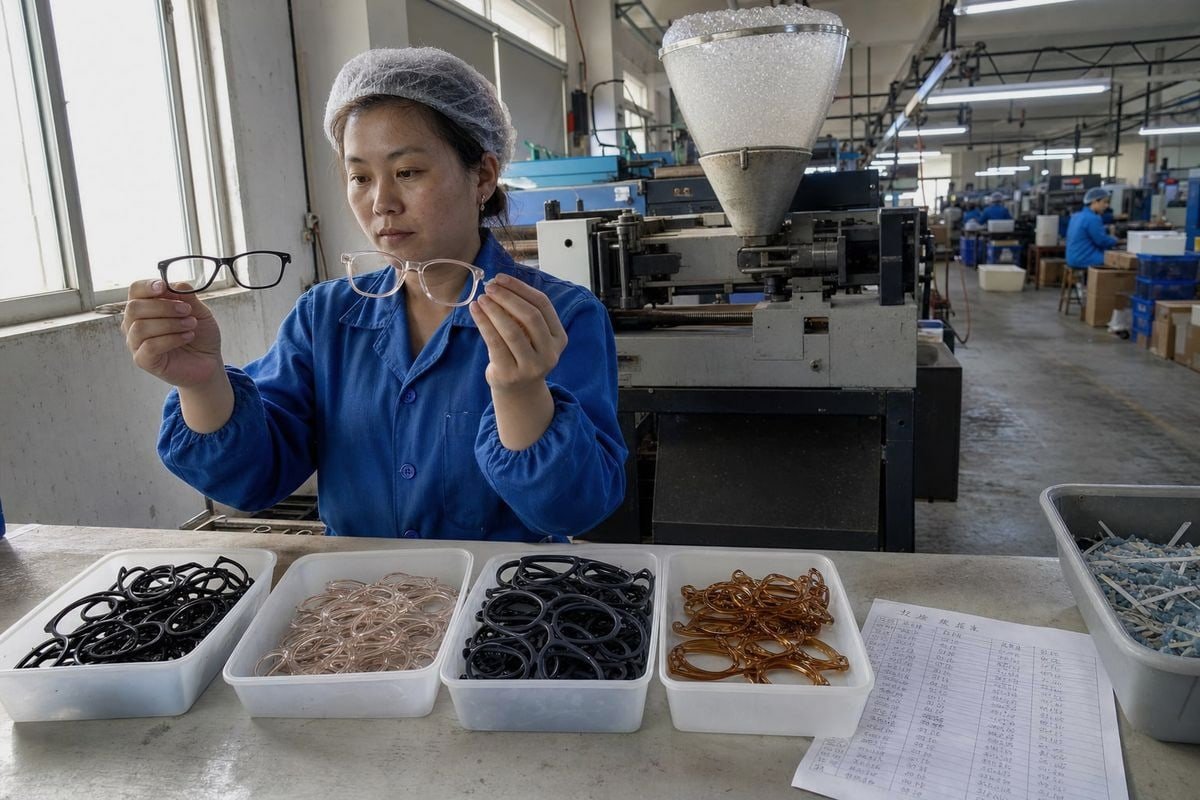
Here is a quick comparison to make the choice scannable:
| المواد | Whitening Resistance | المرونة | Cost Level | Best Use Case |
|---|---|---|---|---|
| TR90 1 | مرتفع | ممتازة | معتدل | Everyday kids' frames, frequent cleaning |
| ULTEM/PEI 2 | عالي جداً | جيد | أعلى | Schools, clinics, heavy disinfection |
| Polyamide/Nylon | جيد | جيد | معتدل | Durable mid-tier programs |
| TPEE 3 | مرتفع | Outstanding | معتدل | Soft temples, toddler frames |
| أسيتات | منخفض إلى معتدل | معتدل | Varies | Fashion-forward retail, gentle cleaning |
| بولي كربونات (PC) | معتدل | منخفض | منخفض | Budget lines, verify finish quality |
| Titanium/Flexon alloys | Very high (corrosion) | جيد | ممتاز | Premium optical retail |
Why "whitening" happens in the first place
Disinfectant whitening is mostly a surface-appearance problem. Alcohol-based wipes and quaternary ammonium cleaners attack the polymer surface. The result is loss of gloss, micro-hazing, faded color, or a chalky finish. Some people call this plastic frame oxidation, though chemical stress-crazing is often the real cause. Materials with tight, stable polymer structures resist this attack. Materials with softer or more porous surfaces do not.
The polymer hierarchy in practice
In our workshop, TR90 frames tolerate repeated cleaning far better than generic injected plastics. TR90 is a nylon-based thermoplastic. It has low surface friction, good heat tolerance, and strong chemical resistance 4. That is why most of our roughly 800 existing kids' styles use TR90 fronts, often paired with TPEE temples.
ULTEM/PEI goes a step further. It offers excellent heat resistance, dimensional stability, and chemical stability. If your frames will face daily hospital-grade disinfectants, ULTEM justifies its price.
Acetate frames deserve honesty here. They look beautiful — like the translucent pink jelly-tone frames we produce — and they are plant-based and non-toxic. But acetate is more vulnerable to alcohol dulling. Titanium alloy frames resist corrosion superbly, but they cost more and are less common in children's ranges. For most B2B buyers, TR90 remains the smart default.
How can I verify that frames I'm sourcing will actually resist disinfectant damage before committing to mass production?
One trade-off I weigh with every new buyer is speed versus certainty. Skipping sample validation saves two or three weeks. But a container of whitened frames costs far more than that. Our sales team now insists buyers test before they commit.
Verify disinfectant resistance by ordering 3–5 samples, running wipe tests with 70% alcohol and quaternary ammonium cleaners over 2–4 weeks, requesting material composition data and CE/RoHS certificates, and confirming the exact resin grade will be used in mass production.
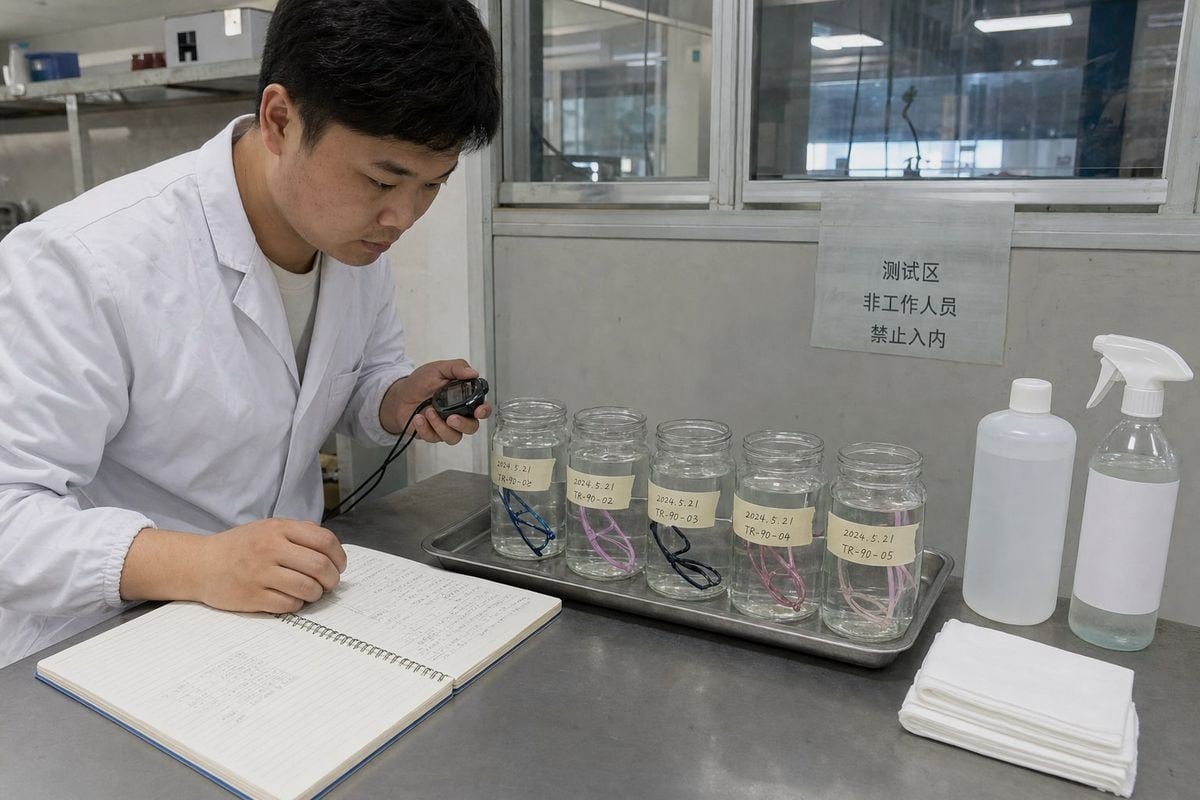
Sample testing sounds complicated, but you can do most of it at your own desk. Here is the process we recommend to our importers and distributors:
A simple five-step validation process
- Order 3–5 physical samples in the exact colors and finishes you plan to sell. Color matters, because pigment stability varies by dye batch.
- Run a repeated wipe test. Wipe one frame with 70% isopropyl alcohol 5 twice daily for two weeks. Wipe another with a quaternary ammonium disinfectant 6. Keep one untouched as a control.
- Run a soak test on offcuts. Ask your supplier for material offcuts. Soak them for 24–48 hours. This accelerates what months of cleaning would do.
- Inspect under bright light. Compare gloss, color depth, and surface texture against the control. Photograph everything for your records.
- Confirm resin traceability. Ask for the resin supplier name and grade. Then require written confirmation that mass production uses the identical grade.
What documentation to collect alongside testing
Physical tests catch surface problems. Paperwork catches substitution risk. Request copies of CE and RoHS certificates 7, plus confirmation the material is BPA-free and non-toxic. A factory audit — even a remote video audit — tells you whether the workshop actually controls raw material intake. Our 5S-managed floor in Taizhou welcomes these audits, because a factory that hides its material storage usually has something to hide.
Also check the small parts. Hinges, screws, and coatings can whiten or corrode even when the main frame material holds up. Test the whole assembled frame, not just the resin.
Can flexible materials like TPEE and TR90 resist disinfectant whitening without losing their comfort and safety properties?
When our engineers were developing TR90 fronts with TPEE temples — the combination behind many of our sporty black-and-blue kids' styles with silicone-textured tips — we asked exactly this question. Flexibility and chemical resistance had to coexist, or the design would fail active children.
Yes. TPEE and TR90 are engineered thermoplastics whose chemical resistance is built into the polymer itself, not a surface coating. They withstand routine disinfecting while keeping the flexibility, hypoallergenic safety, and impact resistance that make flexible eyewear ideal for children.
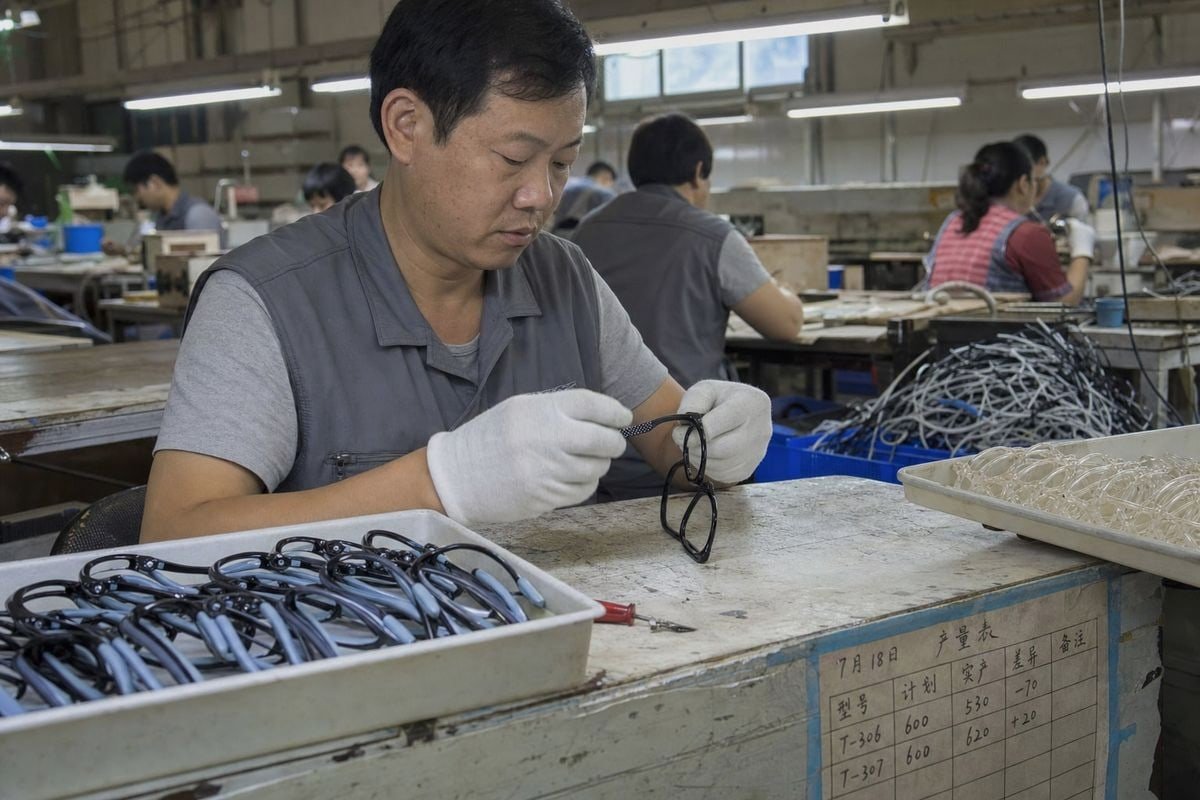
This matters because many buyers assume a trade-off exists. They think soft, bendable frames must be chemically weaker. In fact, the opposite is often true for these two materials.
How flexibility and chemical resistance coexist
TR90 is a memory polymer. It bends and snaps back without stress-whitening at the flex point, which is a common failure in rigid plastics. Its chemical resistance comes from its dense nylon-based structure. TPEE, a thermoplastic polyester elastomer, twists and folds without structural failure. It is typically BPA-free and non-toxic, and it resists the surface attack that dulls cheaper elastomers.
Silicone frames and silicone-detailed temples add another layer. Silicone is naturally hypoallergenic and tolerates most safe cleaning solutions well. That is why we pair TPEE temple cores with textured silicone-style tips on toddler and sport models — comfort, grip, and cleanability in one part.
| خاصية | TR90 | TPEE | Standard Rigid Plastic |
|---|---|---|---|
| Bend without whitening at flex point | نعم | نعم | Often no |
| Alcohol wipe tolerance | جيد | جيد | ضعيف إلى مقبول |
| Hypoallergenic for children's skin | نعم | نعم | Varies |
| Retains shape after twisting | نعم | نعم | لا |
| الوزن | خفيف جدا | خفيف جدا | Light to moderate |
The honest caveats
Two cautions from our experience. First, colored flexible frames depend on pigment stability. A vibrant royal blue in a poor dye system can fade even when the base polymer survives. Ask about pigment testing. Second, matte and rubberized finishes on any material show wear faster than glossy finishes. Frame durability under disinfection is a system property — resin, dye, and finish together. Specify all three, and flexible materials will not force you to compromise on comfort or safety.
What quality controls and testing should I require from my Chinese eyewear supplier to guarantee disinfectant resistance?
A lesson I learned early in fifteen years of eyewear manufacturing in China: the gap between a good sample and a good shipment is quality control, not luck. Buyers who write QC requirements into their purchase orders get consistent frames. Buyers who trust verbal promises gamble.
Require incoming raw material verification, documented resin grade traceability, batch-level disinfectant wipe testing, pigment and coating stability checks, CE/RoHS and BPA-free certification copies, pre-shipment inspection with defined cosmetic standards, and retained golden samples for every production run.

These requirements sound demanding. A serious factory will not flinch at any of them. Here is how to structure the ask.
The QC checklist to put in writing
| QC Stage | What to Require | Why It Prevents Whitening Failures |
|---|---|---|
| Raw material intake | Resin grade certificates matched to your approved sample | Stops silent substitution with cheaper, weaker resin |
| Pre-production | Signed golden sample retained by both parties | Creates a fixed reference for color, gloss, and finish |
| In-process | Batch wipe test with 70% alcohol on first-off pieces | Catches bad dye lots or coating errors early |
| Coating/finish | Adhesion and chemical stability check on painted parts | Coatings often fail before the base material does |
| Pre-shipment | AQL inspection covering gloss, color, and surface haze | Ensures the shipment matches the validated sample |
| التوثيق | CE, RoHS, BPA-free, and non-toxic confirmations | Protects you legally in children's product markets |
Beyond the checklist: partnership habits
Certificates and inspections form the floor, not the ceiling. In our Taizhou factory, with about 120 workers under 5S management, the habits that really protect buyers are simpler. We keep dye recipes locked to approved formulas. We store retained samples from every run. We flag any material change before it happens, never after.
Ask your supplier two revealing questions. First: "What happens if I report whitening six months after delivery?" A committed partner describes an investigation process. A trader shrugs. Second: "Can I specify the cleaning instructions printed on my packaging?" Recommending safe cleaning solutions — mild soap and water rather than harsh solvents — reduces field complaints dramatically. Full OEM/ODM support should include that packaging detail, along with custom colors, logos, and retail-ready presentation. Guaranteeing disinfectant resistance is ultimately a shared system between your specification and your factory's discipline.
الخلاصة
Disinfectant whitening ruins good frames and buyer trust alike. Choose TR90 or ULTEM first, validate every sample, and demand written QC — chemistry plus discipline beats price every time.
ملاحظات ختامية
1. Explains TR90 as a thermoplastic polymer with durability, flexibility, and chemical resistance. ↩︎
2. Provides an authoritative review of Polyetherimide (PEI), its properties, and applications. ↩︎
3. Details the characteristics of Thermoplastic Polyester Elastomer (TPEE), including its chemical resistance. ↩︎
4. Defines chemical resistance as a critical polymer property and its importance in material selection. ↩︎
5. Explains why 70% isopropyl alcohol is an effective antimicrobial disinfectant. ↩︎
6. Provides an overview of quaternary ammonium compounds as common disinfectant ingredients. ↩︎
7. Explains the purpose and requirements of CE marking and RoHS directive for product compliance. ↩︎
مقالات أخرى قد تعجبك
أغسطس 5, 2026
Bio-Based vs Regular Cellulose Acetate: What's the Difference for Kids' Frames?
أغسطس 5, 2026
How Recyclable Are Kids' Optical Frame Materials, and What Eco-Friendly Alternatives Exist?
أغسطس 5, 2026
Do Kids Optical Frames Whiten or Age in Storage, and How to Control Warehouse Conditions?
هل تبحث عن شريك موثوق به للنظارات للأطفال؟
استكشف أكثر من 800 نمط جاهز ودعم OEM/ODM كامل مصمم خصيصًا لعلامتك التجارية.
اتصل بنا English
  Español de México
  Deutsch
  Français
  日本語
日本語  العربية
  Português do Brasil